Grok vs Claude: Which Surface Fits Your Task?
Most people treat this as one decision: work out which assistant is smarter, subscribe to that one, and stop. That framing costs money, because each of these two names covers three separate purchases: a chat subscription, a coding agent, and per-token API models. Grok takes live X and web data, image and video generation, and the cheapest top-tier rate at $2 input and $6 output per million tokens. Claude takes long documents, careful multi-step analysis, and production coding. If your week holds both kinds of work, you will use both, so the useful question is which surface you are buying.
Which one fits the work in front of you?
Grok fits work that has a clock on it: what people are saying right now, image and video generation, and high-volume API calls where the bill is the binding constraint. Claude fits work that needs length and care: long contracts and document sets, multi-step analysis you have to defend in a meeting, and production coding across a large codebase. There is no overall winner, because the two are good at almost disjoint things.
A Tuesday can hold all three shapes of work at once. Something broke an hour ago and you need to know what people are saying about it. A refactor has to move across a large codebase without breaking the test suite. A 90-page contract needs a summary you can defend in a meeting. Same desk, three different first stops, which is why most people end up using both families across a week instead of committing to one.
Where the two families actually separate
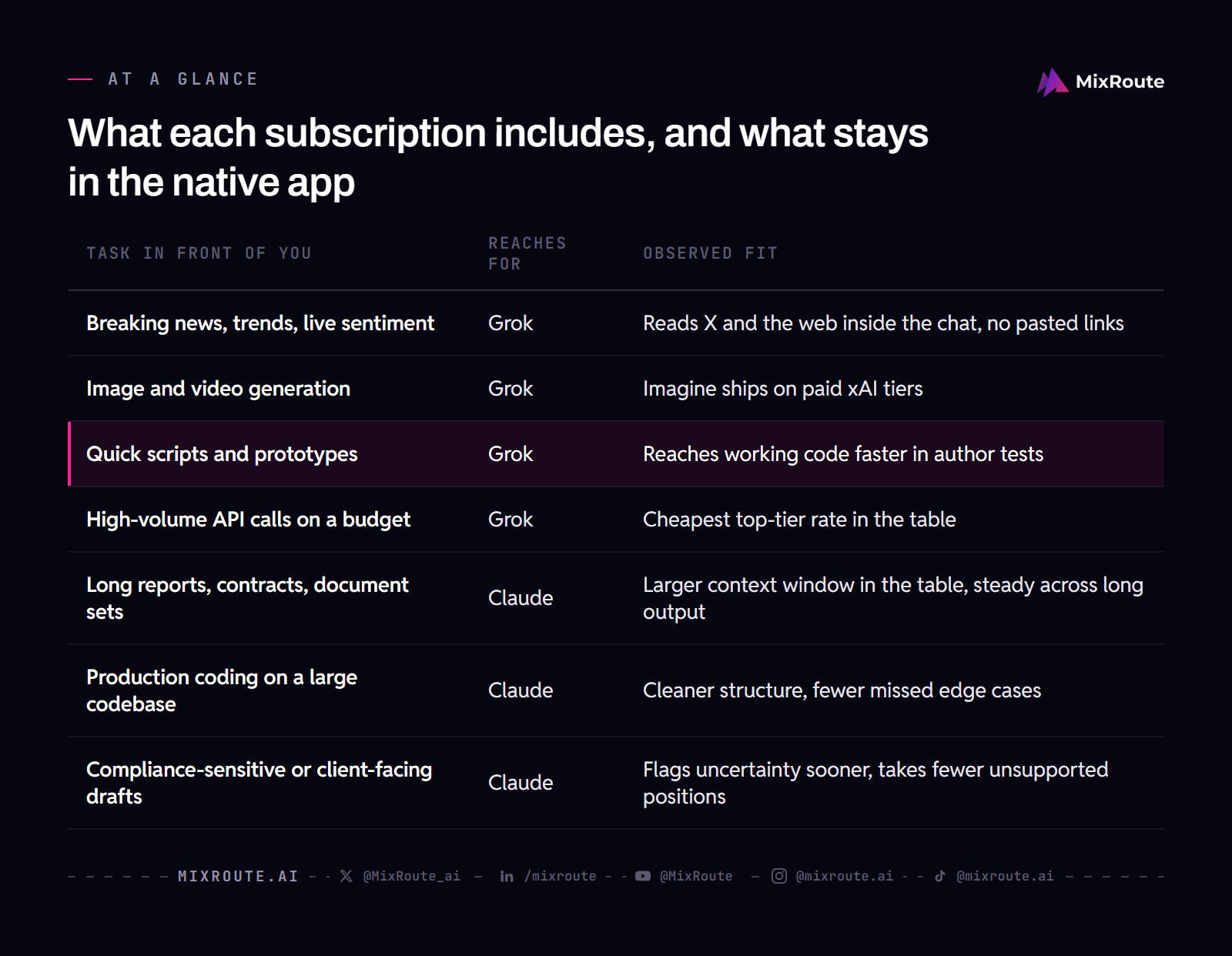
| Task in front of you | Reaches for | Observed fit |
|---|---|---|
| Breaking news, trends, live sentiment | Grok | Reads X and the web inside the chat, no pasted links |
| Image and video generation | Grok | Imagine ships on paid xAI tiers |
| Quick scripts and prototypes | Grok | Reaches working code faster in author tests |
| High-volume API calls on a budget | Grok | Cheapest top-tier rate in the table |
| Long reports, contracts, document sets | Claude | Larger context window in the table, steady across long output |
| Production coding on a large codebase | Claude | Cleaner structure, fewer missed edge cases |
| Compliance-sensitive or client-facing drafts | Claude | Flags uncertainty sooner, takes fewer unsupported positions |
Coding is where the split shows most clearly. Claude holds up better on complex work, producing cleaner structure and missing fewer edge cases, while Grok stays competitive on cost. That is an author comparison, not a controlled benchmark.
Which surface are you choosing: chat app, coding agent, or API model?
Each name covers three separate purchases, so the first thing to pin down is which one you are buying. The chat subscription is one product. The vendor’s coding agent is another. The per-token API is a third. A plan buys a seat with usage limits, an API key buys metered calls, and a coding agent is its own tool with its own surfaces.
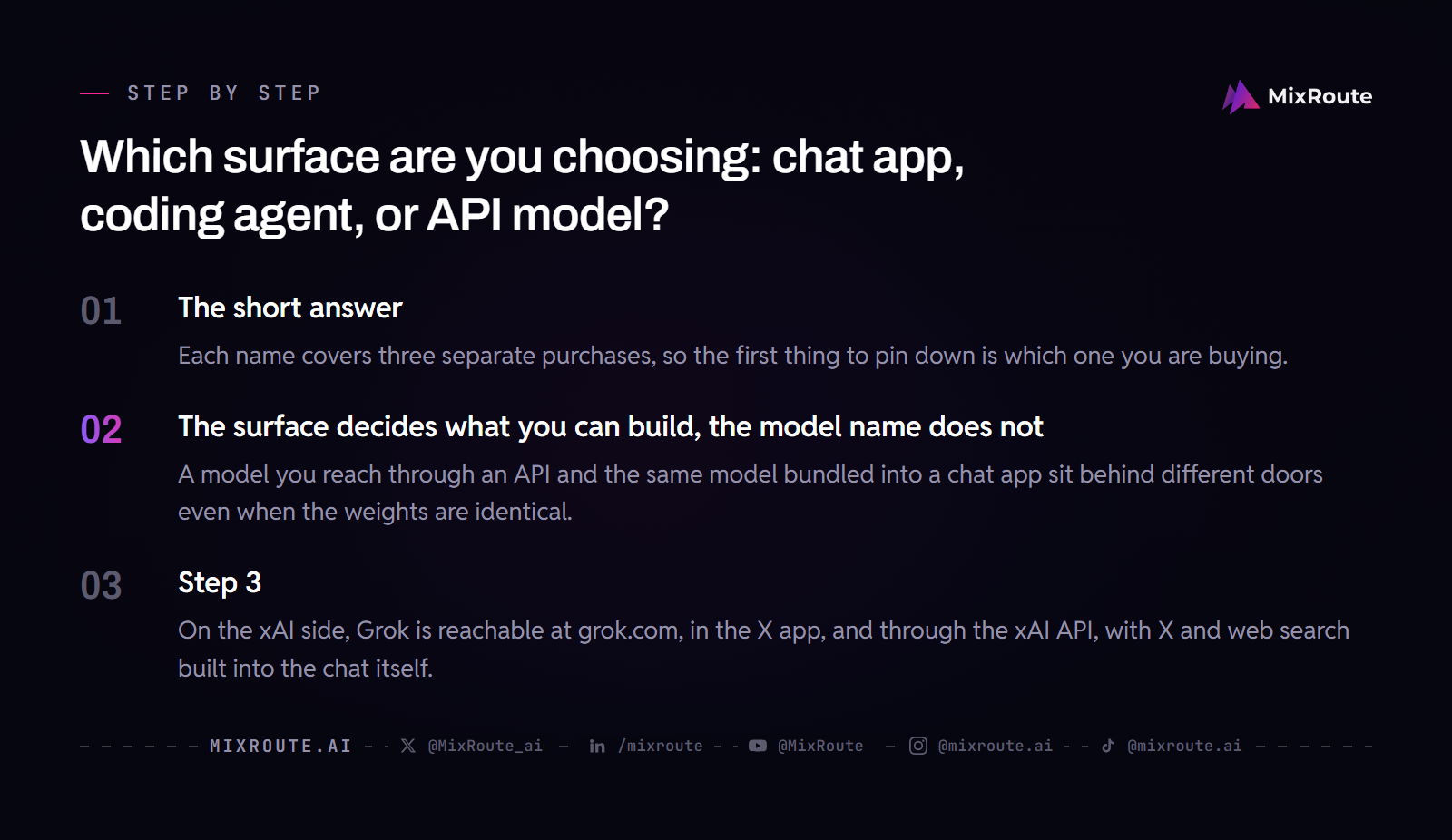
On the xAI side, Grok is reachable at grok.com, in the X app, and through the xAI API, with X and web search built into the chat itself. Claude is Anthropic’s, built on Constitutional AI, a training method that aligns a model against a written set of principles. In practice that produces an assistant more willing to say it does not know, and steadier across a long piece of work.
The mistake is thinking one purchase covers all three. Grok Imagine, DeepSearch, Claude Code, and Cowork stay in the vendors’ native apps, so a third-party multi-model app hands you the models and leaves those features behind. The seat and the call are separate products on both sides, and the free tiers do not blur that line.
The surface decides what you can build, the model name does not
A model you reach through an API and the same model bundled into a chat app sit behind different doors even when the weights are identical. Behind the chat door you get a conversation, a history, and the vendor’s own tooling. Behind the API door you get a request you write, a response you parse, and a bill per token. Consumer plans, business plans, and API access have to be judged by the surface you actually use.
What each subscription includes, and what stays in the native app
The two ladders look nothing alike. xAI spreads tiers from free to $200 a month, and Anthropic runs a tighter set. The figures below are in USD, xAI’s as of its October 12, 2026 announcement and Anthropic’s as of September 2026, with no local-currency conversion.
| Plan tier | xAI (October 2026) | Anthropic (September 2026) |
|---|---|---|
| Free | Free tier on grok.com and in X | Free |
| Entry paid | Plus, $8 per month | Not listed in the September 2026 table |
| Standard | Premium, $30 per month | Pro, $20 per month, about $17 on the annual plan |
| Heavy use | Super $100 per month; Ultra $200 per month | Max, $100 or $200 per month |
| Bundle | Premium at $30 per month includes the benefits of SuperGrok and X Premium+ | Not listed in the September 2026 table |
xAI is cheaper to start, at $8 a month, and cheaper on API rates, but its standard tier is $30 a month against Claude’s $20, and its heaviest tier is $200, the same as Claude’s top Max tier.
A yearly figure makes the arithmetic concrete. At the listed monthly prices, xAI’s $30 Premium tier comes to $360 across twelve months and Claude’s $20 Pro tier to $240.
What the plan price covers, and what it does not
Vendor-specific tools stay inside the vendor’s own surfaces. Grok Imagine and DeepSearch are built around xAI’s native app, and Claude Code and Cowork around Anthropic’s, with two exceptions: xAI also sells the Imagine image and video models per image and per second on its API, and Claude Code also signs in with an Anthropic Console account instead of a subscription. Choose the subscription when you need one of those native tools; otherwise model access is the relevant purchase.
The test is what your week contains. If most of your work happens inside a coding agent or an image tool, the subscription is buying the tool as much as the model, and cancelling it to save $20 a month removes the thing you use. If what you want is strong models without picking a side, the tool bundle is the part you never open.
Where do Grok Build and Claude Code fit?
Claude Code is Anthropic’s agentic coding tool, and it runs in the terminal, in VS Code and JetBrains, in the desktop and web apps, on mobile, and in CI. Paid Claude plans bundle it at no extra charge, which is a larger share of the plan’s value than the chat window alone. xAI’s counterpart is Grok Build, a coding agent you run as a terminal TUI, headlessly in scripts, or inside other apps through the Agent Client Protocol, with Grok 4.7 as its default model. On an existing paid SuperGrok plan its usage draws from the same weekly allowance as chat, Imagine, and voice, while grok-build-0.1 is a separate coding model priced at $1 and $2 per million tokens on the API.
What each agent sits on top of
An agent is a loop above a model. It plans, edits files, runs the tests, reads the failures, and tries again without you pasting anything back. The loop adds tool calls and state around the model response.
If you want that loop inside your own tooling, you either build it against an API or pay a platform that exposes both families behind one key. On the Claude side the arithmetic is simple: a Pro seat at $20 a month is the entry point for the chat app and the coding agent together. A multi-model app at the same price gives you the model and leaves the agent behind, because the agent does not travel with the weights.
What is the API price unit, and what changes it?
Every API row is quoted per million tokens, with input and output priced separately. That unit is the only like-for-like comparison across the two vendors, because a subscription limit is not measured in tokens and cannot be lined up against a rate.
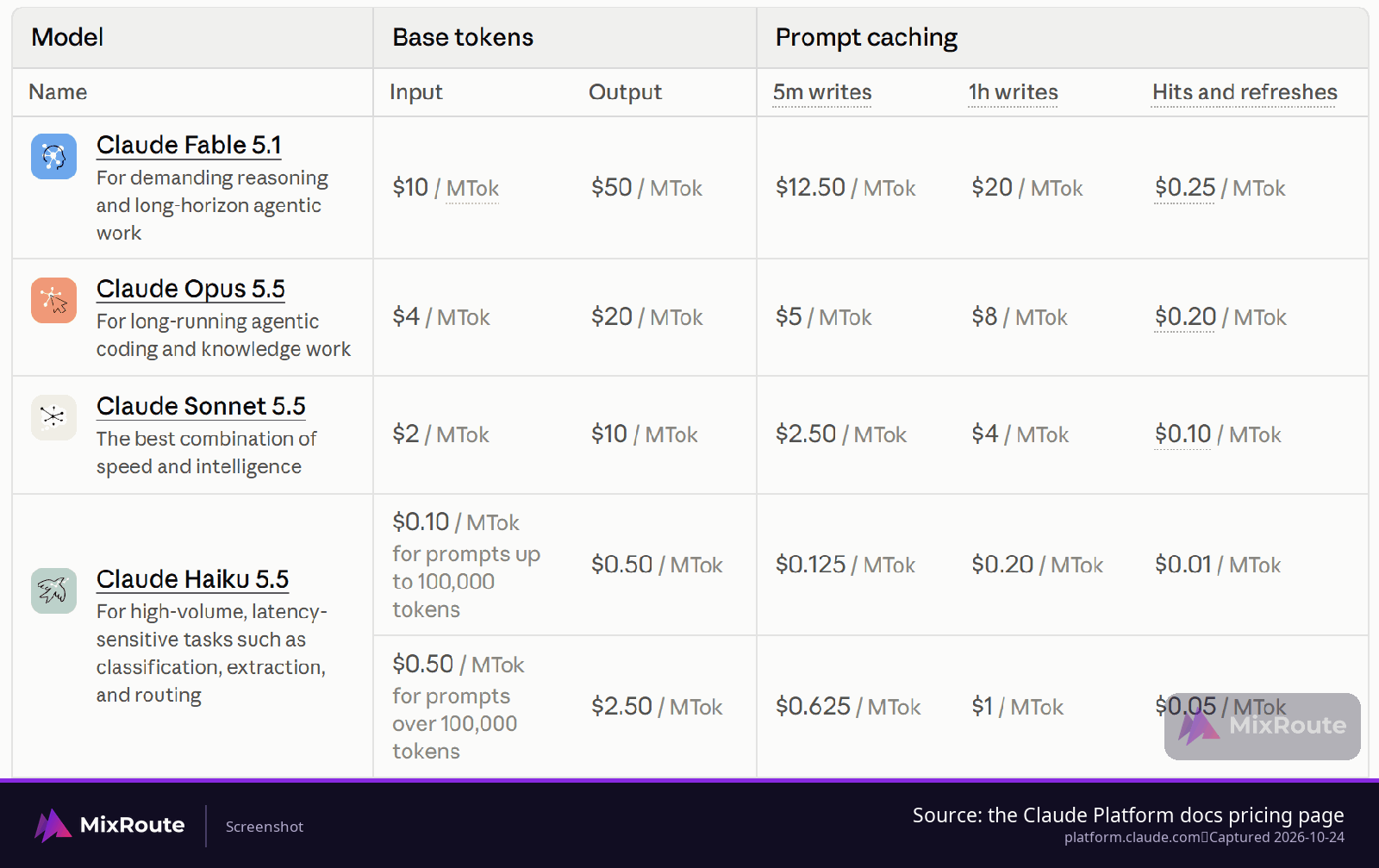
| Model (September 2026) | Input, per million tokens | Output, per million tokens |
|---|---|---|
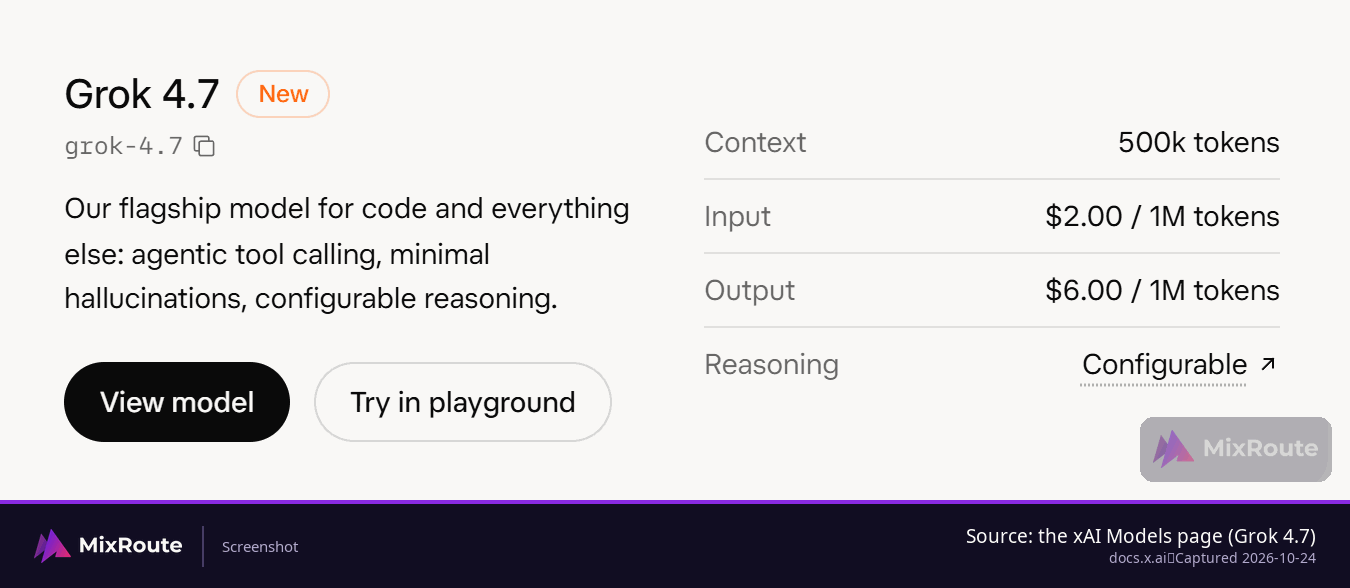
| Grok 4.7 | $2 | $6 |
| Grok Build 0.1 | $1 | $2 |
| Fable 5.1 | $10 | $50 |
| Opus 5.5 | $4.00 | $20.00 |
| Sonnet 5.5 | $2 | $10 |
| Haiku 5.5 | $0.10 | $0.50 |
API rates put Grok cheaper at the top of each ladder. Below the 200K-input threshold, Grok 4.7 at $2 input and $6 output sits against Fable 5.1 at $10 and $50, so the input rate is one-fifth and the output rate about one-eighth. Against Opus 5.5 the comparison is $2/$6 versus $4/$20. Above 200K input tokens Grok’s rates double, so those ratios stop applying. On long-document work, Haiku 5.5 or Sonnet 5.5 can land cheaper per finished task.
Put volumes on it and the units stop being abstract. Suppose a summarization job sends 100,000 input tokens and 20,000 output tokens in a month, staying under the 200K threshold. At Grok 4.7’s $2 and $6 per million tokens that is $0.20 of input and $0.12 of output, so $0.32 for the month. The same volumes on Opus 5.5 at $4 and $20 per million tokens come to $0.40 and $0.40, so $0.80.
Why a version pin belongs next to every rate
Version drift shows up in the rates: Grok 4.3 is quoted at $1.25 and $2.50 per million tokens with a 1M context window, doubling once a prompt reaches 200K tokens. Grok 4.7 is quoted at $2 and $6 with a 500K window, doubling at the same 200K mark. Both are true because they are different model versions, which is the whole argument for printing a version and a comparison date next to every rate.
Two conditions sit behind the Grok rows beyond the token count. The rate doubles once a prompt reaches 200K tokens, and search bills separately: web search at $5 per 1,000 calls, X search at $5 per 1,000 posts fetched and $10 per 1,000 profiles fetched. Both belong to the Grok rows. On the Claude side only Haiku 5.5 has a prompt-length step: a prompt over 100,000 tokens is billed at $0.50 input and $2.50 output per million. If your prompts are long enough to cross the threshold, price those calls at the doubled rate, since the headline number no longer applies.
Context windows are another number that drifts. Grok’s flagship is listed at 500K tokens, and you will see 2M quoted elsewhere, while the Claude models carry 1M. Different dates and model versions explain the gap, so plan against the number on the model’s own catalog page, where context, max output, modality, and price sit together.
When you want to price your own mix, see the current MixRoute plans and the 0% platform fee, and pull the per-model Grok and Claude rates from the model catalog, where each model’s ID, context, and unit price sit together.
What decides it, and where does the next comparison live?
Three axes settle almost every version of this question: how time-sensitive the work is, how much length and care it needs, and the price unit you are billed in. A live question points to Grok, a long document to Claude, and the billing unit decides whether you are comparing a seat against a seat or a rate against a rate.
Billing unit is the axis people skip, and it decides whether a switch saves anything at all. A $20 monthly plan and a $2 per million input rate only become comparable once you know your own monthly volume.
Another frontier pairing runs through the same three axes; see the GPT 5.6 Sol vs Claude Fable 5 comparison for the Claude side.
How do you run both families through one endpoint?
MixRoute carries xAI and Anthropic models behind a single endpoint, so the family choice above does not have to be permanent and the two surfaces do not have to be separate accounts. Two documented SDK paths cover the move, and neither one asks you to rewrite a client.
Your OpenAI SDK client keeps its model names and changes only the API key and the base URL to https://api.mixroute.ai/v1. An Anthropic SDK client sets base_url to https://api.mixroute.ai, without /v1, passes the MixRoute key as api_key, and keeps the same client and the same client.messages.create call. MixRoute also exposes an Anthropic-compatible Messages API at POST https://api.mixroute.ai/v1/messages, authenticated with an Authorization: Bearer header holding your MixRoute key plus the anthropic-version: 2023-06-01 header, and requiring model, messages, and max_tokens in the body.
MixRoute lists 250+ models through that one endpoint with a 0% platform fee, and the catalog showed 279 models across 16 providers in October 2026. Model IDs and unit prices live on the catalog pages, so the page that answers a rate question is also where you copy the model name.
Scoping the key before both families use it
A key does not have to be all or nothing. On MixRoute, a key can be limited to a named set of models with model_limits_enabled and a comma-separated model_limits list. It can carry its own spend budget in remain_quota, deducted request by request and stopping the key at zero, with unlimited_quota turning that ceiling off. It takes an address restriction through allow_ips, which accepts plain addresses or CIDR ranges, and an expiry through expired_time, where -1 means no expiration. The account balance stays the outer ceiling in every case.
Those fields are key-level and independent of how a request is routed. One of them carries its own warning: the console note beside the IP allowlist says not to rely on it alone, because IPs can be spoofed, and to use it alongside nginx or a CDN.
If you are wiring the same two families into an automation tool, the n8n LLM integration walkthrough covers that setup.
FAQ
Is Grok or Claude the better choice overall?
There is no better choice in the abstract; it depends on what you can review. Point Grok at a question about something that happened this week, but look at where the material comes from, because a live feed carries unverified posts as easily as confirmed ones. Point Claude at a document you already have and ask for a multi-step answer you can trace back. If neither of those describes your actual work, you are probably comparing the wrong surfaces.
Can one key call both model families?
Yes. MixRoute serves xAI and Anthropic models behind one endpoint and one key, so a single integration can reach Grok and Claude without a second account. Before an application calls either family, set the key-level model allowlist so it only sees the models you meant to expose. That way an app pointed at the wrong key still cannot reach models outside the list.
How do I compare a $20 monthly plan with a per-token rate?
You cannot line them up directly, because one buys a seat with usage limits and the other meters every million input and output tokens. The two only meet once you can state your own monthly token volume, and for most people that is a number they have to measure. Log a week of real traffic, multiply out to a month, and then put the seat price beside the per-token figure.
What makes the API bill move besides the token count?
Two things on the Grok side. Crossing 200K input tokens doubles the rate on that request, and search bills separately: web search at $5 per 1,000 calls, X search at $5 per 1,000 posts fetched and $10 per 1,000 profiles fetched. A long prompt that also searches can therefore land well above what the headline rate suggests, even when the token count looks modest. Trimming repeated context before you compare model rates keeps the estimate honest.
Should I keep the subscription if I only need the model?
Only if you are actually using something that lives behind the subscription. Claude Code, Cowork, Grok Imagine, and DeepSearch are built around the vendors’ own apps, so cancelling the plan to save $20 a month removes the bundled tool even though the model stays reachable through a key. The exceptions are Claude Code, which also accepts an Anthropic Console account, and the Imagine models, which xAI also sells on its API. If your work is all prompts and responses, the subscription is paying for a chat window an API key would replace.
Which one should I use for live news and trends?
Grok, because it reads X and the web inside the chat instead of waiting for you to paste links. That freshness is also the catch: a live feed is not a vetted one, so a trending claim can arrive with the sourcing problem attached. Treat the first answer as a lead and check the underlying post or article before you act on it.
How should I separate test and production keys?
Give each environment its own key and model allowlist, and keep the account balance as the outer ceiling. A test key can be scoped to only the models you are comparing, while production keeps a separate set and its own budget. That way an experiment in staging cannot drain the balance that production depends on.