DeepSeek vs Claude: Which Route Fits Your Workload
“Which one should I send this to?” Send isolated, high-volume steps to DeepSeek, and anything that has to hold together across a long context to Claude. One check can end the comparison before quality enters it: jurisdiction. If a data-residency policy names a country, settle that first. On price, DeepSeek sits well below Claude’s upper tiers: deepseek-v4-pro lists $1.32 per million input tokens and $3.96 per million output at peak rates against $4 and $20 for Claude Opus 5.5, while Claude Haiku 5.5, at $0.10 and $0.50 on prompts up to 100,000 tokens, comes in under deepseek-flash at $0.30 and $1.20. Published comparisons hand DeepSeek the pure code-generation edge at the cost of needing more explicit prompting on open-ended tasks. Claude leads on multi-step planning, retrieval from deep inside a long document, refactoring and code review.
Picture a nightly job that labels hundreds of thousands of short prompts, and beside it a request to read a long contract, follow six formatting rules and rewrite one clause without disturbing the rest. The first wants the cheapest token that gets the labels right, which is a price check between deepseek-flash and Claude Haiku 5.5 on short prompts, and a clear DeepSeek job once prompts run past 100,000 tokens. The second wants instruction following, and rework on a contract clause costs review time on top of tokens, so that is Claude’s case. Neither call turns on which model is smarter.
Which surface are you choosing: hosted chat, the API, or open weights?
Three different purchases hide behind the same model names, and which one you pick decides how much of the stack you end up owning. A chat subscription buys a seat in someone else’s product. The API buys metered calls against an endpoint. Open weights buy the artifact itself, which you then have to run. Claude is rented in every case, because Anthropic ships its models as closed cloud models. DeepSeek’s family includes one route you can own outright.
Weights you can hold, seats you cannot
Most DeepSeek models ship as open weights under the MIT License, runnable locally or on infrastructure you control. What that path costs you is compute and operations: GPUs, a serving stack, and somebody who owns version upgrades. Check the license and release status on the model card for the version you plan to serve, because open weights do not cover every model in the family. An API call is paying per copy, and running weights is buying the copier. The copier only wins if you print enough, and only if you want to maintain it.
Claude has no equivalent. Access runs through Anthropic subscriptions, its token API, and partner cloud platforms such as AWS Bedrock, Google Vertex AI and Microsoft Foundry. Pointing a Claude-branded client at a different backend is a client swap, not an open-weight release.
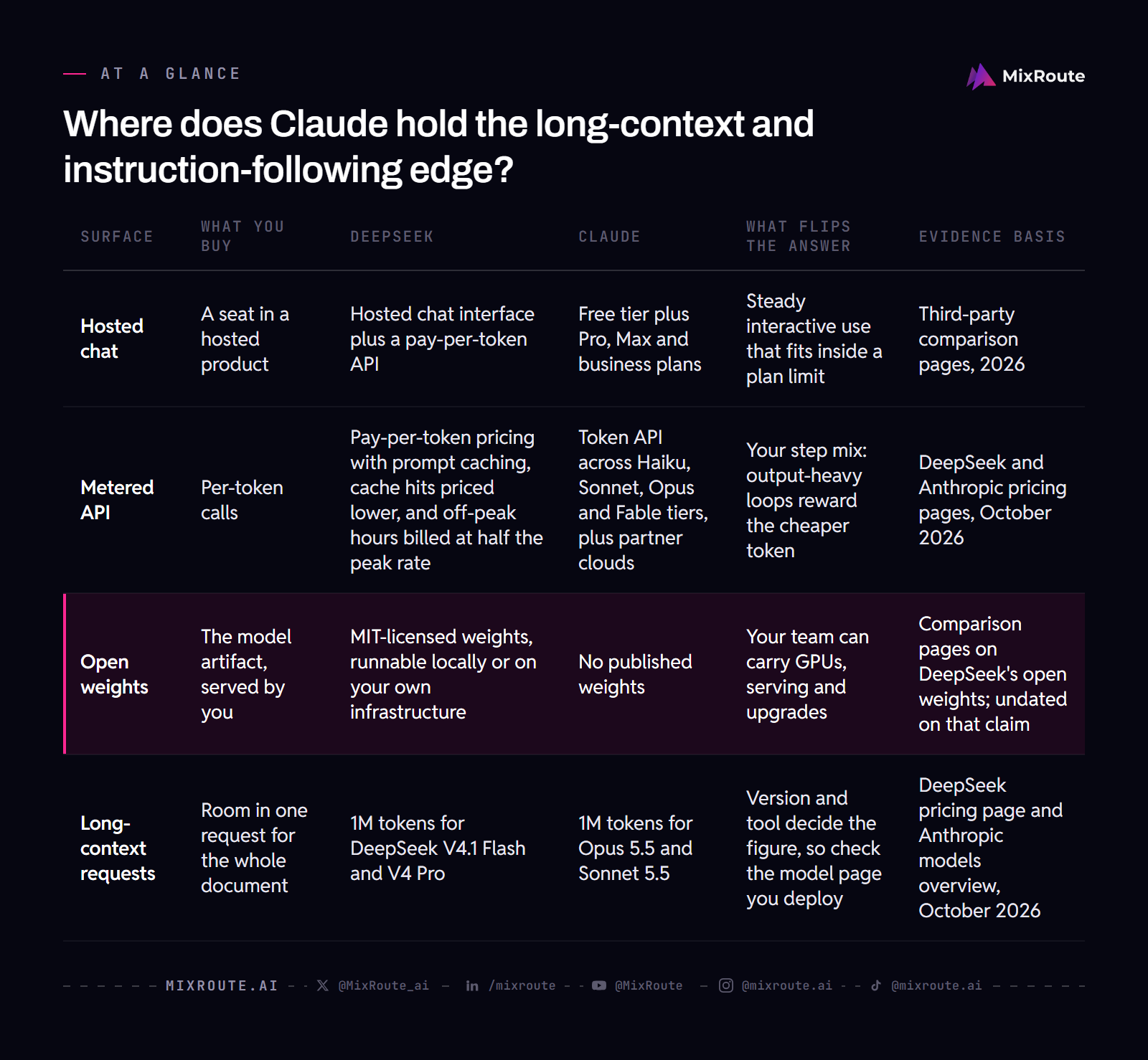
| Surface | What you buy | DeepSeek | Claude | What flips the answer | Evidence basis |
|---|---|---|---|---|---|
| Hosted chat | A seat in a hosted product | Hosted chat interface plus a pay-per-token API | Free tier plus Pro, Max and business plans | Steady interactive use that fits inside a plan limit | Third-party comparison pages, 2026 |
| Metered API | Per-token calls | Pay-per-token pricing with prompt caching, cache hits priced lower, and off-peak hours billed at half the peak rate | Token API across Haiku, Sonnet, Opus and Fable tiers, plus partner clouds | Your step mix: output-heavy loops reward the cheaper token | DeepSeek and Anthropic pricing pages, October 2026 |
| Open weights | The model artifact, served by you | MIT-licensed weights, runnable locally or on your own infrastructure | No published weights | Your team can carry GPUs, serving and upgrades | Comparison pages on DeepSeek’s open weights; undated on that claim |
| Long-context requests | Room in one request for the whole document | 1M tokens for DeepSeek V4.1 Flash and V4 Pro | 1M tokens for Opus 5.5 and Sonnet 5.5 | Version and tool decide the figure, so check the model page you deploy | DeepSeek pricing page and Anthropic models overview, October 2026 |
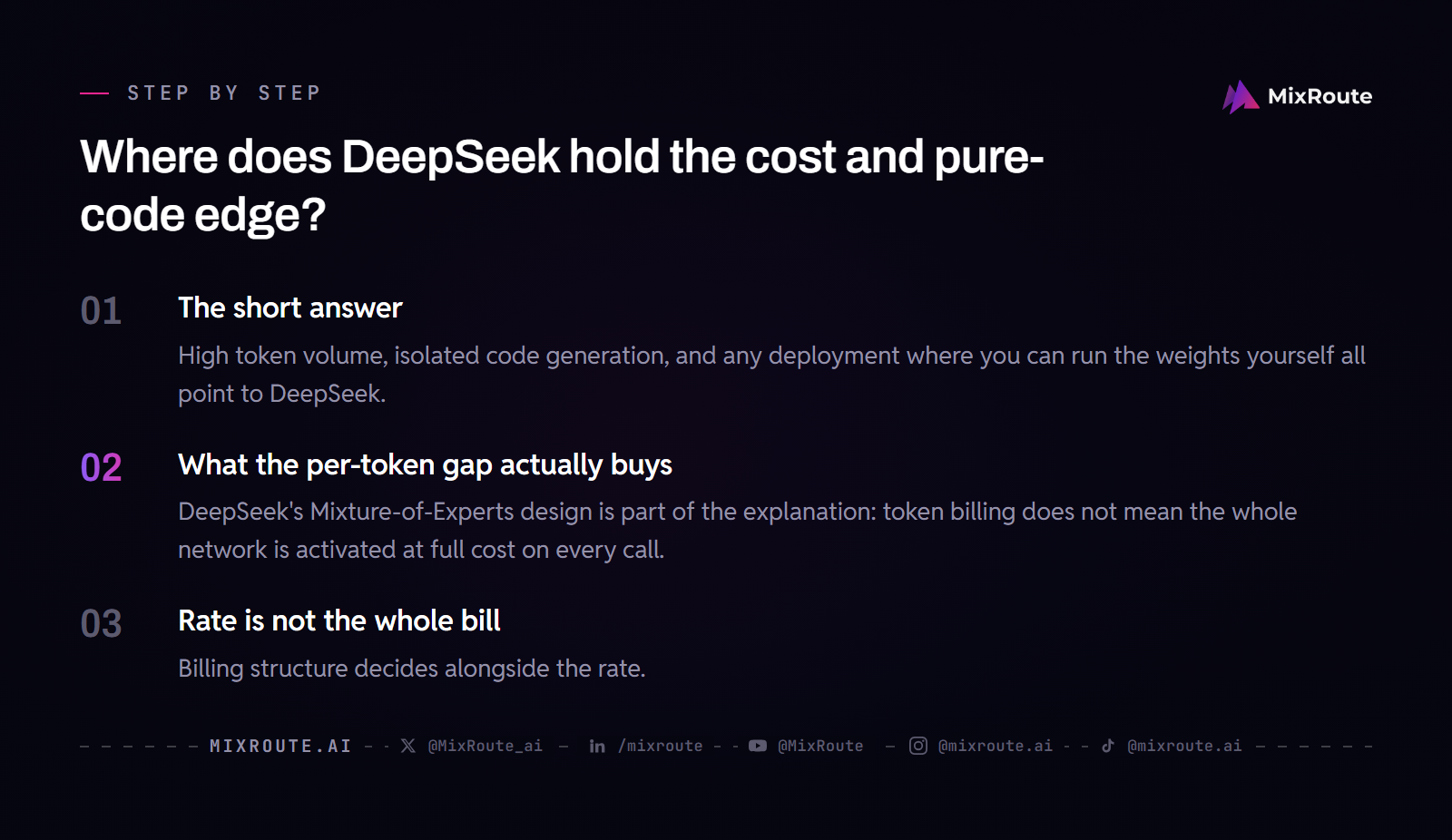
Where does DeepSeek hold the cost and pure-code edge?
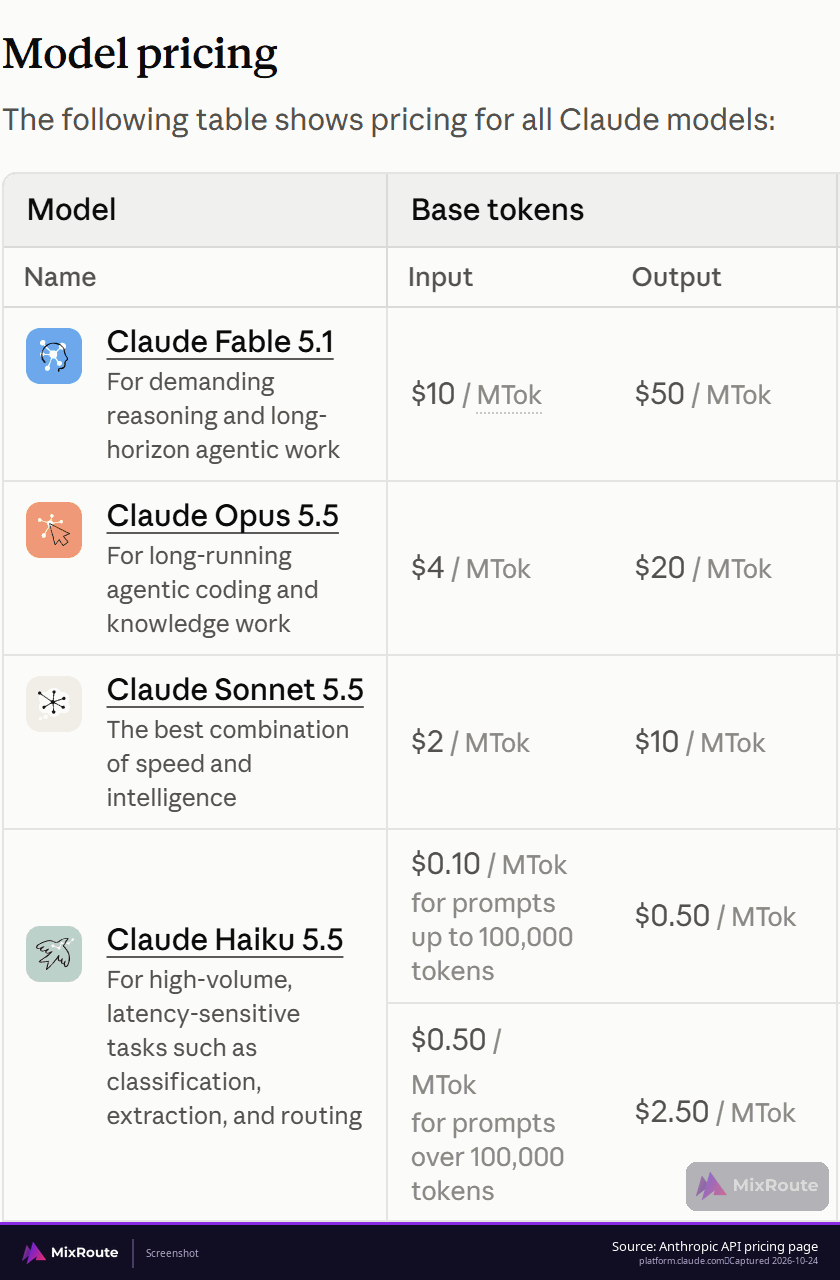
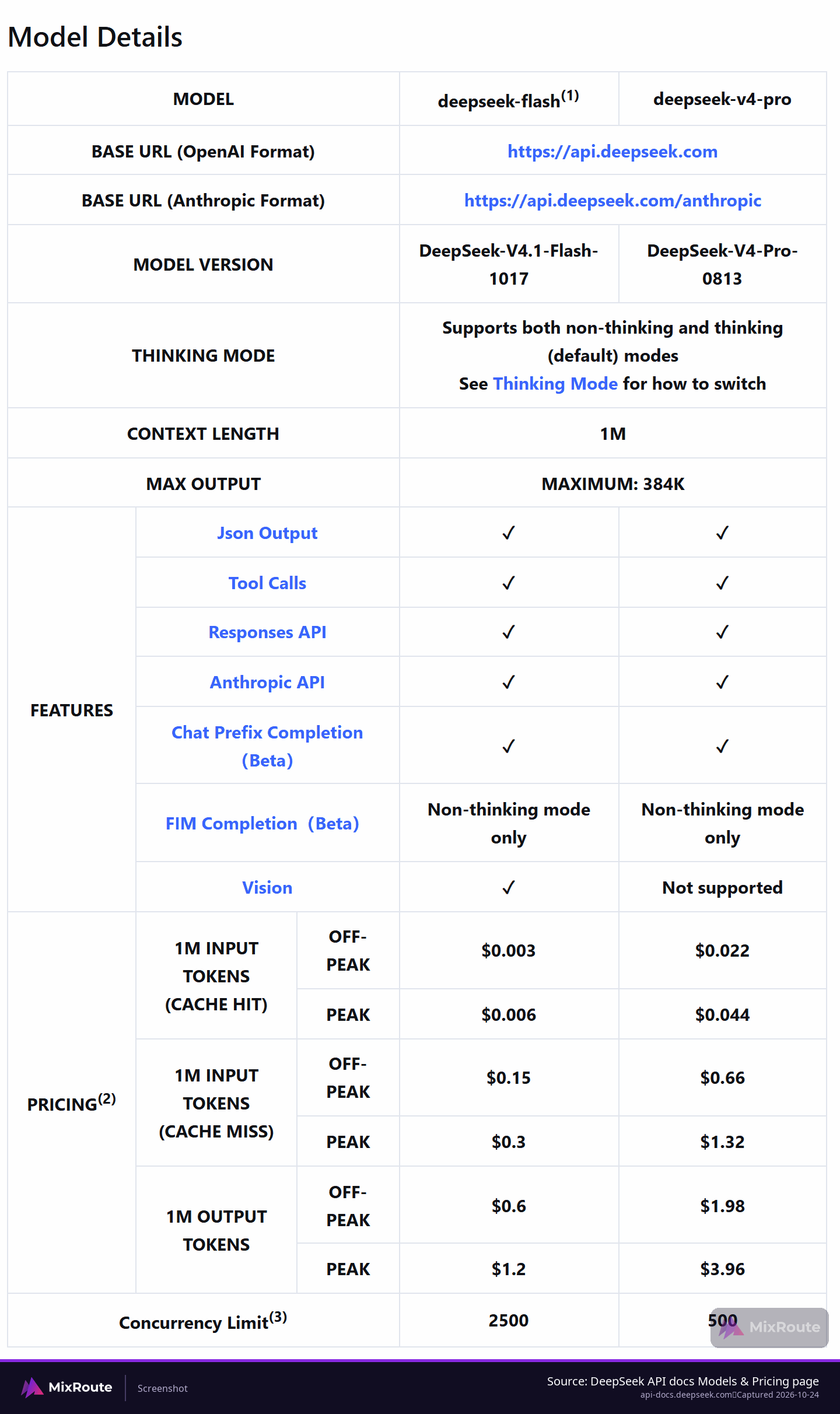
High token volume, isolated code generation, and any deployment where you can run the weights yourself all point to DeepSeek. DeepSeek’s pricing page lists deepseek-v4-pro at $1.32 per million input tokens and $3.96 per million output at peak rates and deepseek-flash at $0.30 and $1.20, with off-peak hours at half those rates, and published comparisons put DeepSeek ahead on code completion, algorithmic tasks and debugging a single function. How wide the gap is depends on the Claude tier you set it against. Anthropic’s pricing page from 2026-10-11 puts Fable 5.1 at $10 per million input tokens and $50 per million output, Opus 5.5 at $4 and $20, Sonnet 5.5 at $2 and $10, and Haiku 5.5 at $0.10 and $0.50 for prompts up to 100,000 tokens, rising to $0.50 and $2.50 above that. Both DeepSeek models undercut Fable, Opus and Sonnet, and Haiku 5.5 is the cheaper token until a prompt passes 100,000 tokens. Use the current MixRoute pricing and plan terms to confirm the gateway conditions.
What the per-token gap actually buys
DeepSeek’s Mixture-of-Experts design is part of the explanation: token billing does not mean the whole network is activated at full cost on every call. The gap also follows the shape of the traffic. An output-heavy mix can widen it, and repeated prefixes change the effective gap, because cache-hit discounts depend on each provider’s current pricing.
Cheap tokens do not guarantee the cheaper outcome, though. A token quote belongs next to the review work and retry path your application actually needs, since a lower rate loses its advantage when the result needs another pass or more human checking. Treat any single application comparison as a dated example, then test your own workload before you commit a route to it.
Rate is not the whole bill
Billing structure decides alongside the rate. Claude Code is primarily subscription-anchored for interactive work inside Pro and Max plan limits, and API-metered Claude Code is also available for teams that want pay-as-you-go. A DeepSeek-based terminal agent is API-metered, with no floor and no seat. Heavy sustained use that would hit a plan ceiling anyway shifts the math toward the subscription; light or bursty batch runs stay cheaper metered. MixRoute charges a 0% platform fee on token usage, so the number you are comparing is the provider’s token rate and not a gateway markup, and the four locale pages display prices in USD with no conversion into a local currency.
| Cost dimension | DeepSeek | Claude | When it changes the route |
|---|---|---|---|
| Per-token API price | deepseek-flash at $0.30 input and $1.20 output per million tokens, deepseek-v4-pro at $1.32 and $3.96, both at peak rates; off-peak is half | Fable 5.1 at $10 and $50, Opus 5.5 at $4 and $20, Sonnet 5.5 at $2 and $10, Haiku 5.5 at $0.10 and $0.50 on prompts up to 100,000 tokens | Only for the versions compared; rates change with every release |
| Prompt caching | Cache hits on repeated prefixes priced lower | Supported as well | You resend the same system prompt across many requests |
| Terminal agent billing | API-metered per token, no subscription floor | Claude Code runs on Pro or Max within plan limits; API-metered use is also available | Sustained interactive hours against bursty batch runs |
Where does Claude hold the long-context and instruction-following edge?
Anywhere the task needs planning across steps instead of one correct answer. Side-by-side tests put Claude ahead on multi-part instructions that arrive in a single prompt, retrieval from anywhere in a long document, refactoring across a project, code review, and writing that has to read well. Both families support structured tool use and function calling, so tool calling is not the dividing line. Holding the original objective across a long chain is.
Planning reliability and tool access
An engineer refactoring a monorepo feels this quickly. Renaming a pattern consistently, noticing which caller will break, and explaining why a new structure causes trouble later all require holding several constraints at once. DeepSeek handles the same territory when the task is narrow: write this function, implement this algorithm, produce unit tests for it. Its output on open-ended prompts tends toward terseness, and comparisons describe it as needing more explicit structure in the prompt. Someone drafting a customer-facing email notices that in the first sentence, not the tenth.
Long-context behavior follows the same line. Inside a long context, DeepSeek retrieval stays solid but can degrade when the answer is buried deep in the document, while Claude carries a reputation for long-context fidelity on that same retrieval. The context figure belongs to the model version you deploy, not to the family: both current DeepSeek models list 1M tokens, and Anthropic lists 1M for Opus 5.5 and Sonnet 5.5. One token count taken from a single model page is not a family limit.
Which model survives your compliance and data-residency check?
DeepSeek runs under Chinese jurisdiction, so a data-residency policy settles this before any benchmark runs. DeepSeek is built by Hangzhou DeepSeek Artificial Intelligence and operates under Chinese law, which governs how API data is processed. Claude comes from a US vendor whose enterprise agreements are the easier fit for SOC 2, HIPAA and GDPR work. Where a policy names a jurisdiction or a data class, that policy is the answer.
Filtering, weights and the paper trail
Each family applies its own content filtering, and they are not the same shape. DeepSeek filters politically sensitive topics defined by Chinese law, so questions about Tiananmen Square, Taiwan sovereignty and certain historical events can come back as refusals or deflections. Anthropic’s Constitutional AI policies are restrictive in their own way, but they are not shaped by Chinese speech regulation. If your work touches those topics, the filtered family is not a candidate, whatever its price says.
Open weights give you a third answer. Running DeepSeek models on your own infrastructure keeps prompts off DeepSeek’s servers, and the cost moves to GPUs and operations. That path suits a research team with idle capacity and a rule against sending data to a foreign-hosted API, and it leaves the serving stack, the upgrades and the on-call rotation in your own hands. A team that would rather not staff that work is better served by a managed endpoint. If procurement asks for a vendor assessment, check the provider’s security record, data handling and content policy against your own requirements.
Payment terms, capacity commitments and any invoicing arrangement depend on where your entity sits and which plan you buy, so those get set with Sales in the quote and the contract.
| Check | DeepSeek | Claude | When it decides the route | Evidence basis |
|---|---|---|---|---|
| Data jurisdiction | Chinese company; API data processed under Chinese law | US vendor with agreements aimed at SOC 2, HIPAA and GDPR alignment | A policy names a jurisdiction or a data class | Comparison pages, 2026 |
| Content filtering | Filtering on politically sensitive topics defined by Chinese law | Anthropic policy, not Chinese speech regulation | Your research or content touches those topics | Comparison pages, 2026 |
| Self-hosting as a privacy path | Weights can run on your infrastructure; compute and operations stay yours | No published weights, so no local option | The data may not leave your infrastructure | Comparison pages, 2026 |
| Vendor review | Enterprise compliance is limited and the ecosystem minimal next to Anthropic’s | Published safety research and model cards; SOC 2 and HIPAA-ready options | Procurement asks for a vendor assessment | Comparison pages, 2026 |
Can one pipeline call DeepSeek and Claude at the same time?
Yes, and for mixed work that is the normal shape rather than a compromise. Bulk classification, first-pass extraction and isolated generation go to DeepSeek. Ambiguous records, multi-step plans and long-document synthesis go to Claude. MixRoute serves both families from one endpoint: an OpenAI-compatible surface at https://api.mixroute.ai/v1 and an Anthropic-compatible Messages API at POST https://api.mixroute.ai/v1/messages, authenticated with Authorization: Bearer <MixRoute key> and anthropic-version: 2023-06-01. The catalog covers 250+ models and includes the anthropic and deepseek provider families, and the Messages API requires model, messages and max_tokens.
Moving an existing Anthropic SDK client across is small work. You construct Anthropic(api_key=<MixRoute key>, base_url="https://api.mixroute.ai") with no /v1 on the base URL, and client.messages.create keeps its current request shape. An OpenAI SDK client instead points its base URL at the /v1 surface and keeps the model names it already sends. On that OpenAI-compatible surface, each step can select a model through the request parameter, so the client integration stays the same.
| Workload step | Route | What moves it |
|---|---|---|
| Nightly classification or extraction over large volumes | DeepSeek | The labels need multi-part reasoning, or the output feeds a customer-facing surface |
| Isolated function, algorithm or unit-test generation | DeepSeek | The code must fit a multi-file structure the model cannot see |
| Refactoring across a project or reviewing a large diff | Claude | The change is local to one function and fits in a single prompt |
| Long-document synthesis or contract review | Claude | The document fits the cheaper window and the asks are factual lookups |
| Multi-step agent planning that must hold the original objective | Claude | The steps are well defined and each one can be checked cheaply |
| Output-heavy retry loops where per-token cost compounds | DeepSeek | A subscription plan already covers the steady interactive hours |
Is DeepSeek versus Claude still the right comparison for your workload?
It stops being the right frame when a coding-specific ranking decides your stack, because the harness matters as much as the model. Claude Code can point at DeepSeek’s Anthropic-compatible endpoint through environment variables, keeping its loop and commands and its effort setting, while DeepSeek’s compatibility table marks other Claude-native fields, among them mcp_servers, cache_control and the thinking budget_tokens, as ignored. If your team already lives inside one harness, the harness decides. Model-family choice stays separate from that, and the tooling built around each family does not transfer.
If your question has shifted to GPT-5.6 Sol versus Claude Fable 5, see the GPT-5.6 Sol and Claude Fable 5 comparison; those model-specific trade-offs are separate from the DeepSeek and Claude route described here.
When the comparison should move to a different pair
Teams working across Chinese and English technical documentation get a different answer, since comparisons treat Chinese-language tasks as a DeepSeek design target and as competent rather than primary for Claude. If your candidates are a different pair, frame a separate comparison around their versions, evidence and deployment constraints. A mixed pipeline can be the finding.
FAQ
Is DeepSeek better than Claude?
Not as a single call, and Claude is not universally better either. The split follows the job: DeepSeek on cost efficiency and pure code generation, Claude on complex reasoning, long-context accuracy and instruction following. Two conditions do most of the work. Volume rewards the cheaper token, and a prompt carrying several constraints at once rewards the model that tracks them all. Teams that open by crowning a winner tend to end up routing per step anyway, which is the cheaper place to land.
How much cheaper is DeepSeek?
It depends on the tier: at peak rates deepseek-v4-pro lists $1.32 input and $3.96 output per million tokens and deepseek-flash $0.30 and $1.20, with off-peak hours at half, so the gap to Claude’s top tiers is wide and the gap to its cheapest tier is not there at all. Anthropic’s current rates put Opus 5.5 at $4 input and $20 output per million tokens and Sonnet 5.5 at $2 and $10, while Haiku 5.5 at $0.10 and $0.50 on prompts up to 100,000 tokens is cheaper than either DeepSeek model. Prompt caching moves the effective number again, since repeated prefixes are priced lower, and an old figure describes an old model.
Can I use DeepSeek in an enterprise environment?
Yes, unless your policy rules out Chinese jurisdiction, and Claude’s US-based agreements are the easier fit where SOC 2, HIPAA or GDPR work is in scope. The open weights give you a second path: run the model on infrastructure you control and prompts never reach DeepSeek’s servers, at the cost of GPUs and an owner for the serving stack. A common split keeps internal tools with no regulated data on DeepSeek and customer records on Claude, in separate pipelines.
Which model is better for coding?
Scope decides it. DeepSeek takes pure code generation and isolated tasks, while Claude is stronger for refactoring, code review and multi-file project work. The line runs between coding as computation and coding as engineering. A pipeline can send isolated generation to DeepSeek and project-level review to Claude without touching the client, because both families sit behind the same endpoint.
What context window does each model have?
The number belongs to a model version, and often to a tool. DeepSeek’s pricing page lists a 1M context length for both current models, DeepSeek-V4.1-Flash and DeepSeek-V4-Pro-0813, and Anthropic lists 1M for Opus 5.5 and Sonnet 5.5. Claude Code runs the current Claude models with the 1M window by default, and DeepSeek’s Claude Code guide selects the 1M variant with deepseek-flash[1m]. Window size is not retrieval quality either: precise attention to details buried deep in a long document is where long windows separate from each other.
Can DeepSeek and Claude run in the same workflow?
Yes. Put bulk and first-pass steps on DeepSeek and reasoning-heavy steps on Claude, and MixRoute serves both families from one endpoint, so one key and the OpenAI-compatible client cover either model name. The Messages API takes native Anthropic requests at POST https://api.mixroute.ai/v1/messages with model, messages and max_tokens required. Whether a retry carries a charge depends on the provider’s billing policy for the failed request.
Is a chat plan or the API cheaper?
Steady interactive work often favors a plan, because Claude Code is primarily used through Pro and Max subscriptions within plan limits, and teams that want pay-as-you-go can run API-metered Claude Code instead. A DeepSeek-based terminal agent meters every token, with no seat to buy. The reversal point is variability: light or bursty use pays less metered, and usage that would hit the plan ceiling anyway shifts the math toward the subscription. Running both at different volumes is workable.
Can Claude Code use DeepSeek as its backend?
Yes. DeepSeek’s integration guide documents the environment variables that point Claude Code at its Anthropic-compatible endpoint, and it sets the effort level there too, though its compatibility table marks fields such as mcp_servers and cache_control as ignored. The variables set a base URL, an auth token, a default model, a subagent model, an effort level and an auto-compact window, and the tool loop and commands stay as they are. Treat it as a cost decision: the Claude Code harness stays in place and DeepSeek becomes the serving model.