How to Pay for AI APIs With USDC: All Four Networks Explained
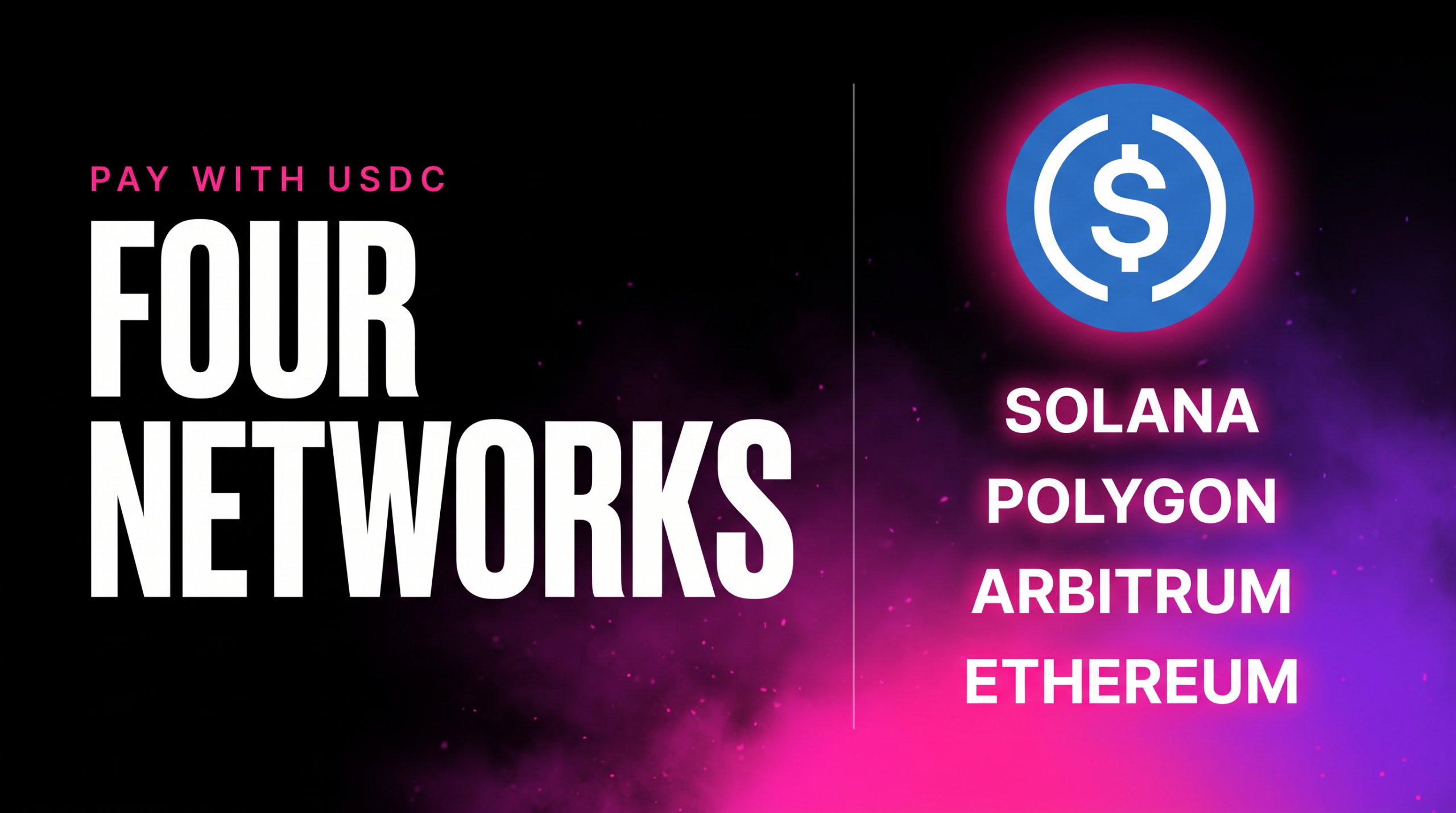
You cannot pay OpenAI, Anthropic, or Google for API access with USDC. None of them accept stablecoin in their billing settings. The working method is an OpenAI compatible gateway that takes USDC deposits, and on MixRoute that means four networks: Ethereum, Arbitrum One, Polygon, and Solana. Notably not Tron, and that is Circle’s decision rather than a gateway limitation, which is worth understanding before you go looking for it.
This guide covers every USDC network, why Tron is not among them, the full deposit flow, and how USDC compares with USDT for this purpose.
Quick answer
Fund an OpenAI compatible gateway with USDC, get one API key, and reach 200+ models through a single endpoint. No card, no KYC to start. USDC runs on four networks here, and Solana is usually the best combination of cheap and fast.
Why the major AI labs do not take USDC
OpenAI, Anthropic, and Google all bill by credit card, or at higher volume by invoice against a verified business account. There is no stablecoin option anywhere in their billing settings.
This is a strange gap for USDC specifically, because USDC is the regulated, audited, compliance oriented stablecoin, issued by Circle, a company listed on the New York Stock Exchange since June 2025. If any digital dollar were going to clear a large enterprise’s payment policy, it would be this one. The labs still do not take it.
So the models are open to the world over an API, and the payment rail behind them assumes a card.
All four USDC networks, compared
| Network | Transfer cost | Speed | Best for |
|---|---|---|---|
| Solana | Very low | Seconds | The default choice. Fastest and among the cheapest |
| Polygon | Very low | Under a minute | Cheap and well established for USDC |
| Arbitrum One | Low | Under a minute | Ethereum security at layer 2 cost |
| Ethereum | Highest | Minutes, longer when congested | Only when your USDC already sits on mainnet |
Solana is the default recommendation for USDC. Fees are a small fraction of a cent and confirmation lands in seconds rather than a minute. If you are buying USDC to fund an API balance and can choose the chain, buy on Solana.
Polygon is the close second, cheap and reliable, and common among users already active in that ecosystem.
Arbitrum One is the compromise if you want settlement to Ethereum without paying mainnet gas.
Ethereum is the one to avoid unless your funds are already there. Mainnet gas is charged per transaction rather than per dollar moved, so it does not shrink with transfer size and a small deposit can lose a meaningful percentage to fees. Bridging to a cheaper chain first is often not worth it either, since the bridge costs gas too.
Why Tron is not an option, and why that is fine
This is the question that brings most people to this page, because Tron is where stablecoin muscle memory lives. The answer surprises people.
Circle discontinued USDC on Tron. In February 2024, Circle announced a phased withdrawal, halting new minting immediately and ending all support by February 2025, citing its risk management framework and its aim to keep USDC “trusted, transparent and safe.”
So the absence is not a gateway limitation. Circle itself withdrew the asset from that chain, and no service can offer deposits for something the issuer no longer supports.
The context explains why it barely registered. USDC never gained meaningful traction on Tron, where USDT has always been overwhelmingly dominant. Circle’s stablecoin was a marginal presence there throughout.
What this means practically. If Tron is where your funds live and you want the cheapest path in, USDT is the answer, not USDC. USDT runs on Tron and five other networks, which is covered in the USDT deposit guide.
How to pay for AI APIs with USDC, step by step
Step 1: Create your account
Sign up with an email address. No identity document, no card, no business verification. New accounts include a starting credit, so you can test a model and confirm the flow works before depositing anything of your own.
Step 2: Select USDC on the deposit screen
Choose USDC from the coin list. The network selection screen appears next, showing Ethereum, Arbitrum One, Polygon, and Solana.
Step 3: Select your network
The deposit address is specific to the network you choose. USDC on Solana and USDC on Ethereum are different addresses on different chains and are not interchangeable.
Match the network to where your funds actually sit. If you are withdrawing from an exchange, the network selected here must match the network you choose in the exchange’s withdrawal screen.
Step 4: Send to the deposit address
Copy the address rather than typing it. On a first or large deposit, send a small test amount, confirm it credits, then send the rest. The extra network fee is negligible on Solana or Polygon and is cheap insurance against any surprise.
Step 5: Save the transaction hash and wait
Your wallet gives you a transaction hash when the transfer broadcasts. Save it, because until your balance updates it is your only proof the transfer happened and the only thing support can use to trace it.
Solana confirms in seconds. Polygon and Arbitrum in under a minute. Ethereum depends on congestion.
Step 6: Generate your API key and make a call
Create a key in the console and copy it once. Store it in an environment variable, never in client side code, and never commit it to a repository.
from openai import OpenAI

client = OpenAI(
    base_url="https://api.mixroute.ai/v1",
    api_key="YOUR_MIXROUTE_KEY",
)

response = client.chat.completions.create(
    model="claude-opus-4-8",
    messages=[{"role": "user", "content": "Say hello in one sentence."}],
)

print(response.choices[0].message.content)
Make sure the base URL ends in /v1. That trailing path is what tells the SDK it is talking to an OpenAI compatible server, and leaving it off is the most common setup mistake.
Switching models is a one string change. Same key, same base URL, different model ID from the catalog.
If your USDC deposit does not arrive
Check the transaction first. Paste your transaction hash into the explorer for the network you used: Solscan for Solana, Polygonscan for Polygon, Arbiscan for Arbitrum One, Etherscan for Ethereum. If it shows as still pending, wait for confirmation. If it shows as confirmed and the funds reached the deposit address, contact support with the hash.
If you sent on a network that was not listed, the funds are generally unrecoverable, because the deposit address may not exist on the chain you sent to. Contact support with the hash regardless, but treat recovery as unlikely. This is why the test transaction in step 4 is worth the small extra fee.
The USDT deposit guide has a fuller troubleshooting walkthrough that applies to stablecoin deposits generally.
USDC or USDT for funding an API balance
Both work. The tradeoff is real but small.
USDC advantages. A regulated, publicly listed issuer with regular reserve attestations. If your business has a policy on which digital assets it will hold, USDC is more likely to clear it. It is also the default in the Circle and Coinbase ecosystem, so if that is where your funds sit, staying in USDC avoids a swap.
USDT advantages. Six supported networks against four, including Tron, which is the most liquid stablecoin rail globally. Far larger overall volume, so it is easier to acquire and move in most markets.
The practical rule. Use whichever you already hold. If you are choosing from scratch and your priority is cost and flexibility, USDT. If your priority is regulatory posture or you already operate on Circle or Coinbase rails, USDC.
Other ways to pay
USDC is one of several options. MixRoute also accepts:
- USDT on Ethereum, Arbitrum One, Polygon, Solana, TON Network, and Tron
- PYUSD (PayPal USD) on Ethereum and Solana
- BTC on the native Bitcoin network, with Lightning support for smaller deposits
- ETH on Ethereum mainnet
- Cards via Visa, Mastercard, and JCB
The full crypto payment guide covers every coin with its supported networks.
How the options compare
| Option | Takes USDC | KYC to start | Platform fee on deposit | Models on one key |
|---|---|---|---|---|
| OpenAI, Anthropic, Google direct | No | Account plus card, business verification at scale | Not applicable | One provider each |
| OpenRouter | Yes | Account required | 5% on crypto, 5.5% on card with a $0.80 minimum | 300+ |
| MixRoute | Yes, four networks | No KYC | Zero | 200+ |
A 5% platform fee comes straight out of your usable credit. On a $10,000 deposit that is $500 that never becomes tokens. On a zero fee gateway, your only cost is the on chain network fee, which on Solana is a fraction of a cent.
FAQ
Which networks does MixRoute support for USDC?
Four: Ethereum, Arbitrum One, Polygon, and Solana. Solana is generally the best choice, combining very low fees with confirmation in seconds.
Why can I not deposit USDC on Tron?
Because Circle discontinued USDC on Tron. It announced a phased withdrawal in February 2024, halting minting immediately and ending all support by February 2025, citing its risk management framework. Circle withdrew the asset from that chain, so no service can offer deposits for it. If Tron is where your funds sit, use USDT instead, which runs on Tron and five other networks.
Which USDC network is cheapest?
Solana, with fees typically a small fraction of a cent and confirmation in seconds. Polygon is close behind. Ethereum mainnet is the most expensive by a wide margin, because gas is charged per transaction rather than per dollar moved, so it does not shrink with transfer size.
Can I pay OpenAI or Anthropic with USDC directly?
No. Both bill by credit card, and at higher volume by invoice against a verified account. Neither accepts stablecoin. A gateway that accepts USDC is the practical way to reach their models with digital dollars.
Does paying with USDC require KYC?
Not on MixRoute. You start with an email, fund with USDC, and generate an API key without submitting identity documents.
Is USDC or USDT better for paying for AI APIs?
Use whichever you already hold. USDC has the stronger regulatory posture, with a publicly listed issuer and regular reserve attestations, which matters if your business has a policy on digital assets. USDT has broader network coverage, six chains against four including Tron, and far greater global liquidity. Neither is meaningfully better for the actual payment.
My USDC deposit has not arrived, what should I check?
Start with the transaction hash on the explorer for your network: Solscan, Polygonscan, Arbiscan, or Etherscan. If it is still pending, wait for confirmation. If it confirmed and reached the deposit address, contact support with the hash. If you sent on a network that was not listed on the deposit screen, that is usually unrecoverable.
Do I pay a markup on models versus going direct?
No markup on tokens. You pay the same per token rate you would pay the provider directly. The difference is one key and one bill instead of several separate accounts, plus automatic failover when a provider has problems.
Do my credits expire?
No. MixRoute credits have no expiration regardless of how you funded them.
The bottom line
USDC works well for funding AI API access, on four networks: Solana, Polygon, Arbitrum One, and Ethereum. Solana is the default for most people, cheap and confirmed in seconds.
Do not go looking for a Tron option, because Circle withdrew USDC from that chain and it is not coming back. If Tron is where your funds are, USDT is the route. And match the network on the deposit screen to where your funds actually sit, since that is where deposits get lost.
MixRoute takes USDC on all four networks with no KYC and no platform fee, alongside USDT, PYUSD, Bitcoin, ETH, and cards. One OpenAI compatible API, 200+ models, credits that never expire. Start building on MixRoute