GPT-6.1 Sol Pricing: Real Cost per Request vs GPT-5.5
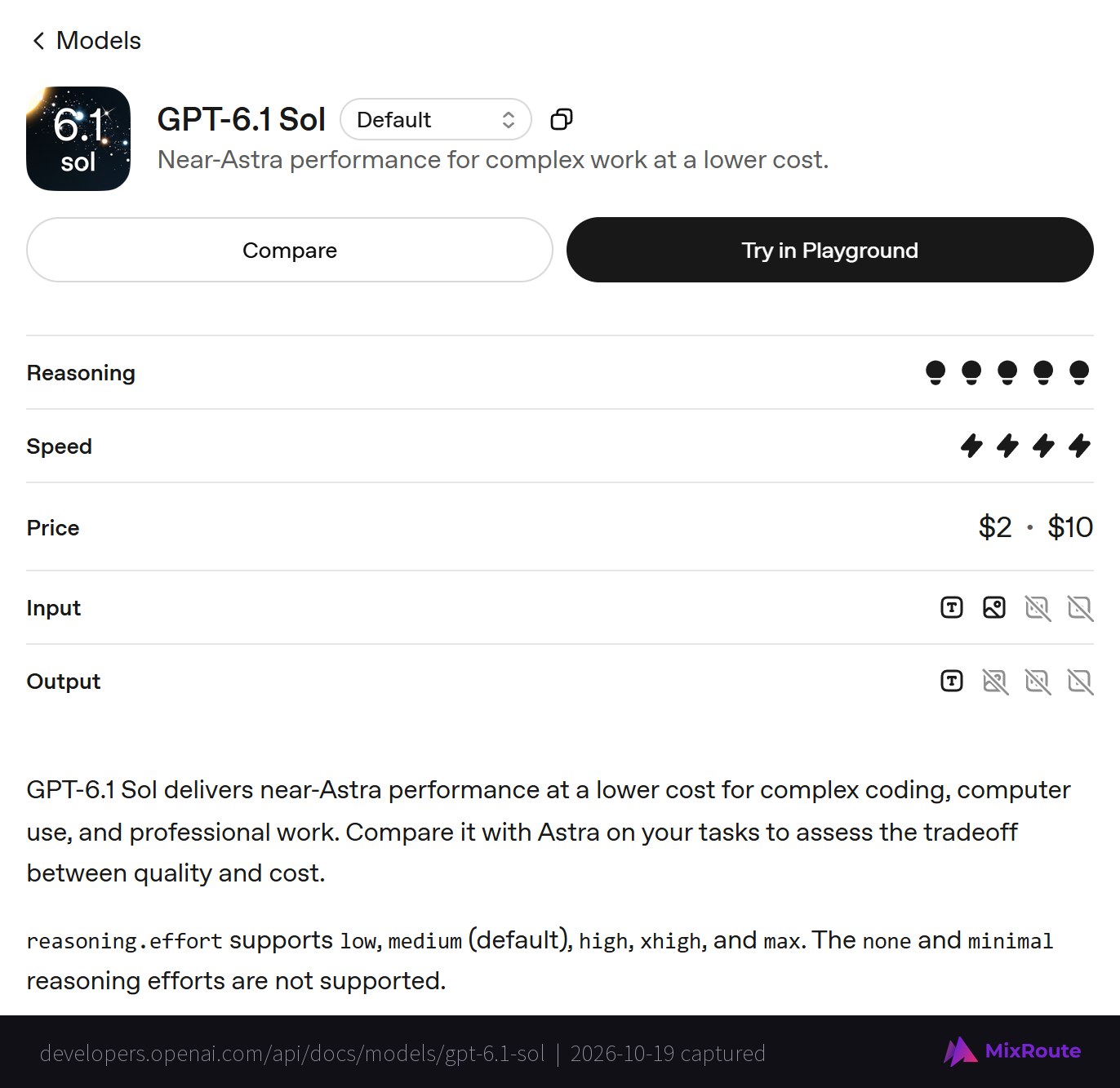
GPT-6.1 Sol costs $2 per 1M input tokens and $10 per 1M output tokens on OpenAI’s API, which is 60% below GPT-5.5’s input price and 67% below its output price. A coding-agent step with 100K input and 10K output tokens costs $0.30 on Sol and $0.80 on GPT-5.5. Four things move that number: a prompt above 272K input tokens reprices the whole request at $4 and $15, cached input drops to $0.10, Batch and Flex halve the rate, and Fast and Ultrafast charge 2x and 6x. All prices are as of October 19, 2026.
GPT-6.1 Sol price per 1M tokens, by processing mode
Standard processing is $2 input and $10 output, and every other mode is a multiplier on those two numbers. The table copies each mode from OpenAI’s pricing page. The three right-hand columns apply when a prompt has more than 272K input tokens.
| Mode | Input | Cached input | Output | Input above 272K | Cached above 272K | Output above 272K |
|---|---|---|---|---|---|---|
| Standard | $2.00 | $0.10 | $10.00 | $4.00 | $0.20 | $15.00 |
| Batch and Flex (0.5x) | $1.00 | $0.05 | $5.00 | $2.00 | $0.10 | $7.50 |
| Fast (2x) | $4.00 | $0.20 | $20.00 | $8.00 | $0.40 | $30.00 |
| Ultrafast (6x) | $12.00 | $0.60 | $60.00 | $24.00 | $1.20 | $90.00 |
Cache writes cost $2.50 per 1M tokens, which is 1.25x the input rate, and cached reads cost 5% of it. Regional processing adds 10% where it is available. Batch finishes within 24 hours, so it fits jobs nobody is waiting on. OpenAI describes Fast mode as up to 2.5x faster than Standard and Ultrafast as its fastest tier, for cases where speed justifies the price.
Sol sits below GPT-6 Astra, which OpenAI calls its most capable model, and above GPT-6 Luna. For how Sol’s price and benchmark scores compare with Claude Fable 5.1, see GPT-6.1 Sol vs Claude Fable 5.1.
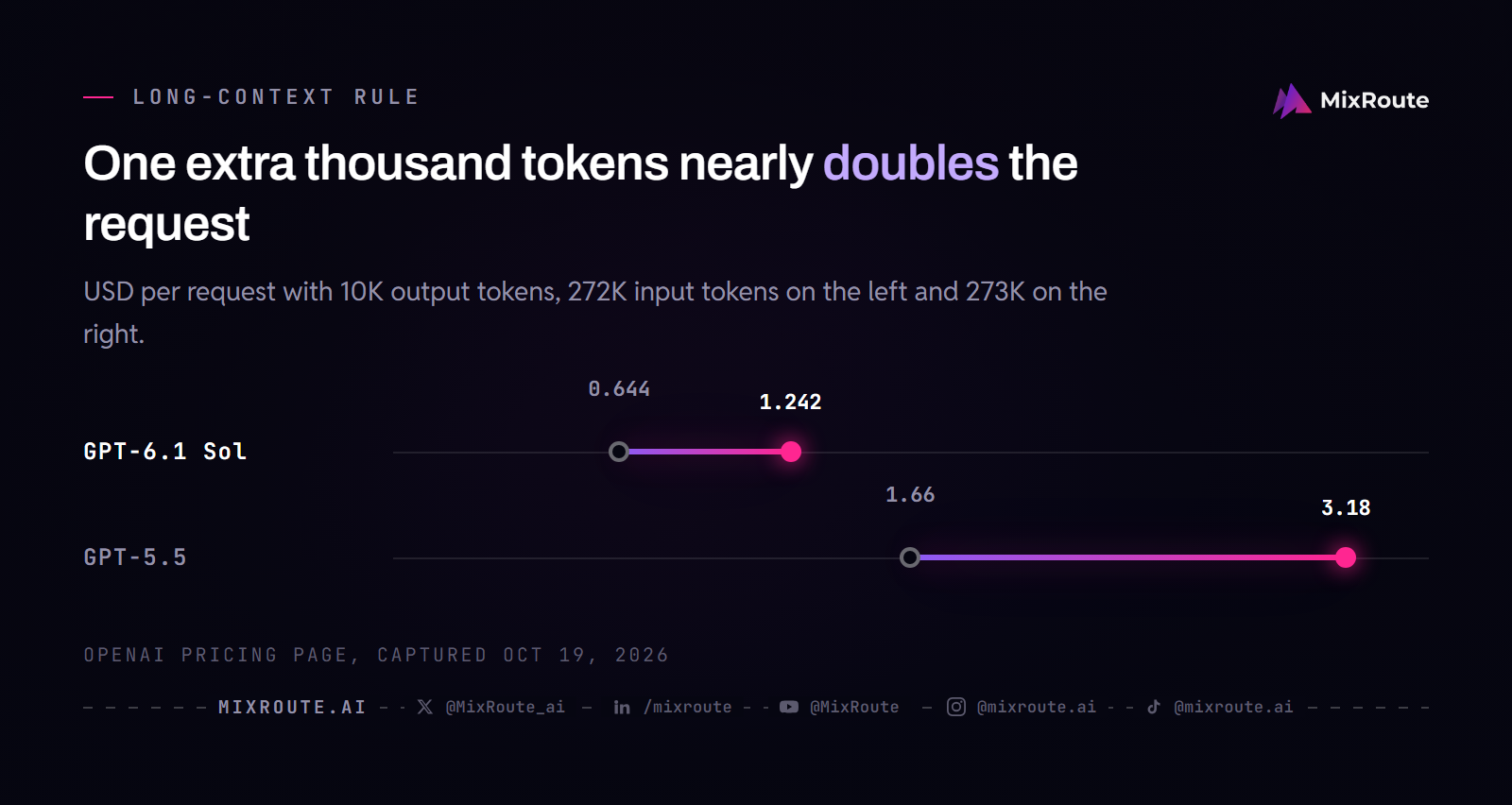
Why 273K input tokens cost 93% more than 272K
Once a prompt passes 272K input tokens, OpenAI prices the whole request at 2x the input and cache rates and 1.5x the output rate, so every token in the request pays the higher rate, not only the ones past the line. The table uses 10K output tokens, Standard processing and no caching.
| Input tokens | GPT-6.1 Sol | GPT-5.5 |
|---|---|---|
| 272,000 | 272K x $2 + 10K x $10 = $0.644 | 272K x $5 + 10K x $30 = $1.660 |
| 273,000 | 273K x $4 + 10K x $15 = $1.242 | 273K x $10 + 10K x $45 = $3.180 |
| 300,000 | 300K x $4 + 10K x $15 = $1.350 | 300K x $10 + 10K x $45 = $3.450 |
One extra thousand tokens raises Sol’s request by 93%. GPT-5.5 follows the same rule on its model page, and its request rises by 92% at the same line. A retrieval job that packs 300K tokens of documents into every call pays $1.35 on Sol. Trimmed to 270K tokens, the same job costs $0.64, a 53% cut for 10% fewer tokens, so it is worth checking whether the last 30K tokens of context change the answer.
Real cost per request: GPT-5.4 to GPT-6.1 Sol
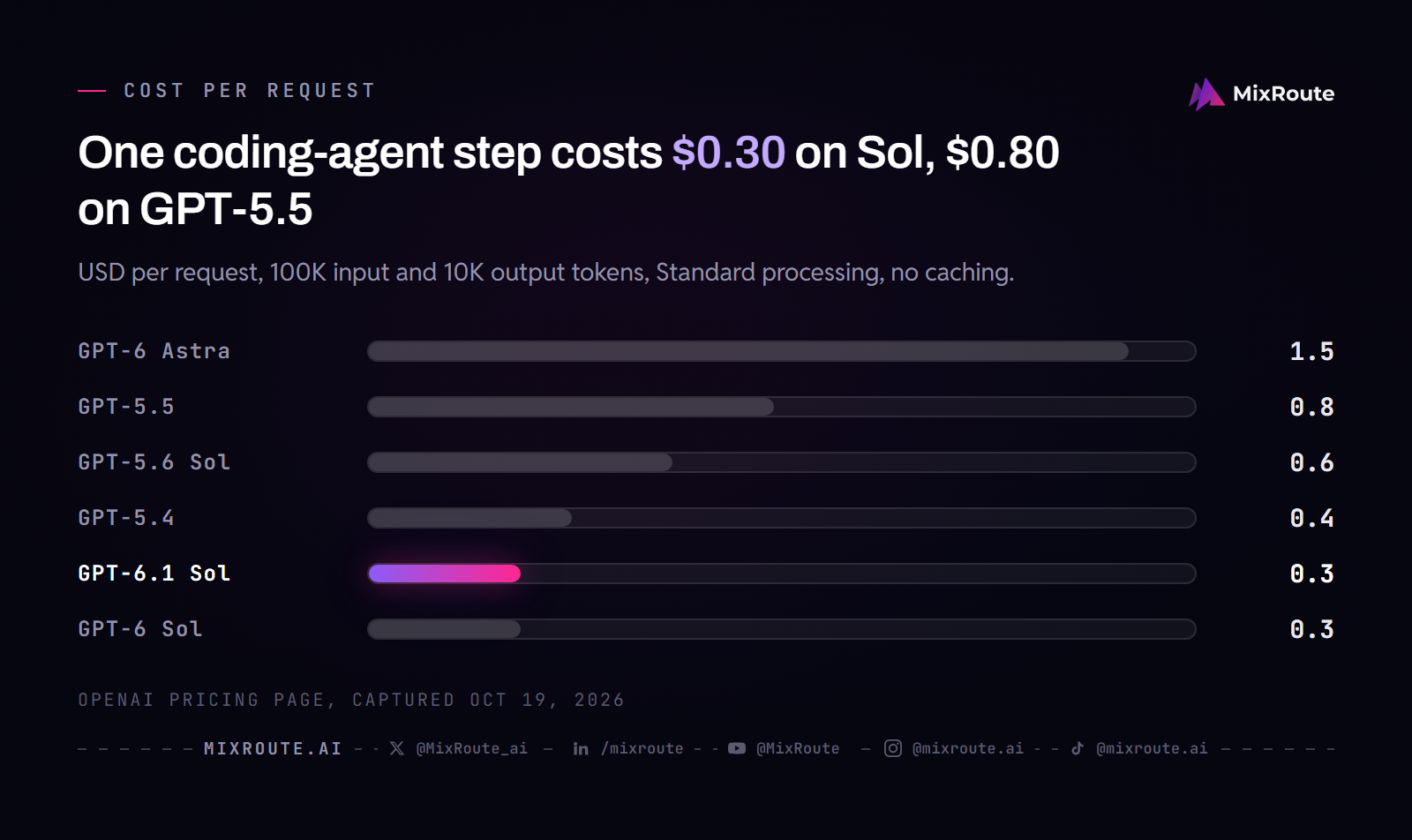
On the same request, GPT-6.1 Sol costs 61% to 65% less than GPT-5.5, half of GPT-5.6 Sol and one fifth of GPT-6 Astra. The cost table below prices three request shapes:
- Support chat: 2,000 input and 800 output tokens, the size of a short conversation turn.
- Coding-agent step: 100,000 input and 10,000 output tokens, an agent that re-reads a repo summary on every step.
- Document job: 300,000 input and 10,000 output tokens, a retrieval call that crosses the 272K line.
These are the list prices behind it, per 1M tokens on Standard processing, from OpenAI’s pricing page:
| Model | Input | Cached input | Output | Input above 272K | Output above 272K |
|---|---|---|---|---|---|
| GPT-5.4 | $2.50 | $0.25 | $15.00 | $5.00 | $22.50 |
| GPT-5.5 | $5.00 | $0.50 | $30.00 | $10.00 | $45.00 |
| GPT-5.6 Sol | $4.00 | $0.40 | $20.00 | $8.00 | $30.00 |
| GPT-6 Sol | $2.00 | $0.20 | $10.00 | $4.00 | $15.00 |
| GPT-6.1 Sol | $2.00 | $0.10 | $10.00 | $4.00 | $15.00 |
| GPT-6 Astra | $10.00 | $1.00 | $50.00 | $20.00 | $75.00 |
| GPT-6 Luna | $0.10 | $0.01 | $0.50 | $0.20 | $0.75 |
And this is what one request costs on each model:
| Model | Support chat (2K in, 0.8K out) | Coding-agent step (100K in, 10K out) | Document job (300K in, 10K out) |
|---|---|---|---|
| GPT-5.4 | $0.017 | $0.40 | $1.73 |
| GPT-5.5 | $0.034 | $0.80 | $3.45 |
| GPT-5.6 Sol | $0.024 | $0.60 | $2.70 |
| GPT-6 Sol | $0.012 | $0.30 | $1.35 |
| GPT-6.1 Sol | $0.012 | $0.30 | $1.35 |
| GPT-6 Astra | $0.060 | $1.50 | $6.75 |
| GPT-6 Luna | $0.0006 | $0.015 | $0.07 |
Assumptions: each cost is input tokens times the input rate plus output tokens times the output rate, with the above-272K rates on the 300K request. Processing is Standard, nothing is cached, and tool fees are left out. Output counts every token the model generates, because MixRoute’s GPT-6.1 Sol page states that reasoning tokens are billed as output. These are calculations from list prices, not measured bills.
GPT-6.1 Sol and GPT-6 Sol list at the same $2 and $10, so the only price difference between them is cached input, $0.10 against $0.20. GPT-5.6 Sol’s $4 and $20 is promotional through at least November 21, 2026, so that row can change. GPT-6 Luna runs the 100K step for $0.015, but OpenAI positions it as its most efficient model for focused, high-volume tasks, so test whether your task holds up on it before you count the saving.
Price per token is half the bill. The other half is how many tokens a model spends on a task. Artificial Analysis prices GPT-6.1 Sol at $0.13 per Intelligence Index task at low effort and $0.72 at max, so one setting moves the cost 5.5x. Sol’s default is medium, and none and minimal are not accepted, so low is the cheapest setting. OpenAI’s developer community post reports about 76% lower cost per task than GPT-6 Sol on DeepSWE v1.1, with Sol at high effort against GPT-6 Sol at max. That is a vendor claim comparing two OpenAI models, so check it on your own prompts.
Cached input, Batch and Fast on the same request
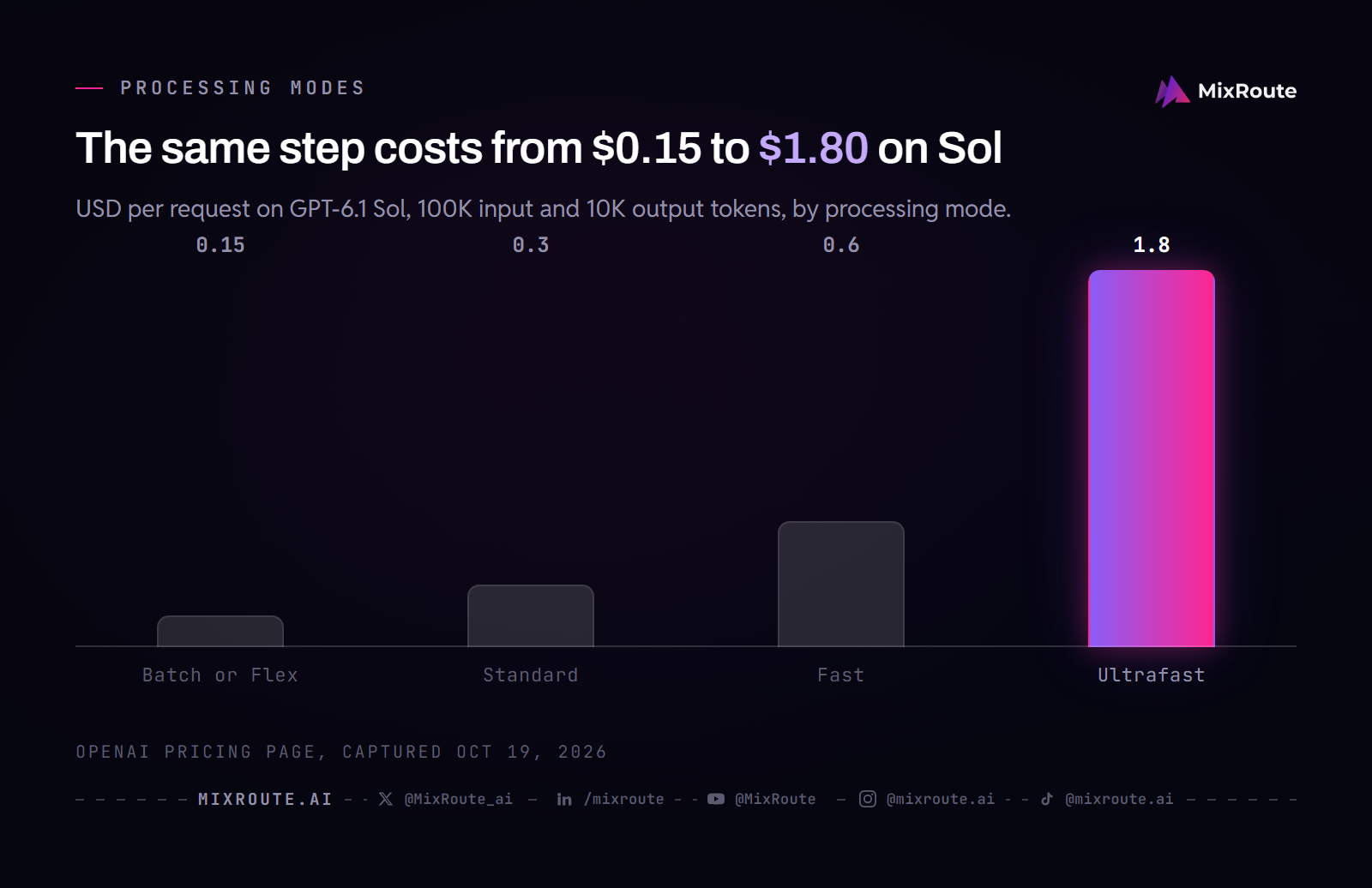
On the 100K-input, 10K-output step, caching 90K of the input takes Sol from $0.30 to $0.129, Batch halves it to $0.15, Fast doubles it to $0.60 and Ultrafast sextuples it to $1.80. The table adds GPT-5.5 for the same request.
| Same coding-agent step | GPT-6.1 Sol | GPT-5.5 |
|---|---|---|
| Standard | $0.30 | $0.80 |
| 90K of the input read from cache | $0.129 | $0.395 |
| Batch or Flex | $0.15 | $0.40 |
| Fast | $0.60 | $2.00 |
| Ultrafast | $1.80 | Not listed |
Output is what stays expensive. At 10K output tokens, $0.10 of the cached request’s $0.129 is output, about 78%, so a bigger cache discount helps less than a shorter answer does. The first request that writes the 90K prefix costs $0.345 on Sol, 15% above the uncached $0.30. A prefix written once and read once costs 1.30x its ordinary input price on Sol against 2x uncached, so the cache pays for itself on the first reuse. Prefixes shorter than 1,024 tokens are not cached. GPT-5.5 lists no cache-write charge, and its Fast mode is 2.5x Standard where Sol’s is 2x. The prompt caching guide covers how write costs and minimums differ by vendor.
What changed since GPT-5.5
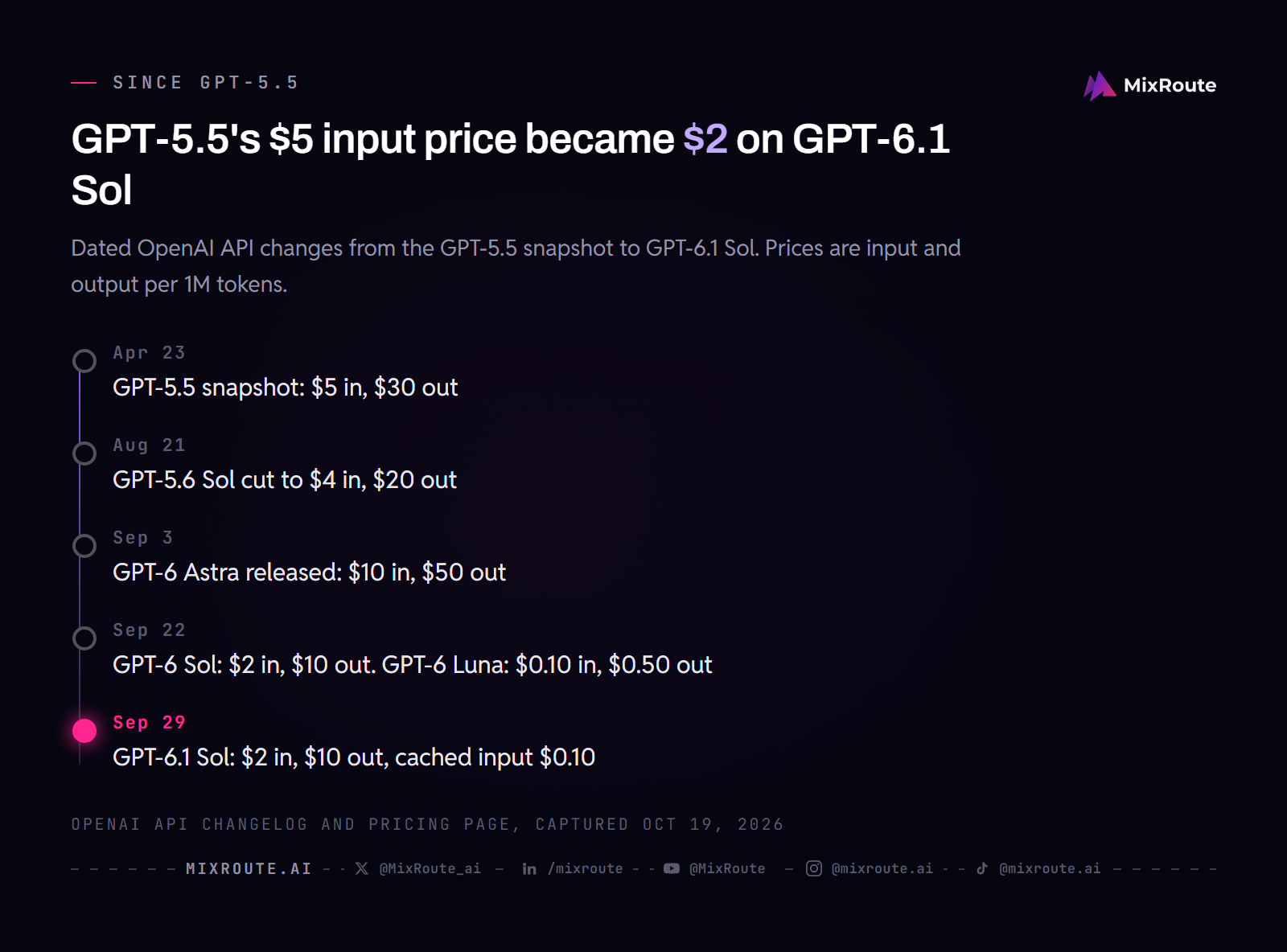
GPT-5.5 is no longer OpenAI’s reference model: the GPT-5.6 family followed it, then four GPT-6 tiers in September, and OpenAI’s Codex models page names GPT-6.1 Sol as the replacement on paid plans. The list below is what moved.
- GPT-5.5 (snapshot
gpt-5.5-2026-04-23) stays in the API at $5 input and $30 output. It retired from Codex for ChatGPT sign-in on October 14, 2026, and API-key sessions are not affected. - GPT-5.6 Sol got a 20% input and 33% output price cut on August 21, to $4 and $20, below GPT-5.5’s $5 and $30. OpenAI says the promotional price runs through at least November 21, 2026.
- GPT-6 Astra arrived September 3 at $10 and $50.
- GPT-6 Sol and GPT-6 Luna arrived September 22, Sol at $2 and $10 and Luna at $0.10 and $0.50.
- GPT-6.1 Sol arrived September 29 at the same $2 and $10 as GPT-6 Sol, with cached input halved to $0.10 and a knowledge cutoff of April 30, 2026.
Two request settings break when you only change the model ID. GPT-5.5 accepts reasoning.effort set to none, and GPT-6.1 Sol starts at low. On Sol, tool calling needs the Responses API, and Chat Completions works only without tools. Both rules come from OpenAI’s GPT-6.1 Sol page.
What MixRoute’s logs showed when GPT-5.5 doubled the price
GPT-5.5 doubled GPT-5.4’s price, from $2.50 and $15 to $5 and $30, and MixRoute’s request logs showed that bills rose between 49% and 92% per million tokens. Shorter completions absorbed part of the increase, but only on long prompts. The cohort was users whose most-used model was GPT-5.4 before launch and GPT-5.5 after, with the same workflows on both. Both models share a tokenizer family, so no normalization was needed.
| Prompt size | Median completion, GPT-5.4 to GPT-5.5 | Change in cost per 1M tokens |
|---|---|---|
| Under 2K | 121 to 129 (+7%) | +92% |
| 2K to 10K | 140 to 213 (+52%) | +69% |
| 10K to 25K | 211 to 143 (-32%) | +51% |
| 25K to 50K | 185 to 150 (-19%) | +62% |
| 50K to 128K | 188 to 136 (-28%) | +49% |
| 128K+ | 215 to 143 (-34%) | +85% |
Above 10K input tokens, GPT-5.5 produced 19% to 34% fewer output tokens, and the 2K to 10K bucket became 52% more verbose. Prompts under 2K tokens took +92%, prompts from 10K to 128K took +49% to +62%, and the 128K+ bucket rose 85%. The lesson carries to a swap to GPT-6.1 Sol: the list price is only the starting point, and token counts decide what changes. This measurement covers GPT-5.4 to GPT-5.5 only and has not been repeated for Sol.
- Source: MixRoute request logs
- Windows: GPT-5.4 from April 21 to 23, 2026. GPT-5.5 from April 25 to 28, 2026 (launch day excluded)
- Sample: Text-only, non-cancelled requests
- Normalization: Cost per million MixRoute tokens, bucketed by prompt size
- Excluded: Media requests, cancelled requests, zero-token requests
Estimate your own bill before you switch
Take a day of real requests, count input, cached and output tokens, and run them through the rates above. This function applies the above-272K rule and the cached-input rate:
RATES = {  # USD per 1M tokens: input, cached, output, then the same three above 272K
    "gpt-5.5":     (5.00, 0.50, 30.00, 10.00, 1.00, 45.00),
    "gpt-6.1-sol": (2.00, 0.10, 10.00,  4.00, 0.20, 15.00),
    "gpt-6-luna":  (0.10, 0.01,  0.50,  0.20, 0.02,  0.75),
}

def request_cost(model, input_tokens, output_tokens, cached_tokens=0):
    r = RATES[model]
    i, c, o = r[3:] if input_tokens > 272_000 else r[:3]
    fresh = input_tokens - cached_tokens
    return (fresh * i + cached_tokens * c + output_tokens * o) / 1_000_000

print(round(request_cost("gpt-6.1-sol", 100_000, 10_000), 3))                       # 0.3
print(round(request_cost("gpt-6.1-sol", 100_000, 10_000, cached_tokens=90_000), 3)) # 0.129
print(round(request_cost("gpt-5.5", 300_000, 10_000), 3))                           # 3.45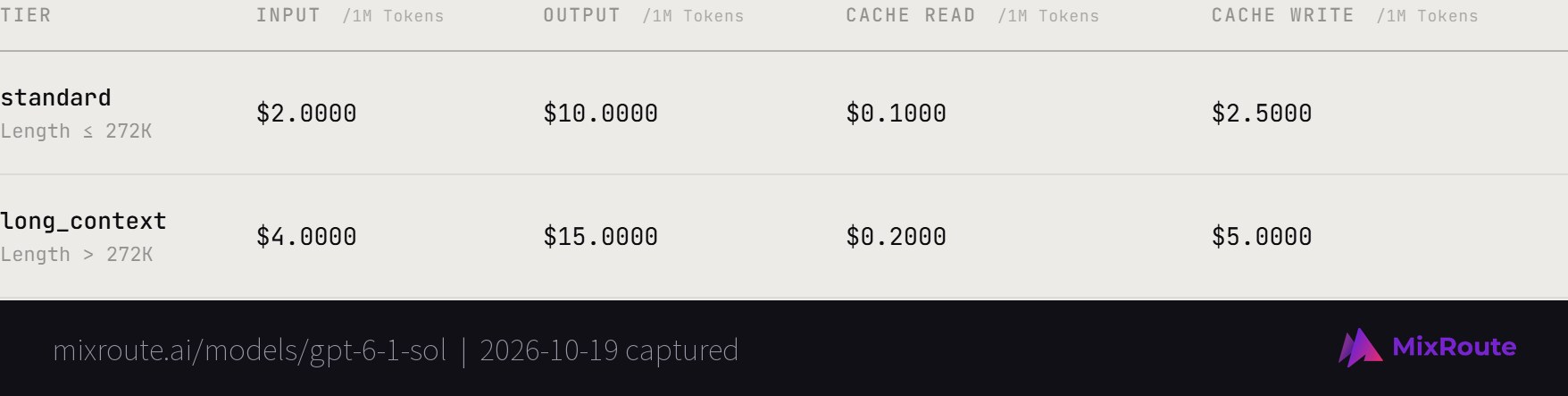
MixRoute’s GPT-6.1 Sol, GPT-5.5 and GPT-6 Luna pages list the same standard and above-272K prices as OpenAI, including Sol’s $0.10 cache read and $2.50 cache write. One key and one OpenAI-compatible base URL, https://api.mixroute.ai/v1, reach all three, and switching between them means changing the model ID. Those pages list two tiers, standard and above 272K, so treat the Batch, Flex, Fast and Ultrafast prices in this article as OpenAI API tiers and read a model’s MixRoute page before budgeting around one. For the wider method, see how to estimate LLM API cost before production.
FAQ
How much does GPT-6.1 Sol cost? On Standard processing it costs $2 per 1M input tokens, $0.10 per 1M cached input tokens and $10 per 1M output tokens, which is $0.002 per 1,000 input tokens and $0.01 per 1,000 output tokens. Prompts above 272K input tokens pay $4 and $15 for the whole request. Cache writes cost $2.50 per 1M tokens, and regional processing adds 10% where available.
Is GPT-6.1 Sol cheaper than GPT-5.5? Yes, per token and on every request shape in the cost table, by 61% to 65%. Cached input is 80% cheaper too, $0.10 against $0.50. The advantage can reverse only if Sol generates far more tokens: on the 100K-input step it would need 60,000 output tokens, six times as many as the 10,000 assumed, to match GPT-5.5’s $0.80.
How much more does GPT-5.5 cost than GPT-5.4? It costs exactly double: $5 input and $30 output per 1M tokens against $2.50 and $15, and $0.50 against $0.25 for cached input. In MixRoute’s April 2026 logs the real increase per million tokens was 49% to 92%, because GPT-5.5 wrote shorter completions on prompts above 10K tokens. Both models reprice requests above 272K input tokens at 2x input and 1.5x output.
Is GPT-5.5 cheaper than GPT-5.6? No. All three GPT-5.6 tiers list below it. GPT-5.6 Sol lists at $4 and $20 per 1M tokens, Terra at $2 and $12, and Luna at $0.20 and $1.20, all below GPT-5.5’s $5 and $30. The Sol price is promotional through at least November 21, 2026. On the 100K-input step that is $0.60 for 5.6 Sol, $0.32 for Terra and $0.032 for Luna, against $0.80 for GPT-5.5.
Is Batch or Flex worth using for GPT-6.1 Sol? Yes for work that can wait. Batch and Flex both list 50% below Standard, $1 input and $5 output, and a Batch job completes within 24 hours. The coding-agent step drops from $0.30 to $0.15, and the above-272K rates halve too, to $2 and $7.50. Skip them for anything a user is waiting on.
Can I call GPT-6.1 Sol through MixRoute? Yes. Point an OpenAI-compatible client at https://api.mixroute.ai/v1 and set the model to gpt-6.1-sol. MixRoute’s page lists tool calling as supported, and OpenAI requires the Responses API for tools on its own endpoint, so send a tool-calling request down the exact route you plan to use before you move production traffic.