GLM-5.3 vs Opus 5.5 vs Fable 5.1: Which One Should You Actually Run?
Run Claude Opus 5.5 as the default. On Artificial Analysis, Opus 5.5 at medium effort scores 51 on its Intelligence Index for $1.34 per task, while GLM-5.3 at max effort scores 45 for $2.01 and Claude Fable 5.1 at max effort scores 53 for $7.63. GLM-5.3 earns a slot when you need weights you can host or high-volume text-only work, where it costs about a third of Opus 5.5 at max effort. Test Fable 5.1 only if Opus 5.5 at high effort fails your own evals. All three sit behind one MixRoute endpoint, so switching means changing the model ID.
GLM-5.3 vs Opus 5.5 vs Fable 5.1 at a glance
Opus 5.5 scores highest on every benchmark in the table, GLM-5.3 has the lowest token prices and the only downloadable weights, and Fable 5.1 is the most expensive of the three. Prices and specs come from Z.ai’s pricing page, Anthropic’s Opus 5.5 page and Fable 5.1 page, and MixRoute’s model pages.
| GLM-5.3 | Claude Opus 5.5 | Claude Fable 5.1 | |
|---|---|---|---|
| Maker | Z.ai | Anthropic | Anthropic |
| Released | Aug 18, 2026 | Sep 22, 2026 | Sep 1, 2026 |
| MixRoute model ID | glm-5.3 | claude-opus-5-5 | claude-fable-5-1 |
| Weights | Open (GLM-5.3 License) | Proprietary | Proprietary |
| Context window | 1M tokens | 1M tokens | 1M tokens |
| Max output | 128K tokens | 128K tokens | 128K tokens |
| Image input | No, text only | Yes | Yes |
| Input per 1M tokens | $1.40 | $4 | $10 |
| Output per 1M tokens | $4.40 | $20 | $50 |
| Cache read per 1M tokens | $0.26 | $0.20 | $0.25 |
| Terminal-Bench 4.0 (tbench.ai, max effort) | 41.8% | 64.8% | 57.9% |
| Intelligence Index (Artificial Analysis, max effort) | 45 | 58 | 53 |
| Cost per Index task (Artificial Analysis, max effort) | $2.01 | $5.98 | $7.63 |
The benchmark rows were captured on October 19, 2026 and the labs run different harnesses, so compare the size of the gaps rather than the decimals.
Benchmarks: Opus 5.5 leads and GLM-5.3 trails by about 23 points
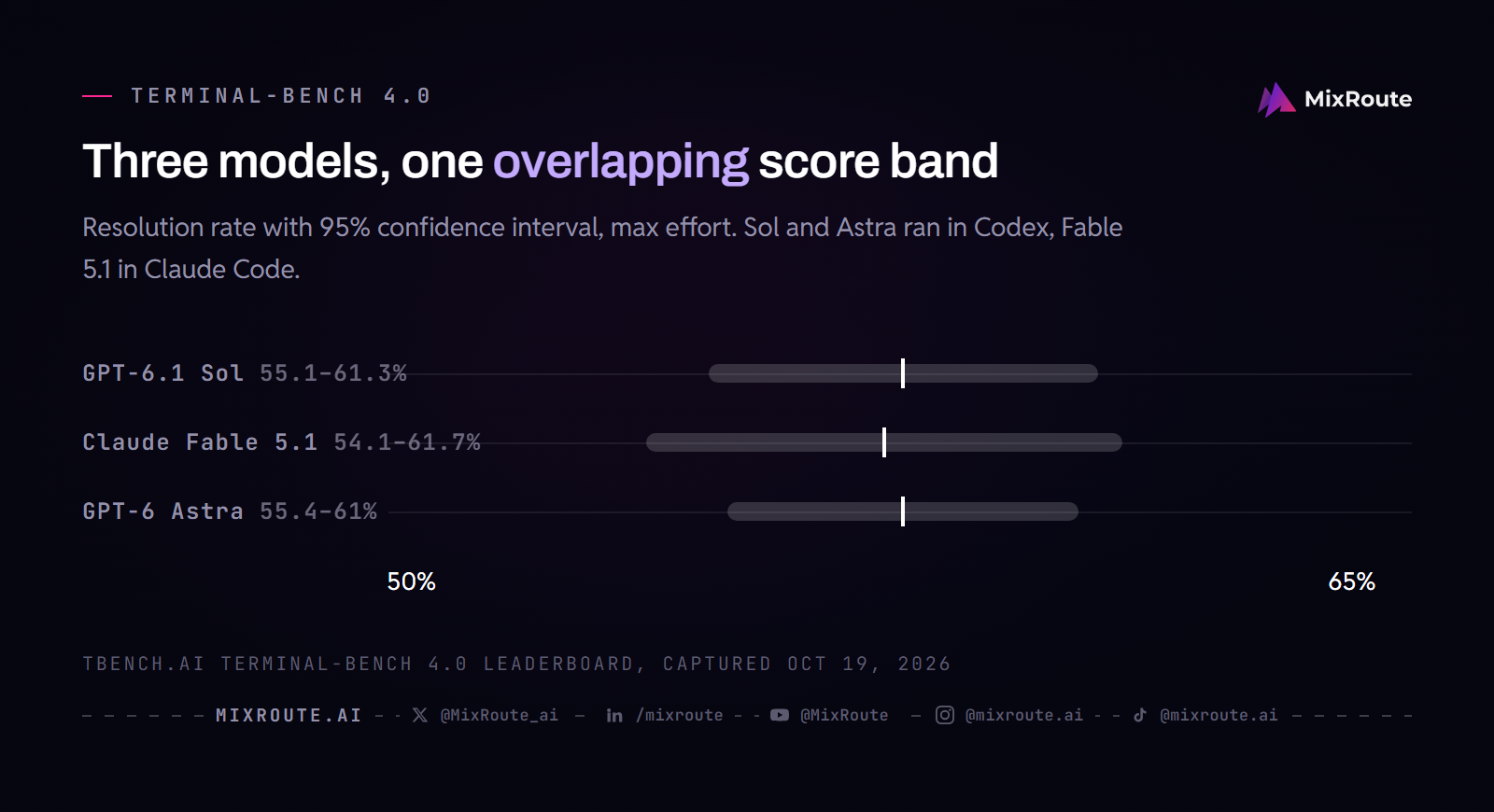
On the tbench.ai Terminal-Bench 4.0 leaderboard, run at max effort in Claude Code, Opus 5.5 resolves 64.8% of tasks, Fable 5.1 57.9% and GLM-5.3 41.8%. The 95% intervals of the two Claude models only touch, and GLM-5.3’s interval (38.6% to 45.0%) sits clear of both.
Artificial Analysis reproduces the order. At max effort its Intelligence Index (version 4.3.2, ten evaluations) puts Opus 5.5 at 58, Fable 5.1 at 53 and GLM-5.3 at 45, and its own Terminal-Bench 4.0 run gives 59.6%, 52.0% and 41.9%.
Anthropic’s Opus 5.5 launch post agrees on direction. It lists Opus 5.5 ahead of Fable 5.1 on Terminal-Bench 4.0 (66.4% against 55.8%, with Opus 5.5 reported at xhigh effort), FrontierCode v1.1 (54.4% against 50.3%) and CursorBench 4.0 (57.8% against 51.8%), then adds that in its own use the gap between the two is narrower than those scores suggest.
Z.ai’s charts look better for GLM-5.3 only because they use older opponents. Its GLM-5.3 page and Hugging Face model card compare against Opus 4.8, Fable 5 and GPT-5.6 Sol, and on its private Z.ai Code Bench GLM-5.3 reaches 34.5% at max effort while Z.ai says Fable 5 stays ahead at 39.5%. None of those opponents is the model you can buy today.
A small hands-on test points the same way. In KingBench 4 (published October 10, 2026), five models each built six apps under a 60-minute limit. Opus 5.5 won the emulator, keyboard configurator and room designer, while GLM 5.3 scored 0.6 out of 10 on the emulator and 7.8 on the room designer against Opus 5.5’s 8.5. Fable 5.1 was not in that test, and 30 builds is a small sample.
Cost per task: GLM-5.3 is cheaper per token, not always per task
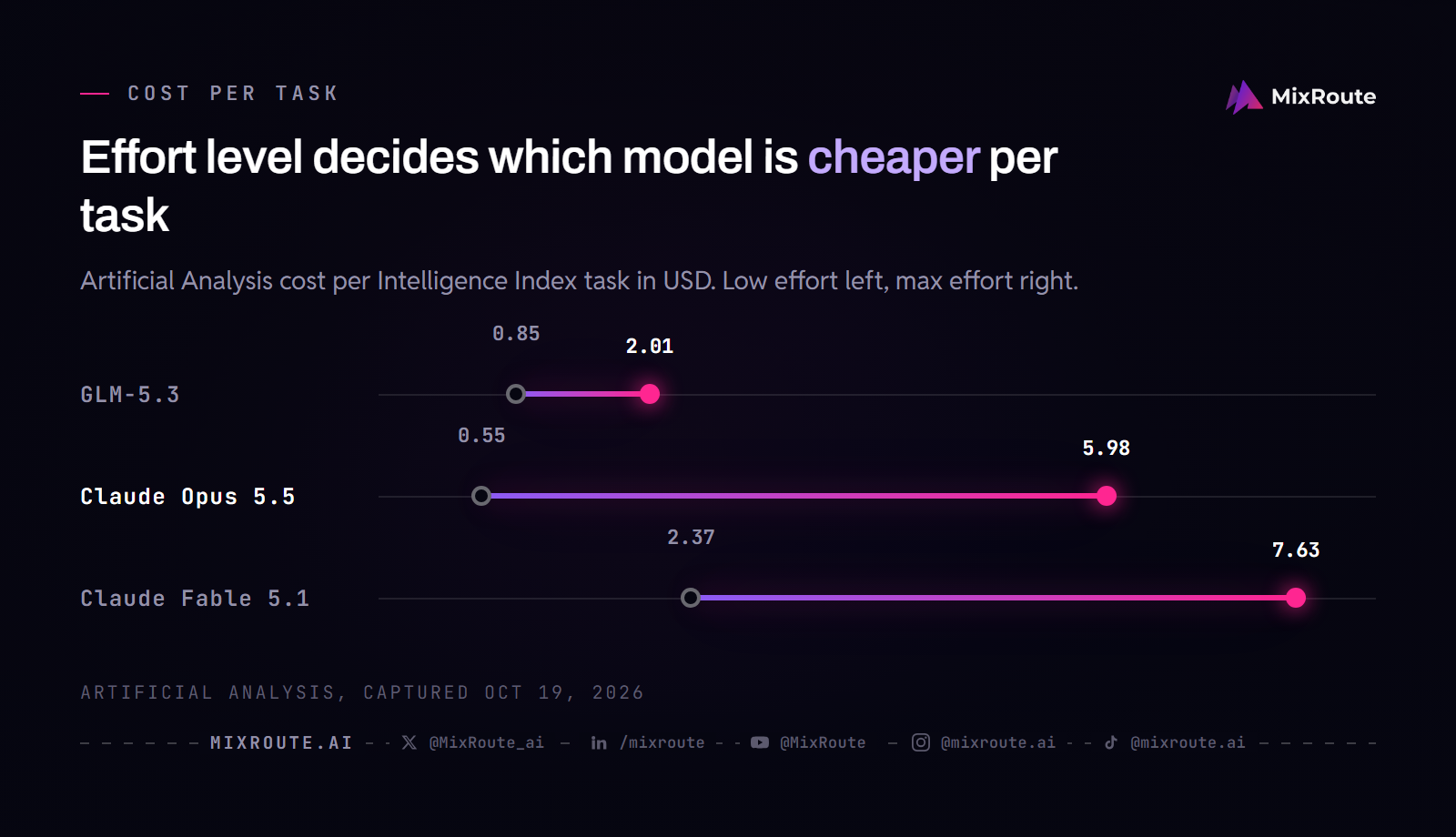
GLM-5.3 charges about 2.9 times less than Opus 5.5 for input and about 4.5 times less for output, but the bill follows tokens used per task and the effort level you pick, not the price list. Artificial Analysis prices the same set of Intelligence Index tasks at several effort levels:
| Model and effort | Intelligence Index | Cost per task |
|---|---|---|
| Claude Opus 5.5, max | 58 | $5.98 |
| Claude Opus 5.5, high | 54 | $1.82 |
| Claude Opus 5.5, medium | 51 | $1.34 |
| Claude Opus 5.5, low | 42 | $0.55 |
| Claude Fable 5.1, max | 53 | $7.63 |
| Claude Fable 5.1, low | 47 | $2.37 |
| GLM-5.3, max | 45 | $2.01 |
| GLM-5.3, low | 34 | $0.85 |
Opus 5.5 at medium effort (51 for $1.34) beats GLM-5.3 at max effort (45 for $2.01) on both counts. At low effort Opus 5.5 costs $0.55 against $0.85 for GLM-5.3 and scores higher, 42 against 34. GLM-5.3 comes out cheaper only against Opus 5.5 at max effort ($2.01 against $5.98) and against Fable 5.1 at every effort level. Fable 5.1 at max effort scores 53 for $7.63, while Opus 5.5 at high effort scores 54 for $1.82.
Caching adds a second wrinkle. Anthropic notes that cache reads make up most of the cost of agentic and coding work, and Opus 5.5 charges $0.20 per 1M cached tokens against $0.26 for GLM-5.3. An agent that re-reads the same repository on every step pays less per cached token on Opus 5.5. Artificial Analysis averages across general tasks rather than coding alone, so run your own workload at two effort levels before you commit to either model.
GLM-5.3: the open-weight option
GLM-5.3 is the model to run when you need weights you can host yourself, or when text-only work at max effort needs the lowest bill. Z.ai built it on the same base model as GLM-5.2 and says every gain comes from post-training. It has 753 billion parameters with 40 billion active per token, a 1M-token context window, 128K output, and text-only input. Reasoning is always on, with low, high and max effort and max as the default. On Z.ai Code Bench it reaches 34.5% at about 75K output tokens per task, against 23.4% at 96K for GLM-5.2.
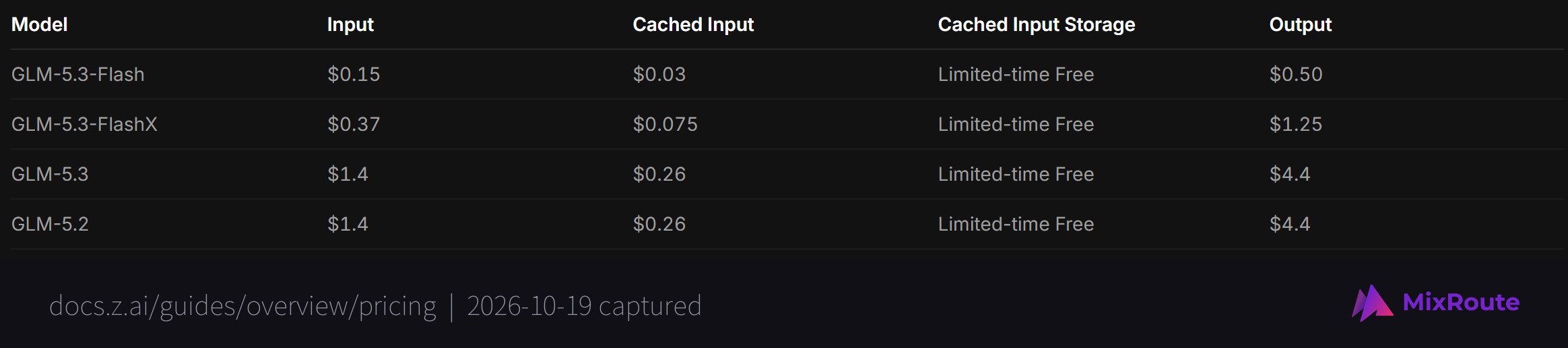
The weights are on Hugging Face under the GLM-5.3 License. It grants broad rights to use, modify and sell the software, with one condition: a company that runs a model-as-a-service business and earns more than 10 billion USD over 12 months must pass a Z.ai security review first. The FP8 files total about 756 GB, so self-hosting means a multi-GPU server. Z.ai also sells GLM-5.3-Flash at $0.15 input and $0.50 output per 1M tokens, and this comparison does not rate its quality.
If your code sends thinking.type: "disabled" to an earlier GLM model, change it to enabled and set reasoning_effort to low before you switch the model ID to glm-5.3, or the request fails.
Run GLM-5.3 when you need open weights, or the work is text and code at high volume and a 23-point gap on Terminal-Bench 4.0 is acceptable.
Claude Opus 5.5: the default
Opus 5.5 is the model to start with: Anthropic’s model overview tells most workloads to begin there, and it costs less than the Fable tier above it. It launched on September 22, 2026 at $4 input and $20 output per 1M tokens, 20% below Opus 5, with a 1M-token context window, 128K output and text and image input. Its default effort is medium. Fast mode costs $8 and $40 per 1M tokens and runs up to 2.5 times faster in Claude Code and on the Claude Platform. At max effort Artificial Analysis measures 97.8 output tokens per second for Opus 5.5, against 68.2 for Fable 5.1 and 95.3 for GLM-5.3.
Anthropic’s own long-job test makes the Fable comparison concrete. It asked both models to translate HAProxy from C to Rust, and both rewrites passed nearly all of HAProxy’s regression tests, but Opus 5.5 finished in 9.5 hours against 12 for Fable 5.1 and cost 51% less. Code that already runs on Opus 5 needs two changes: thinking cannot be turned off, and forced tool use returns an error.
Run Opus 5.5 when you ship every day, need image input, or want the strongest score per dollar of the three.
Claude Fable 5.1: the premium tier to test, not start with
Fable 5.1 costs 2.5 times Opus 5.5 per token and scored lower on every benchmark above, so it earns a place only when Opus 5.5 at high effort falls short on your own tasks. Anthropic says the same: use Fable 5.1 for demanding reasoning and long-horizon agentic work, or when your evals on Opus 5.5 at higher effort still fall short. It was released on September 1, 2026 at $10 input and $50 output per 1M tokens, the same as Fable 5, with cache reads at $0.25. The Opus 5.5 breaking changes above apply to Fable 5.1 as well.
For how Fable 5.1 compares with OpenAI’s cheaper flagship, see GPT-6.1 Sol vs Claude Fable 5.1.
Run Fable 5.1 when a hard, long-horizon task fails on Opus 5.5 at high effort and the extra cost per task is worth a retry on the larger model.
So which should you actually run?
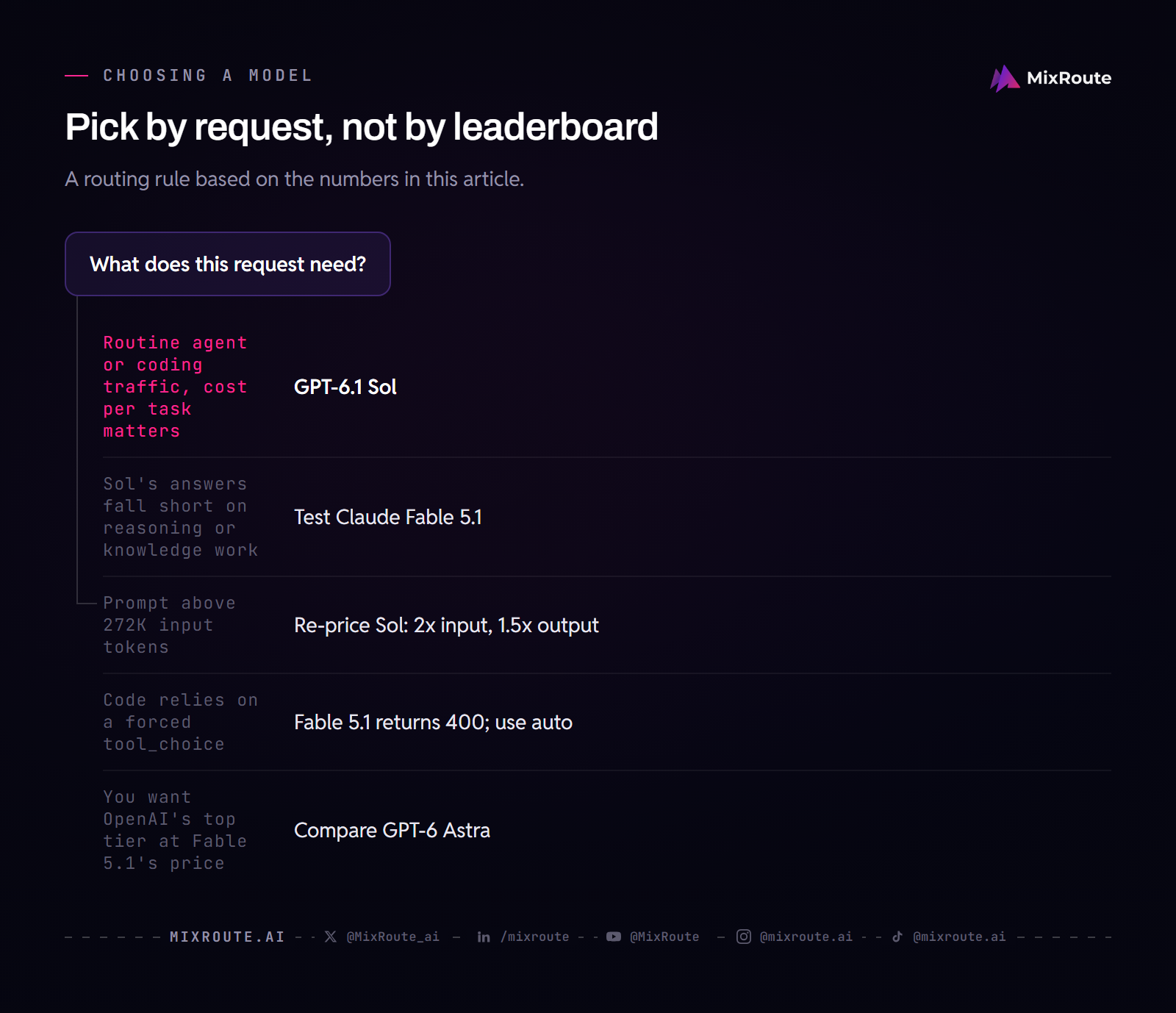
Run Opus 5.5 unless one of the conditions in the chart applies. Because the three models are one model ID apart, you can split traffic: Opus 5.5 on the default path, GLM-5.3 for bulk text work or self-hosted deployments, and Fable 5.1 for the cases Opus 5.5 cannot solve.
Run all three through one API
MixRoute lists GLM-5.3, Claude Opus 5.5 and Claude Fable 5.1 behind one OpenAI-compatible base URL, so switching models means changing the model ID. The model pages list $1.40 and $4.40, $4 and $20, and $10 and $50 per 1M tokens.
from openai import OpenAI

client = OpenAI(
    api_key="YOUR_MIXROUTE_KEY",
    base_url="https://api.mixroute.ai/v1",
)

def ask(model, prompt):
    resp = client.chat.completions.create(
        model=model,
        messages=[{"role": "user", "content": prompt}],
    )
    return resp.choices[0].message.content

# Default path
ask("claude-opus-5-5", "Refactor this module and explain the diff: ...")

# Bulk text work
ask("glm-5.3", "Write unit tests for these 40 functions: ...")

# Escalate the hard case
ask("claude-fable-5-1", "Find the race condition in this scheduler: ...")
Opus 5.5 and Fable 5.1 are also reachable through MixRoute’s Anthropic-compatible /v1/messages endpoint. Send a tool-calling request down the exact route you plan to use before you move production traffic. For choosing a gateway when model access changes, see AI API gateway options when model access changes, and for a wider coding shortlist see which LLM to use for coding.
What changed since GLM 5.2 vs Opus 4.8 vs Fable 5
All three models were replaced, and the Fable 5 suspension that framed the earlier comparison is over. If you arrived from that version, this table shows what moved.
| Earlier comparison | This comparison | |
|---|---|---|
| GLM | GLM 5.2, $1.40 in and $4.40 out | GLM-5.3, released Aug 18, 2026, same prices, same base model, reasoning cannot be disabled |
| Opus | Opus 4.8, $5 in and $25 out | Opus 5.5, released Sep 22, 2026, $4 in and $20 out |
| Fable | Fable 5, $10 in and $50 out, suspended from Jun 12, 2026 | Fable 5.1, released Sep 1, 2026, $10 in and $50 out, cache read $0.25 |
| Fable on Terminal-Bench 4.0 (tbench.ai) | Fable 5: 44.5% | Fable 5.1: 57.9% |
On June 12, 2026 the US government applied export controls to Fable 5 and Mythos 5, and Anthropic suspended both for all users. The controls were lifted on June 30, and Anthropic restored access on July 1, 2026. That outage is the reason to keep a second model one model ID away.
FAQ
Is GLM-5.3 better than Opus 5.5 for coding? No. On tbench.ai’s Terminal-Bench 4.0, Opus 5.5 resolves 64.8% of tasks and GLM-5.3 resolves 41.8%, and Artificial Analysis shows the same order at 59.6% against 41.9%. GLM-5.3 is the stronger pick only when you need downloadable weights or the lowest bill on text-only work at max effort. Run your own repository’s tasks through both before you move traffic.
How much cheaper is GLM-5.3 than Opus 5.5? Per token, about 2.9 times cheaper on input ($1.40 against $4) and about 4.5 times on output ($4.40 against $20). Per task, Artificial Analysis puts GLM-5.3 at max effort at $2.01 against $5.98 for Opus 5.5 at max, yet Opus 5.5 at medium effort scores higher (51 against 45) for $1.34. Cache reads run the other way, at $0.26 for GLM-5.3 and $0.20 for Opus 5.5.
Is Claude Fable 5 still suspended? No. The US export controls on Fable 5 and Mythos 5 were lifted on June 30, 2026, and Anthropic restored access on July 1. The current model is Fable 5.1, released September 1, 2026 at the same $10 and $50 per 1M token prices, and it is generally available on the Claude API, Amazon Bedrock, Google Cloud, Microsoft Foundry and Claude Platform on AWS.
Is there a Fable 5.2? Not as of October 19, 2026. Anthropic’s model overview and MixRoute’s model catalog both list Fable 5.1 as the latest Fable and show no 5.2. If you are weighing Opus 5.5 against the next Fable, the model to evaluate is Fable 5.1.
Does GLM-5.3 accept images? No. Z.ai lists GLM-5.3 as text input and text output only. Claude Opus 5.5 and Claude Fable 5.1 both accept text and images, so screenshots, charts and scanned documents need one of the two.
Can I self-host GLM-5.3? Yes. Z.ai publishes the weights on Hugging Face under the GLM-5.3 License, and the model card lists SGLang, vLLM and other servers for deployment. The FP8 checkpoint is about 756 GB. The license adds one condition: model-as-a-service operators with more than 10 billion USD in revenue over 12 months must pass a Z.ai security review.
Can I switch between the three without rewriting code? Mostly. Through MixRoute you keep the same OpenAI-compatible client and change the model ID. Settings still differ: Opus 5.5 and Fable 5.1 return an error for forced tool use and do not allow thinking to be turned off, and GLM-5.3 fails requests that set thinking to disabled. Test a tool-calling request on each model before moving production traffic.