What Is an AI API Gateway? (And When You Actually Need One) 2026
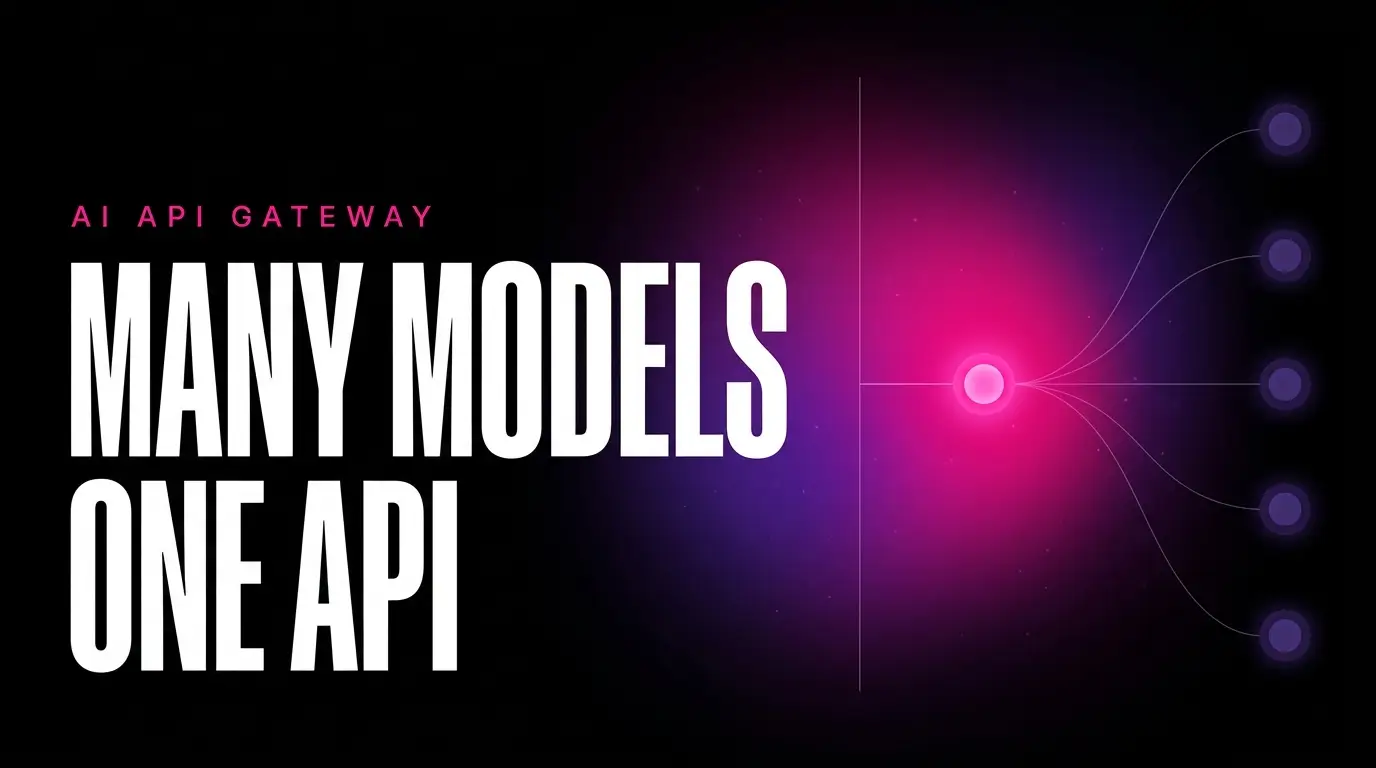
An AI API gateway is a single endpoint that sits between your application and multiple LLM providers. Instead of integrating OpenAI, Anthropic, Google, and others separately, you call one API, and the gateway routes each request to the right model, fails over when a provider is down, and bills you through one account. With 78% of companies now running two or more model families in production, managing those providers by hand has become the bottleneck a gateway removes.
This guide explains what a gateway actually does, and gives you a straight answer on whether you need one, including the cases where you do not.
What an AI API gateway actually does
Strip away the marketing and a gateway does four concrete things.
One unified API. Every model, from every provider, behind a single endpoint that speaks one request and response format. You write your integration once instead of once per provider.
Routing. It sends each request to a chosen model, and switching which model handles a task is a configuration change rather than a new integration. Some gateways route automatically based on cost, latency, or the nature of the request.
Failover. When a provider is rate limiting you or is down, the gateway reroutes to a healthy alternative automatically, so a single provider’s outage does not take your product down with it.
One bill and one view. Usage, spend, and latency across every model land in one place, with a single invoice instead of a stack of provider accounts to reconcile.
That is the whole category. Everything else a gateway offers is a variation on those four.
Why gateways exist now
Two years ago, most teams used one model from one provider, and a gateway would have been overkill. That is no longer the shape of the market.
The move to multiple models is now the default, not the exception. Databricks’ State of AI Agents 2026 report, built on aggregated data from more than 20,000 organizations including over 60% of the Fortune 500, found that 78% of companies use two or more LLM model families. The share using three or more rose from 36% to 59% in the space of three months. In retail the multi-model figure reaches 83%.
The reason is simple: no single model is best at everything. One is sharp at code, one is cheap at classification, one handles long context better, one writes better prose. Matching the model to the task is how teams control both quality and cost, which means running several models at once.
And running several models by hand is where the pain starts. Each provider is a separate account, API key, SDK, billing relationship, rate limit, and failure mode. Add a second provider for reliability and you have doubled all of it before you have shipped a feature. This integration tax is why many teams stay on one provider longer than they should, overpaying on some tasks and carrying a single point of failure on all of them. The gateway exists to make the multi-model strategy that the data says everyone is adopting actually practical to run.
What you get, concretely
Four benefits, each of which is a deep topic in its own right.
A single OpenAI compatible endpoint. Most gateways standardize on the OpenAI API format, which most providers now support. Your code targets one endpoint, and reaching a different model is a change of one string. This is also what makes model evaluation cheap: testing a task across five models is a loop over five strings, not five integrations.
Lower cost through routing. Routing each task to the cheapest model that clears your quality bar is the single largest lever on an AI bill. The spread between a frontier model and a cheap one on high-volume work like extraction can exceed 40x, because quality saturates and you are paying for headroom the task cannot use. The full breakdown is in how to reduce your LLM API costs.
Reliability through failover. Every major provider went down in 2026. A single provider at around 99.5% uptime is roughly 41 hours of downtime a year, while two independent providers with automatic failover clear 99.99%. A gateway gives you that failover without the multi-provider plumbing. The details are in how to handle LLM API failures.
Observability and one bill. Instead of logging into several provider dashboards to answer “what did we spend and where,” you get spend, latency, and usage per model in one place, on one invoice. For finance and for debugging, that consolidation is worth more than it sounds.
When you actually need one
You have outgrown direct integration when any of these is true.
- You run more than one model. The moment you have a second provider in your stack, a gateway pays for itself in removed integration work.
- Uptime matters. If a provider outage means lost revenue or a broken product, you need failover, and failover means more than one provider behind one interface.
- You want to cut costs by routing. Capturing the routing saving requires cheap models and expensive models reachable through the same call, which is exactly what a gateway provides.
- You are constantly evaluating models. In a market where the best model for a task changes every few weeks, the ability to swap by changing a string is a real operational advantage.
- You want to avoid lock-in. A gateway abstracts the provider, so switching away from one is a config change rather than a migration.
If two or more of those describe you, the integration tax you are paying by hand is already larger than the cost of a gateway.
When you do not need one
A gateway is not always the answer, and pretending otherwise would be dishonest.
- You are prototyping on a single model. If you are early, on one provider, and reliability is not yet critical, direct integration is simpler and you should not add a layer you do not need. Add the gateway when you add the second model.
- One provider genuinely covers you. If a single provider meets your quality, cost, and uptime needs and you have no plans to diversify, the abstraction earns its keep slowly. Be honest about whether that is really true, since most teams outgrow it.
- You depend heavily on one provider’s native features. If your product is built around provider-specific capabilities that do not map cleanly to a shared interface, a gateway can get in the way. Check that the features you rely on pass through.
- You are using subscription tools, not the API. A gateway is for API traffic. Tools billed on their own bundled plans, like a coding assistant on a vendor subscription, run on that vendor and a gateway does not change that.
There is also a real tradeoff to weigh: a gateway adds a network hop, so it introduces a small amount of latency overhead. For nearly all applications this is negligible against model inference time, but if you are chasing single-digit-millisecond budgets, measure it.
What to look for in a gateway
If you decide you need one, evaluate on these, because they are where gateways genuinely differ.
| Criterion | What to check |
|---|---|
| Markup | Does it charge a margin on top of provider prices, or pass them through? A per-token markup compounds at scale. |
| Model coverage | How many models and providers, and how fast are new ones added? |
| Failover | Is rerouting automatic on rate limits and outages, or do you configure it yourself? |
| Latency overhead | How much does the extra hop add? Ask for a number. |
| Data handling | What is logged and retained? This matters for sensitive workloads. |
| Payment | Card only, or does it support how your team actually pays, including options for teams that cannot use traditional billing? |
The markup line deserves emphasis. A gateway that adds a percentage to every token is a tax that grows with your usage, and at the volumes where a gateway is worth having, that tax is exactly where it hurts most. A zero markup gateway that passes provider pricing through, and makes its model available at cost, is a structurally better deal at scale.
Where MixRoute fits
MixRoute is an AI API gateway built on the four things above. One OpenAI compatible API across 200+ models, automatic failover when a provider drops, one bill, and zero markup on provider pricing, so you pay provider rates rather than provider rates plus a margin. It also supports USDT deposits with no KYC, which matters for teams that cannot or prefer not to use traditional billing. Smart routing, which picks the best model per request on quality, cost, and latency, is coming.
To keep the boundary honest: a gateway removes the multi-provider integration burden. It does not remove your need for good application code, your own retries and timeouts, or an evaluation set to prove a cheaper model held quality. It makes a multi-model strategy practical to run. The engineering around it is still yours.
FAQ
What is an AI API gateway? A single endpoint that sits between your application and multiple LLM providers. It gives you one unified API across every model, routes each request to a chosen model, fails over automatically when a provider is down, and consolidates usage and billing into one account, so you do not integrate and maintain each provider separately.
What is the difference between an AI gateway and calling an API directly? Calling an API directly means integrating each provider yourself, with a separate key, SDK, bill, and failure mode for each. A gateway puts every provider behind one interface, so switching models is a configuration change, failover is automatic, and billing is unified. Direct integration is simpler for a single provider, a gateway wins as soon as you run more than one.
Do I need an AI API gateway? You need one if you run more than one model, care about uptime enough to want failover, want to cut costs by routing tasks to cheaper models, or evaluate models frequently. You do not need one if you are prototyping on a single provider that meets all your needs, or if you depend on provider-specific features that do not map to a shared interface.
Does an AI API gateway add latency? It adds a network hop, so there is a small latency overhead. For almost all applications this is negligible compared to model inference time, but if you operate on very tight latency budgets, ask the gateway for a measured number and test it against your own traffic.
How does an AI API gateway save money? Mainly through routing. It lets you send high-volume, low-complexity work to cheap models and reserve expensive models for tasks that need them, all through one interface. On high-volume work the cost difference between the right and wrong model can exceed 40x. A zero markup gateway also passes provider pricing through rather than adding a margin.
Is an AI API gateway a single point of failure? It can be, which is why the gateway’s own reliability matters. A well-built gateway increases your reliability by adding provider failover you would not otherwise have, turning several providers into one resilient endpoint. Evaluate the gateway’s uptime the same way you would evaluate a provider’s.
The bottom line
An AI API gateway is one endpoint in front of many models, giving you a unified API, per-task routing, automatic failover, and one bill. It exists because the multi-model strategy is now the norm, with most companies running several models, and running those providers by hand is the tax a gateway removes.
You need one when you run more than one model or care about cost and uptime, which is most teams past the prototype stage. You do not when a single provider genuinely covers you. And when you evaluate, weigh markup, model coverage, failover, and latency, because that is where gateways actually differ.
MixRoute is that gateway with zero markup: every major model behind one OpenAI compatible endpoint, automatic failover, one bill, and provider pricing passed straight through. Start building on MixRoute