OpenAI Compatible APIs: What It Means and How to Switch Providers
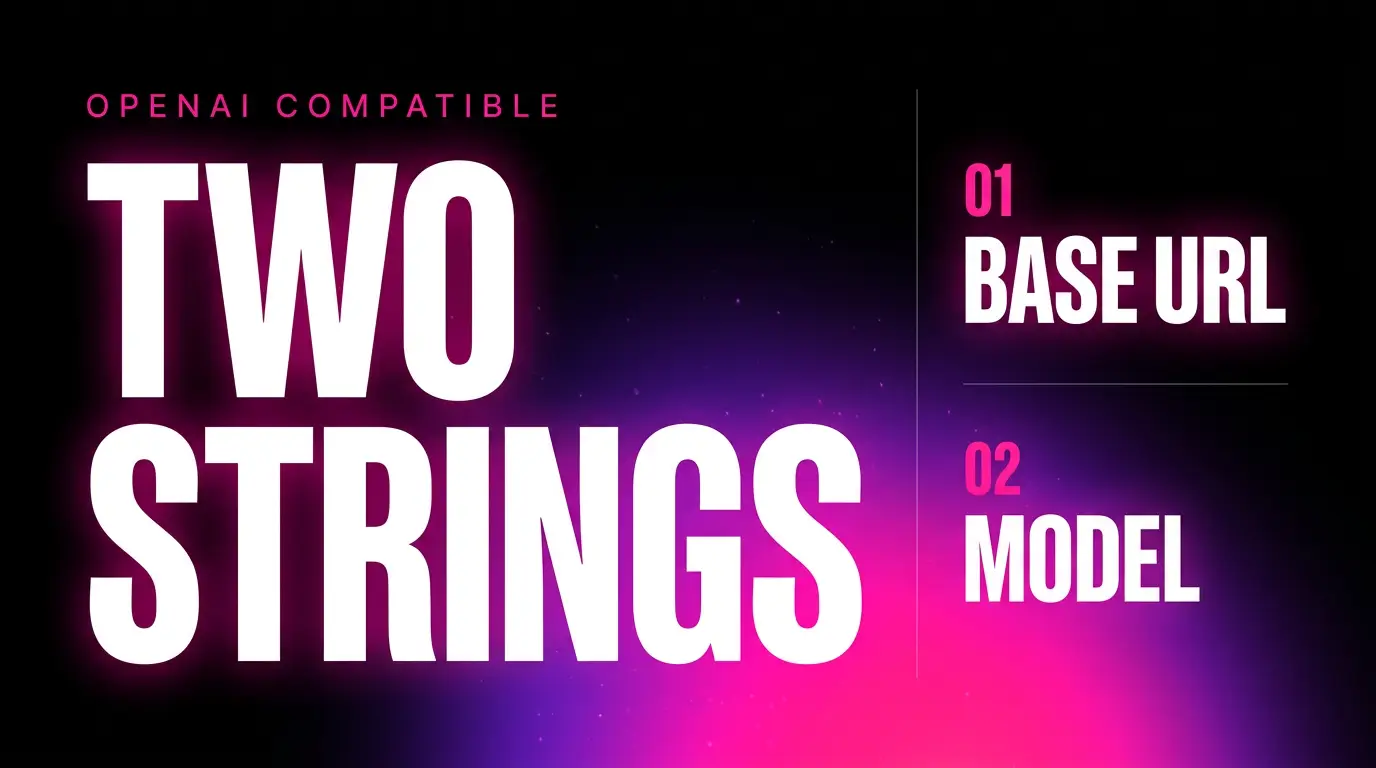
An OpenAI compatible API accepts the same request format as OpenAI’s Chat Completions endpoint and returns the same response shape. In practice it means you can point an existing integration at a different provider by changing two things, the base URL and the model string, without rewriting your application. That is why it became the de facto standard for LLM APIs, and why switching models is now a configuration change rather than an engineering project.
This guide covers what compatibility actually gives you, the parts it does not cover, and the specific things that break when you move a workload from one provider to another.
The format everyone standardized on
There was never a committee. OpenAI’s Chat Completions endpoint arrived first and got adopted widely enough that its request shape became the shape everyone else implemented, so that existing client libraries and tooling would work against them without modification.
The core of it is small. You POST to a chat completions path with a model identifier and a list of messages, each with a role and content. You get back a list of choices, each containing a message with the assistant’s reply, plus a usage object reporting how many tokens went in and out.
That is the whole contract most applications depend on, and it is why the official OpenAI client libraries work against non-OpenAI providers. You construct the client with a different base URL, pass a different model string, and the rest of your code does not know or care.
Two consequences follow, and they are the entire reason this matters.
Your integration is portable. Application code written against this format is not locked to the provider you started with.
Your tooling is portable too. Frameworks, SDKs, observability tools, and libraries built around the format work anywhere that implements it, which is a much larger investment than the API calls themselves.
What compatibility does not mean
Here is where a lot of migrations go wrong, because “compatible” is treated as “identical” and it is not. Compatibility is about the request and response envelope. It says nothing about what happens inside.
The core chat shape is reliable. The edges are not. Basic message exchange, streaming, and token usage reporting are broadly consistent. Tool and function calling, structured output enforcement, multimodal inputs, and reasoning controls vary considerably in how completely each provider implements them, and some providers expose their own parameters that have no equivalent elsewhere.
Identical requests produce different outputs. This is obvious when stated and constantly forgotten in practice. The format being the same does not make the models the same. Same prompt, same parameters, different model, different answer.
Sampling parameters are not universally honored. Some providers restrict or ignore parameters like temperature and top_p on certain models, and some reject non-default values outright rather than silently ignoring them.
The practical rule: treat compatibility as a guarantee about plumbing, not about behavior. It means you do not have to rewrite your integration. It does not mean you can skip testing.
What actually breaks when you switch providers
This is the part no compatibility page tells you. Your code keeps working. These things still change underneath it.
Your token counts change
Different model families use different tokenizers, so the same text becomes a different number of tokens depending on where you send it. Your prompt did not change. The count did.
That has three knock-on effects people miss. Your cost estimates are wrong until you re-measure, because cost is rate times tokens and only the rate is on the pricing page. Your context budgets shift, so a prompt sized to fit with comfortable headroom may run closer to the limit or over it. And any token-based logic in your own code, truncation rules, chunk sizing, budget guards, is calibrated to the old tokenizer.
Never carry a token count across a provider switch. Re-measure with the new one.
Your prompt was tuned to a specific model
Every production prompt accumulates model-specific adaptation. Few-shot examples chosen because they worked. Output formatting instructions added because one model kept adding markdown. Phrasing that got reliable behavior after several tries.
None of that transfers cleanly. A prompt tuned against one model is a prompt fitted to that model’s quirks, and moving it somewhere else means those adaptations are now either useless or actively counterproductive. Expect to retune, and budget for it.
Your cache goes cold
If you use prompt caching, a cache lives with the provider that holds it. Send the same request elsewhere and you start from a cold cache, paying full input rates until it warms up again.
This matters most when you are migrating incrementally or splitting traffic. A test that routes 10% of requests to a new provider will show worse cost per request than a full migration would, purely because that slice never accumulates enough traffic to keep a cache warm. Do not draw cost conclusions from a small traffic split without accounting for it.
Your rate limits are completely different
Rate limits vary in structure, not just in number. Some providers limit requests per minute, some limit tokens per minute, some limit both, some apply separate input and output token limits, and tier systems differ entirely.
So retry and backoff logic tuned against one provider’s limits is not correct for another’s. The error codes are usually consistent enough, but the thresholds and headers you are reacting to are not.
Your error handling has gaps
Compatible providers generally return standard HTTP status codes, but error body structures, error type names, and the level of detail differ. Code that parses a specific error message or field to decide what to do will find that field missing or different.
Handle errors by status code first, and treat any provider-specific detail as best effort rather than something you depend on.
Your output format enforcement may weaken
If you depend on guaranteed valid JSON, check how strictly each provider enforces it. Some validate against a schema and guarantee conformance. Some accept the same parameter and merely make it likely. Code that assumes guaranteed validity will encounter parse failures at whatever rate the new provider actually delivers.
The migration playbook
Six steps, in order. The order matters more than any individual step.
1. Build a baseline before you touch anything. Take fifty to a hundred real inputs and record what your current setup produces, along with tokens per request and cost per completed task. Without this you have nothing to compare against, and every conclusion after the switch is a guess. This is the step people skip and the one that makes the rest work.
2. Pin your model identifiers. Use specific versioned model identifiers rather than floating aliases that point at whatever is newest. Otherwise the model can change under you mid-migration and you will not know whether a difference came from your change or the provider’s.
3. Swap the base URL and the model string. The mechanical part, and genuinely the easy part.
4. Re-measure tokens immediately. Before evaluating quality, check tokens per request on the new provider. This tells you your real cost picture and catches context budget problems early.
5. Run your baseline set and compare. Not vibes, not a spot check of three examples. Compare against the recorded baseline on the dimensions that matter for your task: correctness for extraction, ranking quality for retrieval, human judgment or rubric scoring for generated text. A cheaper model that got slightly worse will not announce itself, because a wrong answer arrives with exactly the same confidence as a right one.
6. Shift traffic gradually, with a way back. Move a slice, watch error rates, latency, and cost per task, then widen. Keep the ability to route back instantly. And remember the cold cache effect from earlier when you read the numbers from a partial split.
Design so you can move
Whether or not you migrate soon, a few habits keep the option cheap.
Keep the model identifier in configuration, not scattered through your code. If changing models means editing several files, you will not do it, and you will keep paying for a decision you made once.
Isolate provider-specific code. Anything that depends on one provider’s particular behavior belongs behind a thin internal interface, so swapping it out is contained.
Maintain an evaluation set continuously. This is the single highest-leverage habit in the list. An eval set is what turns “should we switch” from an argument into a measurement, and it works for prompt changes and model upgrades too, not just migrations.
Log tokens and cost per task, per task type. Not globally. Aggregate numbers hide the specific workload where a change hurt you.
Where a gateway fits
Everything above assumes you are managing providers directly, which means one account, key, SDK, bill, and set of failure modes per provider. That friction is real, and it is why many teams stay with their first provider well past the point where it was the right choice.
An AI API gateway collapses that. Every provider sits behind one OpenAI compatible endpoint, so reaching a different model is a model string change rather than a new integration, with one key and one bill. That is also what makes evaluation affordable, because running your baseline set across several models becomes a loop over model strings instead of several integrations built just to run a comparison.
To keep the boundary honest: a gateway removes the integration work. It does not remove the need to re-measure tokens, retune prompts, or validate quality, because those are consequences of changing models, not of managing providers. What it changes is that trying a model costs you almost nothing, so you find out with a measurement rather than deciding with an argument.
MixRoute is built for that: every major model behind one OpenAI compatible endpoint, with automatic failover and zero markup on provider pricing. Start building on MixRoute
FAQ
What is an OpenAI compatible API? An API that accepts the same request format as OpenAI’s Chat Completions endpoint and returns the same response structure. You send a model identifier and a list of messages with roles and content, and receive choices containing the assistant’s reply plus token usage. Because the format matches, existing OpenAI client libraries and tooling work against it by changing the base URL.
Can I switch LLM providers without rewriting my code? Largely yes, if both speak the OpenAI compatible format. The mechanical switch is changing the base URL and the model string. What you cannot skip is re-measuring token counts, retuning prompts that were fitted to the old model, and validating output quality, because the format being identical does not make the models identical.
Why do my token counts change when I switch models? Different model families use different tokenizers, so identical text becomes a different number of tokens. This changes your costs even when the advertised rate is the same, and it can shift prompts closer to context limits. Always re-measure token counts after a provider change rather than reusing old figures.
Does OpenAI compatible mean the responses will be the same? No. Compatibility describes the request and response envelope, not model behavior. The same prompt sent to two compatible providers will produce different output, because they are different models. Compatibility saves you the integration work, not the testing.
What usually breaks when migrating between LLM providers? Six things, in rough order of how often they cause trouble: token counts change with the tokenizer, prompts tuned to the old model behave differently, prompt caches start cold, rate limit structures differ so retry logic needs revisiting, error body formats vary even when status codes match, and structured output enforcement may be less strict than you assumed.
How do I test a new provider before fully switching? Record a baseline of fifty to a hundred real inputs on your current setup, including tokens per request and cost per completed task. Swap the base URL and model, run the same inputs, and compare directly. Then shift traffic gradually while watching error rates, latency, and cost per task, keeping the ability to route back immediately.
The bottom line
OpenAI compatibility made LLM providers interchangeable at the plumbing level. Your integration is portable, your tooling is portable, and switching is a base URL and a model string.
What it did not do is make models interchangeable. Token counts change, tuned prompts stop being tuned, caches go cold, and rate limits work differently. So migrate on measurement: baseline first, pin your versions, re-measure tokens, compare against the baseline, and shift traffic gradually.
MixRoute puts every major model behind one OpenAI compatible endpoint with automatic failover and zero markup, which makes trying a different model cheap enough that you can decide with data instead of debating it. Start building on MixRoute