What Is Mistral AI? Model Families and Access Routes
What is Mistral AI?
“I keep seeing Mistral in model dropdowns. Is it a company, a chatbot, or something I download?” It is a company, and whether you download anything depends on which model you pick. Mistral AI is a France-based artificial intelligence company founded in April 2023 that builds large language models, and it releases many of them with open weights while keeping its most capable tier commercial. That split decides which routes are open to you at all, so settle it before you compare anything else.
Arthur Mensch co-founded the company alongside Guillaume Lample and Timothée Lacroix, and the three serve as CEO, chief science officer and CTO. IBM’s 2024 profile describes Mensch as formerly of Google DeepMind and Lample and Lacroix as formerly of Meta AI, and notes that Mensch was a lead author on the Chinchilla scaling paper, which examined how model size and training data trade off, and that Lample and Lacroix were among the researchers behind the original LLaMA models.
Two product tracks run at once. Open-weight releases are published for self-hosting and fine-tuning, while the commercial models run on hosted endpoints or through distribution partners. The default API endpoint is global and not tied to a location, while separate EU and US regional endpoints keep inference inside that geography for a 10% upcharge, which matters when residency is the constraint you cannot move.
Which Mistral models exist, and what is each family for?
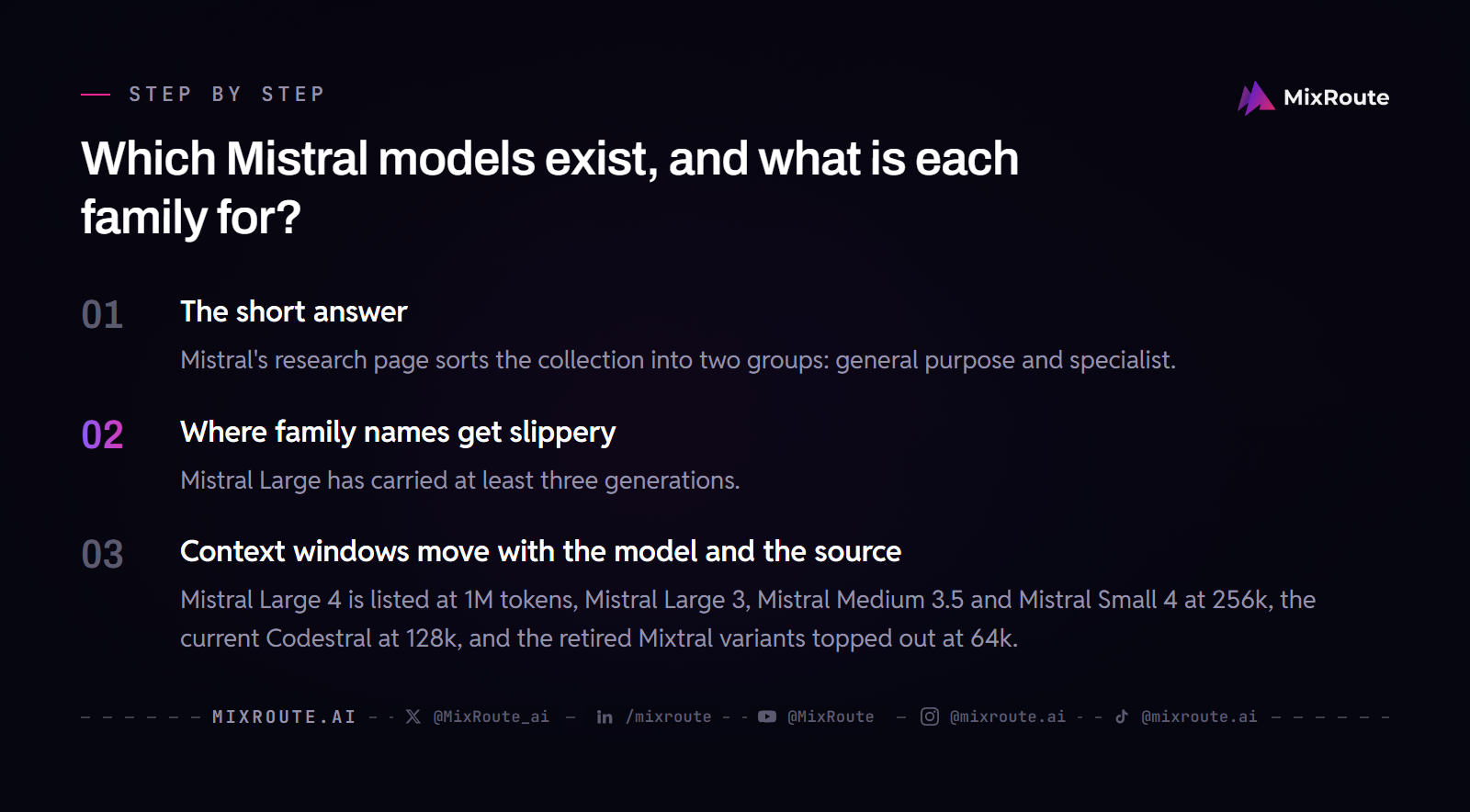
Mistral’s research page sorts the collection into two groups: general purpose and specialist. General-purpose models are built for reasoning, language, multimodal understanding and coding, and specialist models target specific tasks and domains such as document intelligence, audio, robotics and physical AI. The boundaries are not rigid, and some of the same models turn up under different headings in different write-ups, so treat the bucket as a first sort rather than a specification.
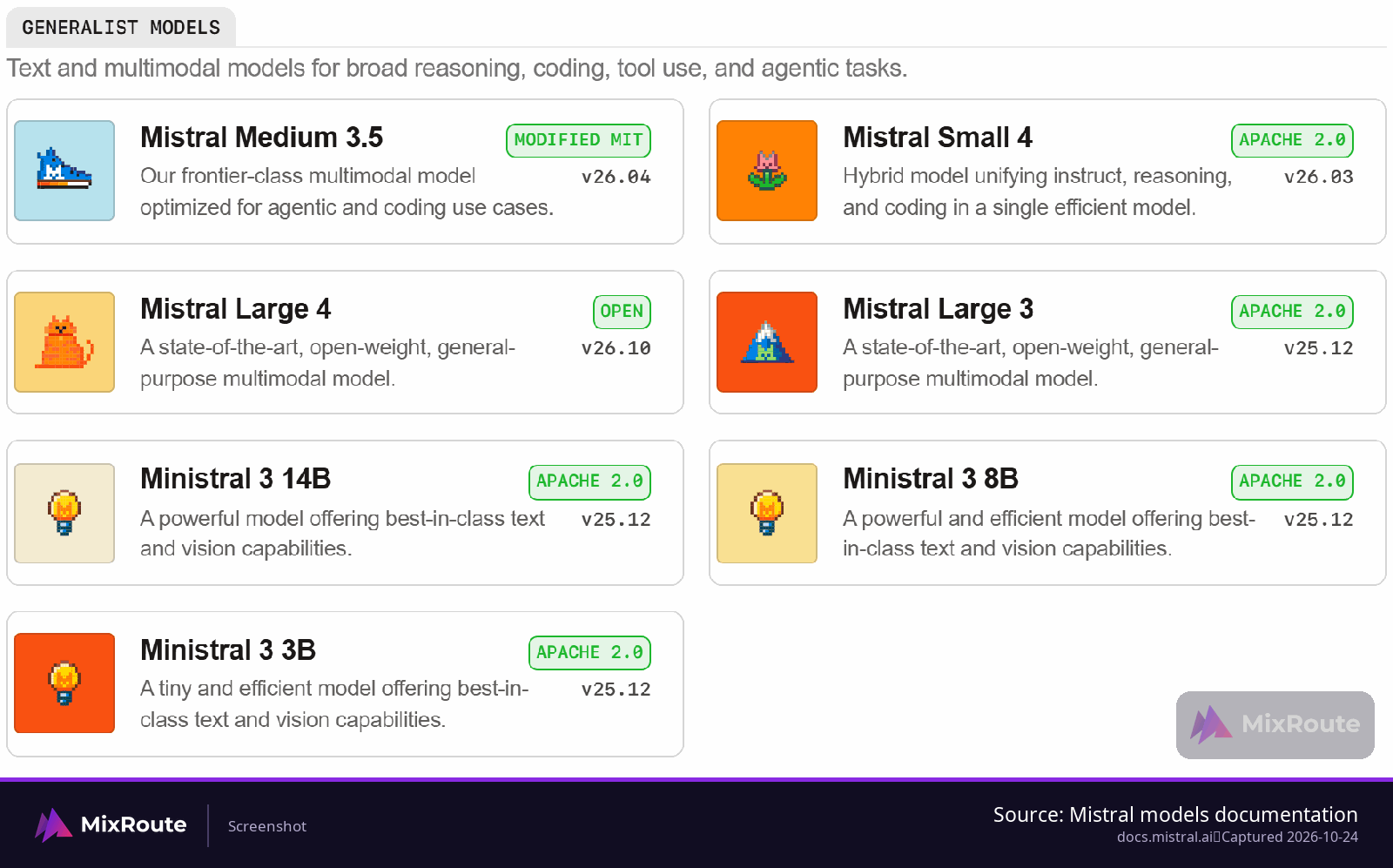
Vision is no longer a separate line. The current general-purpose models, Mistral Large 4, Mistral Medium 3.5, Mistral Small 4 and Ministral 3, all take image input, while the Pixtral 12B and Pixtral Large models that used to carry it were retired on December 31, 2025 and May 31, 2026, respectively, with Ministral 3 14B and Mistral Medium 3.5 named as their replacements. Audio sits on the specialist side under Voxtral, next to OCR 4.1 for documents.
Where family names get slippery
Mistral Large has carried at least three generations. The 2024 profile calls Mistral Large 2 the flagship at 123B parameters, sized so it could run at high throughput on a single node. Mistral Large 3 replaced it on December 2, 2025 as a 675B-parameter open-weight model under Apache 2.0, and Mistral Large 4 followed on October 6, 2026 in public preview at about 1T total parameters. If you are matching a version string against an eval, check which generation the name points at before you assume the scores transfer.
Context windows move with the model and the source
Mistral Large 4 is listed at 1M tokens, Mistral Large 3, Mistral Medium 3.5 and Mistral Small 4 at 256k, the current Codestral at 128k, and the retired Mixtral variants topped out at 64k. Those numbers are model-specific, which is why a single headline figure misleads you at the exact point where you size a document pipeline.
Each row below carries the status Mistral’s own model documentation gave it in October 2026, because a retired 2024 release and a current one are not describing the same catalog.
| Model or family | What it is for | License and weights | Status in Mistral’s docs (October 2026) |
|---|---|---|---|
| Mistral Large 4 | General-purpose multimodal flagship with a mixture-of-experts architecture and a 1M context window | Open weights announced, with the release due by the end of October 2026 | Public preview on the API since October 6, 2026 |
| Mistral Large 3 | Open-weight general-purpose multimodal model, 675B total parameters with 41B active, 256k context window | Apache 2.0 | Generally available, released December 2, 2025 |
| Mistral Medium 3.5 | Multimodal model optimized for agentic and coding work, 256k context window | Open weights under a Modified MIT license | Generally available, released April 28, 2026 |
| Mistral Small 4 | Hybrid model unifying instruct, reasoning and coding, 119B parameters with 6.5B active, 256k context window | Apache 2.0 | Generally available, released March 16, 2026 |
| Ministral 3 (3B, 8B, 14B) | Compact text-and-vision models for edge and local deployment | Apache 2.0 | Generally available, released December 2, 2025 |
| Codestral | Code completion and fill-in-the-middle, 128k context window | Listed as Premier | Generally available, version 25.08 |
| OCR 4.1 | Document extraction and understanding | Listed as Premier | Generally available, released July 16, 2026 |
| Voxtral Small, Voxtral Mini Transcribe Realtime and Voxtral TTS | Audio line covering speech understanding, live transcription and speech generation | Apache 2.0 for Voxtral Small and the realtime model, CC BY-NC 4.0 for Voxtral TTS | Generally available |
| Mistral Large 2 | The 2024 flagship, 123B parameters | Mistral Research License | Retired on March 30, 2025, with Mistral Large 3 named as the replacement |
| Mistral Small v24.09 | The 2024 small model | Mistral Research License | Retired on November 30, 2025, with Mistral Small 4 named as the replacement |
| Mistral NeMo | 12B multilingual general-purpose model | Apache 2.0 | Retired on July 31, 2026, with Ministral 3 8B named as the replacement |
| Pixtral 12B and Pixtral Large | The 2024 text-and-image models | Apache 2.0 for Pixtral 12B, Mistral Research License for Pixtral Large | Both retired, Pixtral 12B on December 31, 2025 and Pixtral Large on May 31, 2026, with Ministral 3 14B and Mistral Medium 3.5 named as replacements |
| Mixtral 8x7B and 8x22B | Sparse mixture-of-experts family | Apache 2.0 | Retired on March 30, 2025, with Mistral Small 4 named as the replacement |
| Mathstral and the first Codestral (24.05) | A 7B math model and the original 22B code model | Apache 2.0 for Mathstral, Mistral AI Non-Production License for Codestral 24.05 | Both retired |
Which Mistral models are open weights, and which are API-only?
The answer flips by tier. Apache 2.0 now covers Mistral Large 3, Mistral Small 4 and the Ministral 3 family, alongside older releases such as Mistral NeMo, Pixtral 12B and Mathstral. The label on the model card, not the category, is what a legal review will ask for.
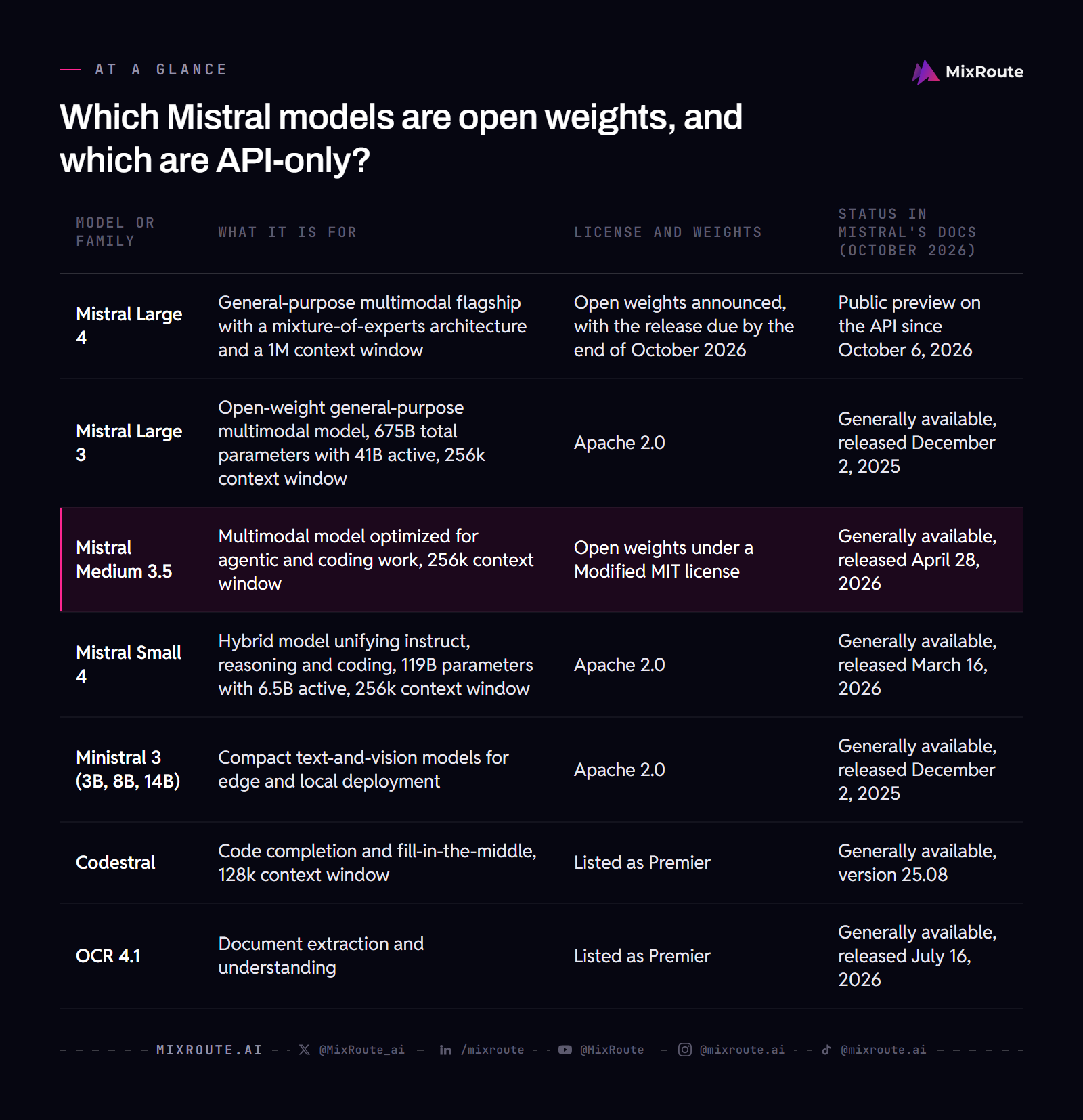
Mistral Large 3 and Mistral Small 4 both ship as open weights under Apache 2.0, the latter since March 2026 as a 119B model with 6.5B active parameters, while the current Codestral and OCR 4.1 are labeled Premier rather than carrying an open license. Mistral Large 2 and Mistral Small v24.09 went out under the Mistral Research License, which allows usage and modification for noncommercial purposes and sends commercial deployment through a commercial license or a partner route. A prototype built on those releases can be fine to explore and blocked from production at the same time.
Codestral is the awkward middle case. The original release was 22B, open-weight, fluent in more than 80 programming languages, and released under the Mistral AI Non-Production License, with commercial licenses granted on request, and it has since been retired. The current Codestral, version 25.08, is listed as Premier rather than carrying open-weight terms, so the license that governs is the one attached to the specific release, not the family name.
Read the license before the benchmark
A benchmark chart tells you which model scores higher. The license tells you whether you can put that model in front of paying users at all. When two Mistral models land within a few points of each other on your own eval, and one is Apache 2.0 while the other is research-licensed, the score is not the deciding line. Some teams pick on score first and find the license afterwards, which is the expensive order.
How do you run or call a Mistral model?
Four routes reach the same models, and they are not interchangeable, because each one hands you a different amount of control.
- Vibe, the chat and agent app that used to be called Le Chat, still reached at chat.mistral.ai.
- Studio, Mistral’s developer console and API, where you generate keys, prototype in the Playground, run evaluations and call the models through a Chat Completions API that follows the same request structure as OpenAI. Older write-ups, and parts of Mistral’s own docs, still call the API La Plateforme.
- Open-weight downloads from Hugging Face, which you self-host on your own GPUs.
- Cloud distribution through Amazon Bedrock, Microsoft Foundry and Google Cloud’s Gemini Enterprise Agent Platform, where the model is already served for you and each catalog carries its own subset of Mistral models.
Where the setup starts for each route
The hosted API route starts with an account and an API key generated from the dashboard, after which you call the models from a Mistral Python SDK. The self-hosting route starts with a download whose license you can live with, plus a GPU plan sized to it. A cloud partner route starts in that provider’s console, where the model is already served and you configure access and billing there instead.
Agent-shaped workloads add a layer on top of whichever route you chose. An Agents API with connectors and Model Context Protocol support reaches external systems, and a Workflows orchestration layer, where you write the workflow in code, composes several steps and models into one durable pipeline. Those change the code around the model. They do not change where the model runs.
How do you choose between the families and the routes?
Start with the constraint that cannot move, then let the family fall out of it. Whether the data may leave your infrastructure, which license terms you can accept, and whether you need to fine-tune are the three that settle most cases. Benchmarks are a tiebreaker between options that already passed.
The three constraints, in the order they bite
Residency comes first. If a regulation or a customer contract keeps the data inside a region, Mistral’s EU and US regional endpoints and the cloud regions you already use become the shortlist, and the family choice narrows to whatever those routes serve. License comes second. Shipping a commercial product on a model you host yourself means Apache 2.0 releases such as Mistral Large 3, Mistral Small 4 and Ministral 3 clear the bar without a conversation, while the older research-licensed releases need a commercial agreement first.
Fine-tuning comes third, and it is the constraint people discover late. Weights you can download can be tuned on your own hardware. Mistral’s docs now mark the hosted fine-tuning API as deprecated, and its homepage puts customizing models on your own data under Forge, so check what is on offer before you plan a training run. When two families satisfy all three constraints, take the smaller one and measure, because the smallest model that passes your eval is also the cheapest to keep running.
When the choice crosses vendors, the same comparison structure applied to two other frontier model families covers the half of the decision that does not stay inside one vendor.
Where does a gateway fit when you call models over an API?
A gateway sits between your client and the providers you call, and what changes for you is narrow: the endpoint your client points at, the credential it sends, and what you can cap per key. MixRoute exposes one OpenAI-compatible base URL at https://api.mixroute.ai/v1 in front of provider APIs, so an existing OpenAI client moves by changing the key and the base URL and nothing else. Anthropic-style code has a matching path: MixRoute also serves an Anthropic-compatible Messages endpoint at https://api.mixroute.ai/v1/messages that keeps client.messages.create and sends Authorization: Bearer <MixRoute key> with anthropic-version: 2023-06-01. The request still needs model, messages and max_tokens.
What one key can be capped to
MixRoute documents four controls on each key, and none of them depends on how requests are routed. A model allowlist (model_limits_enabled and model_limits) restricts a key to a named set of models. A deductible spend budget (remain_quota, with unlimited_quota switching the key ceiling off) is drawn down request by request, and the key stops when the balance reaches zero. CIDR IP allowlists (allow_ips) and an expiry time (expired_time, where -1 means no expiration) complete the set.
Two details change how you plan with those fields. Your account balance is always the outer ceiling, so a key budget only adds a second, inner limit; skip the budget and the key has one ceiling, not two. The budget is a balance in money rather than a request count or a monthly allowance, so a busy key drains it faster than a quiet one. The console text for the IP allowlist carries its own warning that IPs can be spoofed and that the control should sit behind a proxy or CDN rather than stand alone.
What the catalog covers
MixRoute’s homepage and pricing copy advertise 250+ models through a single endpoint with no platform markup, checked on 2026-08-24, while the catalog page listed 279 models across 16 providers on 2026-10-08. The two counts differ because one is marketing copy and the other is the index, and the index is what tells you whether a specific model ID is reachable. Each catalog entry carries the context, max output, modalities, endpoints and per-million-token price for that model, so a shortlist that came out of the family map can be priced there before you rewrite a client.
Compare the top-up tiers and enterprise plan thresholds before you commit to a billing route.
FAQ
Does Mistral AI make open-source models?
Partly. Mistral Large 3, Mistral Small 4 and the Ministral 3 models carry Apache 2.0 terms, and Mistral Medium 3.5 ships open weights under a Modified MIT license. The 2024 flagship-tier releases, Mistral Large 2 and Mistral Small v24.09, shipped under the Mistral Research License, which limits free use to noncommercial work. On any model you plan to ship, the line that matters is the license on the model card, because Mistral mixes permissive and restricted terms inside the same lineup.
Who founded Mistral AI?
Arthur Mensch, Guillaume Lample and Timothée Lacroix co-founded the company in April 2023. Mensch is the CEO, Lample the chief science officer and Lacroix the CTO, and IBM’s 2024 profile describes Mensch as arriving from Google DeepMind and Lample and Lacroix from Meta AI. The founding year is the detail that ages well: a catalog that has moved through several generations since April 2023 is why a version name needs checking against a dated table rather than a memory of what the flagship was called.
How large a context window do Mistral models support?
It depends on the model, and no family-level figure will size a document pipeline for you. Mistral Large 4 is listed at 1M tokens, Mistral Large 3, Mistral Medium 3.5 and Mistral Small 4 at 256k, the current Codestral at 128k, and the retired Mixtral variants at up to 64k. Read the model card for the release you actually deploy, then size your chunks against that number instead of against the family name.
Do I have to use Mistral’s own API to run a Mistral model?
No, as long as the release you pick ships with open weights. Apache 2.0 releases such as Mistral Small 4 and Ministral 3 can be downloaded from Hugging Face, modified and self-hosted on your own GPUs without asking permission. If you would rather not run GPUs, the API-only tiers still run through the hosted endpoint or through a cloud partner, where access and billing are configured in that provider’s console instead of Mistral’s.
What is the difference between Mistral and Mixtral?
Mistral is the company name, and it also appears inside model names such as Mistral Large, while Mixtral is its family of sparse mixture-of-experts models, released under Apache 2.0 and now retired. Parameter counts appear in some names and size words in others, so the name alone rarely tells you the architecture, and a family name is not a size class. When a model name is all you have, the model card is the faster read.
Is Mistral Large the best Mistral model?
Mistral Large is the family the company positions as its flagship, and that name covers several generations with different license terms, so best depends on your task and on what you are allowed to ship. Mistral Large 2 was the 123B 2024 flagship under the Mistral Research License and is now retired, while Mistral Large 3 is an open-weight release and Mistral Large 4 is in API preview with its weights due by the end of October 2026. If a smaller open-weight release lands within a few points on your own eval, the flagship label is not what decides it.
What can you build with Mistral models?
Text generation and summarization, conversational agents, code assistance, and multimodal document work such as chart understanding and OCR are the common applications for these models. Voxtral extends the family into transcription and voice conversations, and the code-oriented releases cover more than 80 programming languages. What you can ship from that list depends on the route rather than the capability: anything you self-host has to clear the license on its model card first, while the API-only tiers are reachable once you have an account.