How to Vibe Code in 2026: The Full Tutorial (and Which Model to Use)
To vibe code, write a 30 to 50 word spec, prompt in three layers, fix mistakes by iterating instead of regenerating, keep a context file the tool reads every session, and review the result before it ships. For the model, plan on Claude Opus 5.5, do most of the session on Claude Sonnet 5.5 or GPT-6.1 Sol, and hand scaffolding to a cheap model such as GLM-5.3 or DeepSeek V4.1 Flash. On the Terminal-Bench 4.0 leaderboard, Opus 5.5 resolves 64.8% of tasks and Sonnet 5.5 resolves 61.8%, and Sonnet 5.5 lists at half the per-token price.
Vibe coding is building software by describing what you want in plain language and letting an AI write the code while you steer, review, and iterate. It deletes the typing, not the engineering. The people who get real products out of it still think about software; they just stop typing it.
What vibe coding actually is
Andrej Karpathy coined the term in a post on X on February 2, 2025, describing a way of building where you fully give in to the vibes and “forget that the code even exists.” Collins Dictionary named vibe coding its Word of the Year for 2025.
The practice has since gone mainstream. Sonar’s developer survey, as reported by TechRadar in January 2026, puts AI-generated code at about 42% of what developers commit, up from 6% in 2023, and expects 65% by 2027.
Vibe coding is not no-code. No-code platforms lock you into their builder and give you no code to take anywhere. Vibe coding produces real code in a real repo that you can run, edit, audit, and ship on your own infrastructure. It is also not autocomplete: autocomplete finishes your line, while vibe coding takes a described outcome and builds the feature.
| Traditional coding | No-code | Vibe coding | |
|---|---|---|---|
| You write | Every line | Nothing, you drag blocks | Descriptions and corrections |
| Output | Code you own | A locked platform config | Code you own |
| Skill floor | High | Low | Low to start, judgment matters fast |
| Ceiling | Unlimited | The platform’s features | Unlimited, if you review |
How to vibe code: your first session tonight
Six steps fit in one evening and end with a running project. The discipline inside each step is what separates a shipped product from code nobody checked.
Step one, pick your lane
Two categories of tool exist, and choosing the wrong one wastes your first week.
App builders (Lovable, Bolt, Replit and their kind) take a description and produce a running application. Replit and Bolt both list hosting and databases inside the same product, so there is nothing to set up. Pick one if you are not a developer, or you want a prototype in front of someone today.
Coding agents (Claude Code, Cursor, Codex and their kind) live in your terminal or editor and work inside a real codebase. Pick one if you are a developer, or the project has to outlive the demo.
Many people prototype in a builder and graduate to a coding agent for production. Choose by which of those two descriptions fits you, not by brand.
Step two, write the spec before the prompt
Most people open the tool and start typing a 500 word prompt. Write a 30 to 50 word spec first, in a file, before any tool is open.
A spec answers three things: what the thing does, who it is for, and what done looks like tonight, not eventually. “A dashboard where my client logs in, sees this month’s leads in a table, filters by status, and exports CSV” is a spec. “A CRM” is a mood.
The same test governs every AI workflow worth running: if you cannot tell whether the output is done, the model cannot either.
Step three, prompt in three layers
Send the prompt as three layers, in this order.
Layer 1, technical context. The stack and the patterns.
"This is a Next.js app with TypeScript, Tailwind, and Supabase.
Follow the existing component structure in /components."

Layer 2, functional requirements. The feature from the user's side.
"Users see their last 30 orders in a table, filter by date range
and status, and export the filtered view as CSV."

Layer 3, edge cases and integration. The part everyone skips.
"Show a loading skeleton while fetching. Empty state when there
are no orders. Redirect unauthenticated users to /login."
Layer 3 is where quality lives. A model given layers 1 and 2 produces the happy path. A model given all three produces software. Edge cases go in the prompt, not in the bug tracker.
Two habits pay off quickly. Ask for a plan before code on anything non-trivial (“outline your approach and wait for my confirmation”); Claude Code has a Plan Mode built for this. And ask for tests alongside the feature (“write the function and three tests covering the happy path, an edge case, and a failure”).
Step four, iterate, never regenerate
When the output is wrong, and it will be, tell the model exactly what to fix. Regenerating from scratch throws away every correct decision already made and rolls the dice on all of them again. Iteration converges; regeneration wanders.
Build in vertical slices for the same reason. One working slice, database plus API plus UI for a single feature, can be tested, shipped, and built on. Three half-finished layers cannot. Commit to Git after every slice that works, so a later change that breaks something rolls back instead of becoming a rescue job.
Step five, give it memory
Every AI tool forgets your project between sessions. Left alone, session two rediscovers your stack, reinvents your conventions, and quietly contradicts session one. Context files fix that: write them once and the tool reads them every session. Claude Code reads CLAUDE.md at the start of every session and can read an existing AGENTS.md in its place. Codex reads AGENTS.md files before it does any work.
CLAUDE.md or AGENTS.md   the project name and purpose, the stack,
                         naming conventions, what must never be touched
progress notes           what was built, what is in flight, what is next,
                         updated at the end of every session
Five minutes of writing these saves you the same conversation every day. The model forgets between sessions; the file does not.
Step six, review like it came from a contractor
It did come from a contractor, and this step decides whether vibe coding works for you. The data on skipping it is poor.
Veracode’s 2025 GenAI Code Security Report gave more than 100 models 80 coding tasks. In 45% of test cases the models produced code with a vulnerability from the OWASP Top 10, and Java failed 72% of the time. CodeRabbit compared 470 open source pull requests and found the 320 AI co-authored ones carried about 1.7x more issues than the 150 human-only ones. A research paper on package hallucinations generated 576,000 code samples with 16 models and recorded 205,474 unique package names that do not exist. Attackers can register those names with malicious code inside, an attack called slopsquatting.
Developers know this. In the Sonar survey, 96% said they do not fully trust AI-generated code to be functionally correct, yet only 48% always check it before committing.
So review, and make the model help. The minimum pass before anything touches production: parameterized queries on every database call, no hardcoded keys or secrets, auth checked on every protected route, user inputs sanitized, every suggested package verified to exist, and rate limits on public endpoints. Then run one meta prompt as the closer: “Review this code for SQL injection, authentication gaps, secrets exposure, and XSS. List every issue found.”
Which model should you vibe code with?
Use a different model for each phase: Claude Opus 5.5 to plan, Claude Sonnet 5.5 or GPT-6.1 Sol to build, a cheap model to scaffold, and a model from another vendor to review. No single model wins every phase, and the benchmark and price data below show why.
Prices are per million tokens (input / output) on MixRoute, checked October 19, 2026. Terminal-Bench 4.0 comes from tbench.ai and the Intelligence Index from Artificial Analysis. A dash means the benchmark owner’s page does not list that model.
| Model (ID) | Price | Terminal-Bench 4.0 | AA Intelligence Index | Use it for |
|---|---|---|---|---|
| Claude Opus 5.5 (claude-opus-5-5) | $4 / $20 | 64.8% | 58 | Planning, architecture, hard refactors |
| Claude Sonnet 5.5 (claude-sonnet-5-5) | $2 / $10 | 61.8% | 56 | The default for most of the session |
| GPT-6.1 Sol (gpt-6.1-sol) | $2 / $10 up to 272K input | 58.2% | – | Building on a tight bill, cross-vendor review |
| Claude Fable 5.1 (claude-fable-5-1) | $10 / $50 | 57.9% | 53 | Only for a task Sonnet 5.5 keeps failing |
| Gemini 4 Argon (gemini-4-argon) | $2 / $10 | – | 53 | Review from a third vendor, screenshots as input |
| GLM-5.3 (glm-5.3) | $1.40 / $4.40 | 41.8% | 45 | Scaffolding and budget volume, open weights |
| DeepSeek V4.1 Flash (deepseek-v4.1-flash) | $0.30 / $1.20 | – | 39 | Boilerplate and cheap first drafts |
| Claude Haiku 5.5 (claude-haiku-5-5) | $0.10 / $0.50 up to 100K input | – | – | Small, focused subagent tasks |
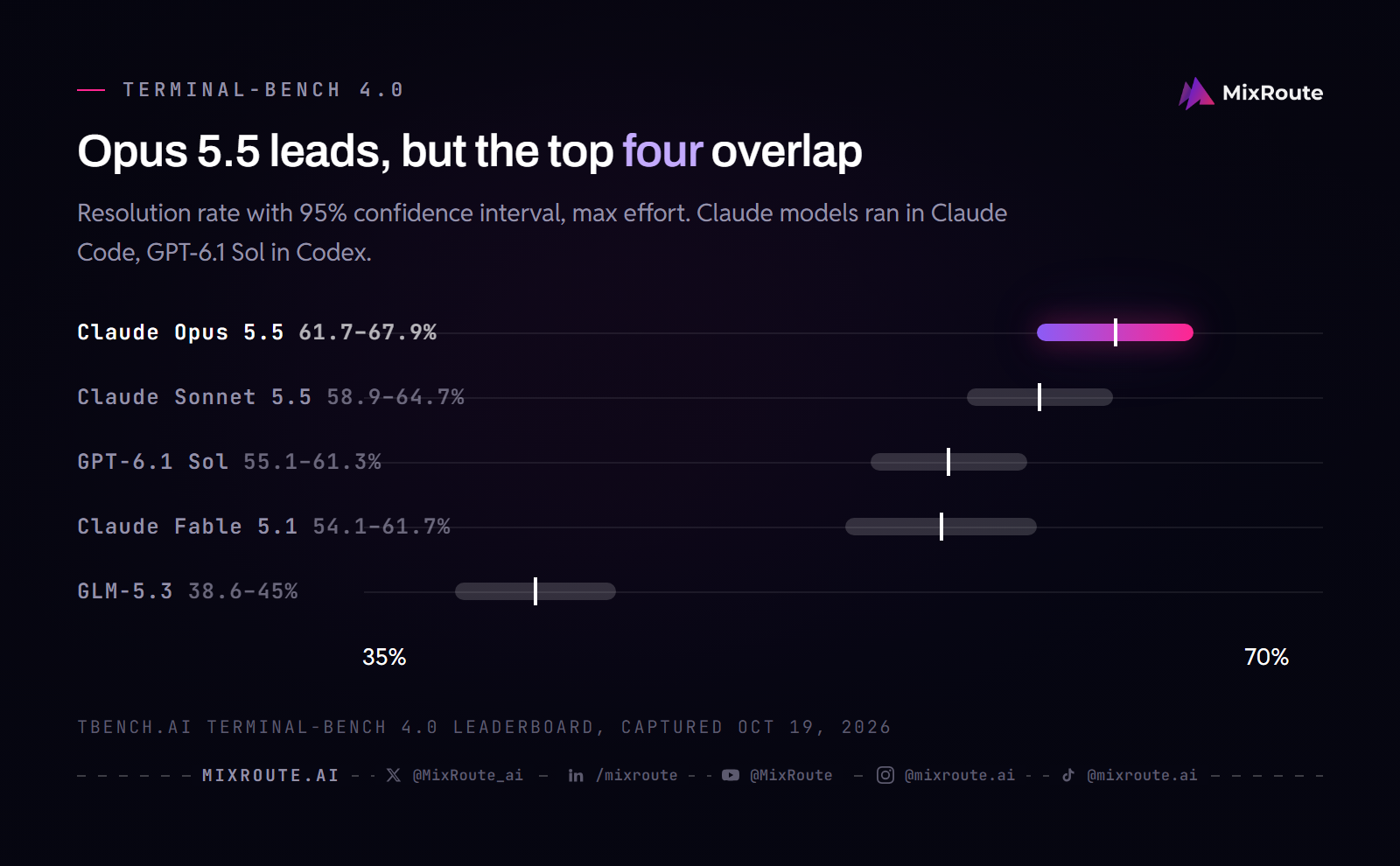
Read the benchmark column with its error bars. Terminal-Bench 4.0 lists Opus 5.5 at 64.8% plus or minus 3.1 and Sonnet 5.5 at 61.8% plus or minus 2.9, so the two sit inside each other’s margins. GPT-6.1 Sol (58.2%) and Fable 5.1 (57.9%) overlap too. The gap that holds up is the one to GLM-5.3 at 41.8%. The leaderboard also runs different models in different agents: Claude models in Claude Code, GPT models in Codex.
Claude Fable 5.1 costs five times what Sonnet 5.5 does, and its listed 57.9% sits below Sonnet 5.5’s score with overlapping margins. Earlier versions of this guide recommended Fable 5, Opus 4.8, GPT-5.5, Sonnet 5, Gemini 3.1 Pro, GLM-5.2, and DeepSeek V4 Flash; each now has a newer release in the table.
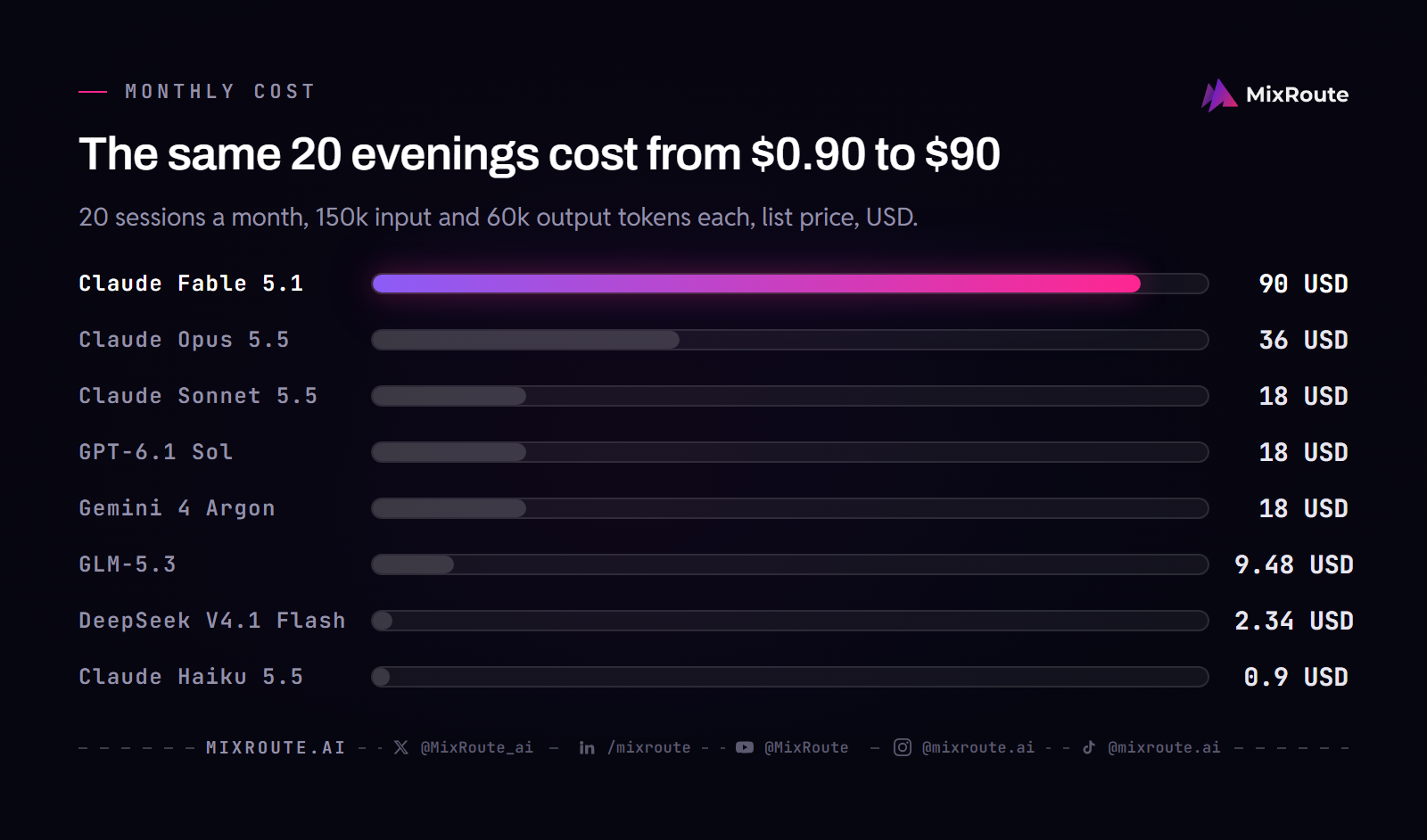
Now what a session costs. Take one evening of vibe coding, roughly 50 exchanges at about 3,000 tokens in and 1,200 out each, which is 150k input and 60k output tokens per session at list price.
| Model | One session | 20 sessions a month | AA cost per Index task |
|---|---|---|---|
| Claude Fable 5.1 | $4.50 | $90.00 | $7.63 |
| Claude Opus 5.5 | $1.80 | $36.00 | $5.98 |
| GPT-6.1 Sol | $0.90 | $18.00 | – |
| Claude Sonnet 5.5 | $0.90 | $18.00 | $5.46 |
| Gemini 4 Argon | $0.90 | $18.00 | $1.99 |
| GLM-5.3 | $0.47 | $9.48 | $2.01 |
| DeepSeek V4.1 Flash | $0.12 | $2.34 | $0.49 |
| Claude Haiku 5.5 | $0.045 | $0.90 | – |
That is a 100x spread between the top and bottom rows for the same evening. The last column shows why the list price is only part of the bill. Artificial Analysis measured what it cost to run its Intelligence Index, and the order changes: Sonnet 5.5 lists at half Opus 5.5’s price but costs $5.46 per task against $5.98, because it wrote 420M output tokens in the Index run to Opus 5.5’s 260M. On Terminal-Bench 4.0 the same pattern is larger. Sonnet 5.5’s run cost $7.3k on 19.4B tokens, Opus 5.5’s $4.7k on 8.0B, and GPT-6.1 Sol’s $0.6k on 1.5B.
So the cheapest model per token is not always the cheapest per finished task. Sonnet 5.5 supports adaptive reasoning with configurable effort, which is where those extra tokens come from; read what actually changed on the Sonnet 5 bill before trusting the sticker price.
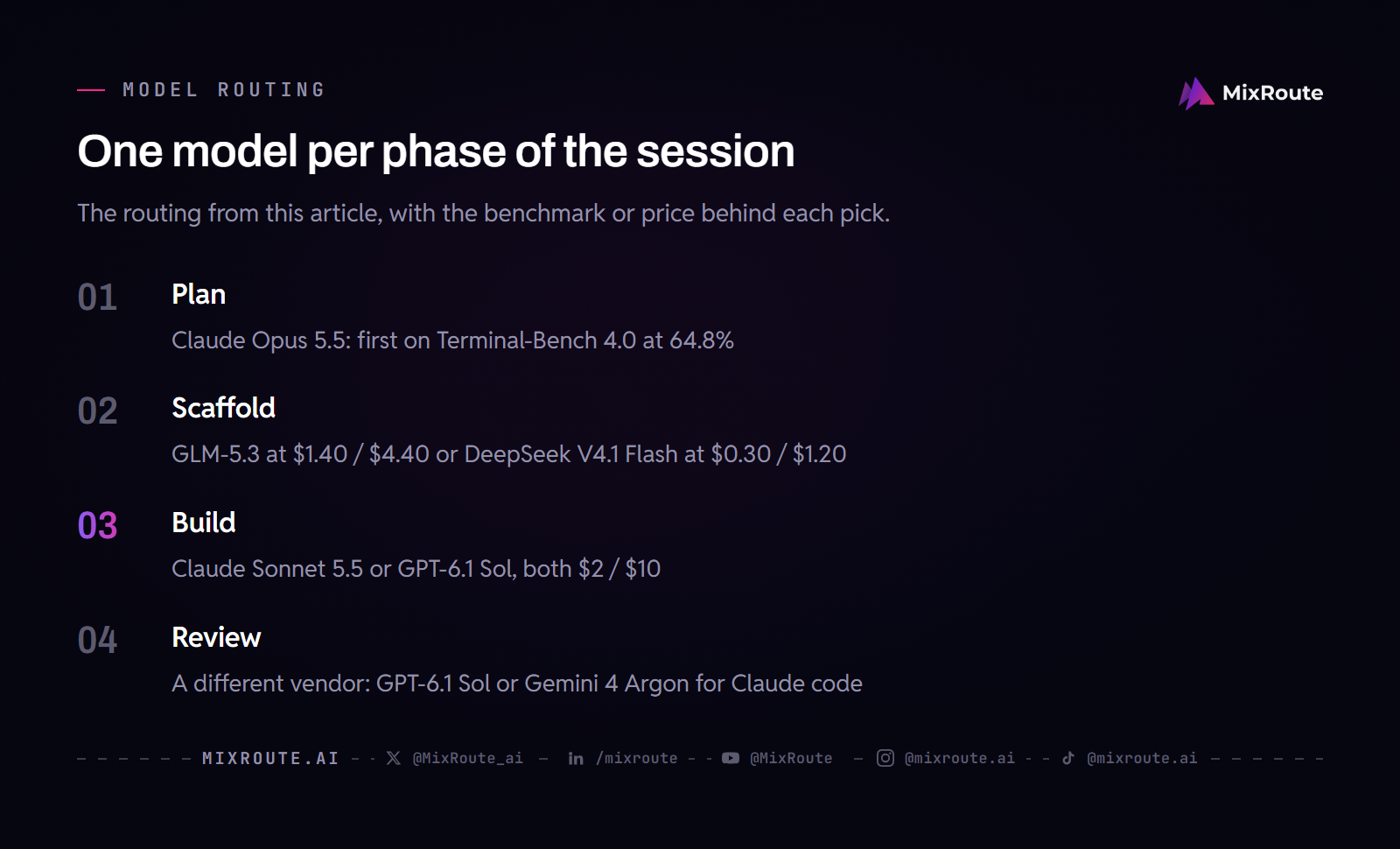
The routing that follows from the data maps onto the phases of every vibe coding session:
Plan and architect on the top of the leaderboard. Opus 5.5 leads Terminal-Bench 4.0 and the Intelligence Index (58, first of 217 models). Planning is a few prompts per project, so its $4 / $20 price barely registers.
Execute on the value model. Sonnet 5.5 is the default for the bulk of the session. If the bill matters more than a few benchmark points, GPT-6.1 Sol lists at the same $2 / $10 and the leaderboard shows it finishing the run for a fraction of the cost. Scaffolding, boilerplate, and first drafts can drop further, to GLM-5.3 or DeepSeek V4.1 Flash.
Review on a different vendor than the one that wrote it. If Claude wrote the code, have GPT-6.1 Sol or Gemini 4 Argon review it, and the reverse. A second model line gives you a check that does not come from the model that made the mistake.
That last rule is the bridge to what comes after vibe coding.
When you outgrow vibe coding
A year after coining the term, in February 2026, Karpathy proposed “agentic engineering” for professional AI-assisted work, where you orchestrate agents and act as oversight instead of writing the code directly. Vibe coding still has you in the middle of every cycle: prompt, read, correct, prompt again. The whole system runs at the speed of you.
The next step is designing loops instead of prompts: a verifiable objective, an agent that iterates toward it, an independent judge that decides when it is done, and a turn cap so it cannot run away. That is a guide of its own, and if this tutorial felt easy, loop engineering is the sequel.
Vibe code first and learn to write specs a judge could check. The habits transfer.
Where MixRoute fits
The routing above uses models from Anthropic, OpenAI, Google, and Z.ai or DeepSeek, which normally means four accounts, four keys, and four bills before you write a line. MixRoute puts 250+ models behind one OpenAI-compatible endpoint, https://api.mixroute.ai/v1, at provider prices with 0% markup. Switching the brain mid-session means changing the model ID, and the reviewer from another vendor is the same integration as the writer. Model IDs are listed in the MixRoute model catalog.
The coding tools take the endpoint like this, according to MixRoute’s integration guides:
- Claude Code: set
ANTHROPIC_BASE_URLtohttps://api.mixroute.aiandANTHROPIC_AUTH_TOKENto your MixRoute key. - Codex CLI: set
base_urltohttps://api.mixroute.ai/v1in~/.codex/config.tomland put the key inauth.json. - Cursor: enter your MixRoute key and check Override OpenAI Base URL with
https://api.mixroute.ai/v1. The guide notes that Cursor’s free plan cannot use third-party API keys.
One boundary: subscription tools running on their own plans, like Claude Code on a Claude subscription, bill through their own vendor, and a gateway does not change that. MixRoute is for the API-driven half of your stack. You can pay by Visa, Mastercard, JCB, USDT, or USDC. Smart Routing can pick a model per request from a pool you authorize, at no routing fee; it adds one triage step before the request goes out.
FAQ
What is vibe coding? Building software by describing what you want in natural language and letting an AI generate the code, while you review, correct, and iterate. Andrej Karpathy coined the term in February 2025, and Collins Dictionary named it Word of the Year for 2025. Unlike no-code, it produces real code you own and can ship anywhere.
Can non-programmers vibe code? Yes. App builders like Lovable, Bolt, and Replit need no setup and produce running applications from a description. The caveat is that shipping to real users still requires review and security checks, so non-programmers should keep scope small or bring in a developer before production.
Is vibe coding real programming? The output is real: runnable, shippable code. What changes is your role, from typing implementations to specifying, reviewing, and directing. The engineering judgment does not go away. CodeRabbit’s review of 470 pull requests found AI co-authored code carried about 1.7x more issues than human-only code, which is what happens when output ships unreviewed.
What is the best AI model for vibe coding? There is no single best model, only a best model per phase. As of October 2026, Claude Opus 5.5 leads Terminal-Bench 4.0 at 64.8% and suits planning, Claude Sonnet 5.5 at $2 / $10 per million tokens is the everyday default, and cheap models like GLM-5.3 or DeepSeek V4.1 Flash handle scaffolding. Use a different vendor to review than the one that wrote the code.
Is vibe coded software safe to ship? Not without review. Veracode found that AI-written code introduced an OWASP Top 10 vulnerability in 45% of its test cases, and researchers recorded 205,474 unique hallucinated package names that attackers can register as malware. Before production: parameterized queries, no hardcoded secrets, auth on protected routes, sanitized inputs, verified package names, and a dedicated security review prompt.
What is the difference between vibe coding and no-code? No-code platforms give you a visual builder and keep the result locked inside their platform. Vibe coding generates real source code in a real repository that you can run, modify, audit, and host anywhere. No-code trades ownership for speed; vibe coding keeps both, at the price of needing review.
How much does a vibe coding session cost? At list prices, one evening of about 50 exchanges costs $0.90 on Claude Sonnet 5.5 or GPT-6.1 Sol, $1.80 on Claude Opus 5.5, $4.50 on Claude Fable 5.1, and $0.12 on DeepSeek V4.1 Flash. Reasoning-heavy models cost more per finished task than those figures suggest, because they write more output tokens, so test a model on your own project before you commit to it.
The bottom line
Write the spec, prompt in three layers, iterate instead of regenerating, give the tool memory, and review everything like it came from a contractor. Then route by phase: Opus 5.5 for architecture, Sonnet 5.5 or GPT-6.1 Sol for execution, GLM-5.3 or DeepSeek V4.1 Flash for scaffolding, and a different vendor for review.
MixRoute puts all of those models behind one OpenAI-compatible endpoint with 0% markup, so the routing is a string change instead of four accounts. Start building on MixRoute