Claude Sonnet vs Opus: Which Tier Fits Your Task and Budget?
“Do I just run Opus then, if I want the better answer?” Only when the extra rate buys something your task needs. On the current lineup, Opus 5.5 runs $4 per million input tokens and $20 per million output tokens, and Sonnet 5.5 runs $2 and $10, which is 2x on both sides of the request. Start on Sonnet, watch where it comes up short on your own task, and move that task up to Opus. The two build comparisons further down ran on 4.5 and 4.6 models that Anthropic now lists as legacy, so read their results for how the tiers behave, not for what you would pay today.
Sonnet or Opus: which one does your task actually need?
Which answer you get depends on where you are running Claude. The app guide frames the choice by rate-limit use and tells you to start on Sonnet for coding, writing and multi-step work, then move to Opus once you have watched Sonnet come up short on that same task. The API docs’ model selection matrix starts somewhere else: most workloads start with Claude Opus 5.5, with Sonnet 5.5 for speed and everyday coding, agent and enterprise workloads. If your code sends the requests, that second frame is the one closer to your bill.
The shortfall usually shows up in the output. A refactor lands with the constraint you restated twice quietly dropped, or a summary of a long paper walks past the methodology section you wanted critiqued. Before paying for the next tier, check whether the miss came from the model or from the way the prompt framed the task. Re-running on the same tier with the requirement moved to the front costs a few minutes and settles that question.
Which tiers you can pick at all depends on your plan. The free tier includes Haiku and Sonnet; paid tiers add Opus and Fable along with more headroom, so on a free account the Sonnet-versus-Opus question is an upgrade question first.
The default tier and the trigger that moves you up
Sonnet is the moderate, versatile default in the app guide. It covers writing and content creation, coding work including debugging and refactoring, analysis that needs reasoning without being extremely complex, support chatbots that need context and nuance, multi-step problems and workflows, and most general purpose work where you are not sure which model to pick.
Opus takes over for deep research and analysis you will question and redirect as you go, for complex work in a live back-and-forth session where you want each answer sooner, and for problems you have already tested on Sonnet and watched struggle. That last condition is the one worth holding onto, because it replaces a hunch about difficulty with a failed attempt you can point at. One setting matters before you compare the two: on the API, state the effort level explicitly on both models, because they do not share a default.
What do Sonnet and Opus cost per million tokens, release by release?
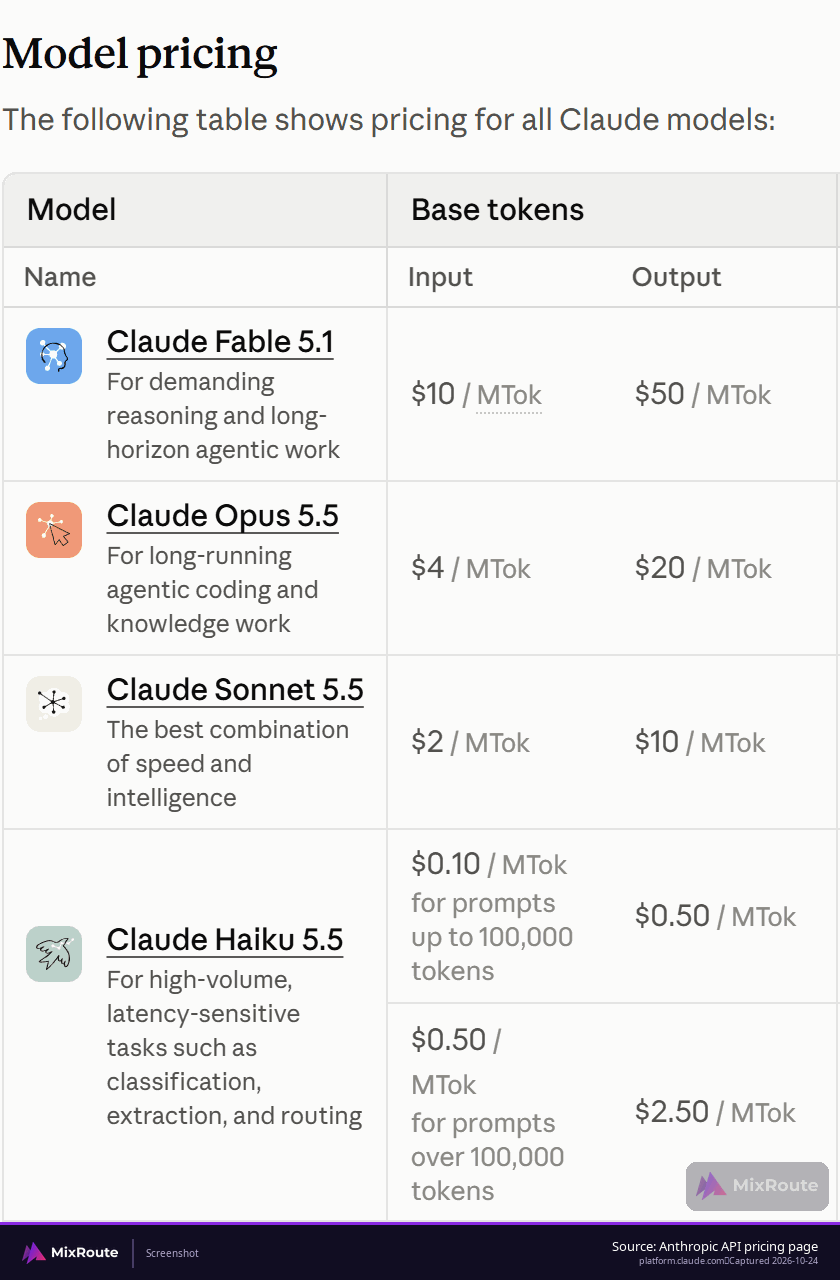
On Anthropic’s pricing page as of October 11, 2026, Sonnet 5.5 is $2 input and $10 output per million tokens, and Opus 5.5 is $4 and $20. Opus costs 2x Sonnet on both sides. Above them sit Fable 5.1 at $10 and $50, and Haiku 5.5 from $0.10 and $0.50 for prompts up to 100,000 tokens, then $0.50 and $2.50 above that.
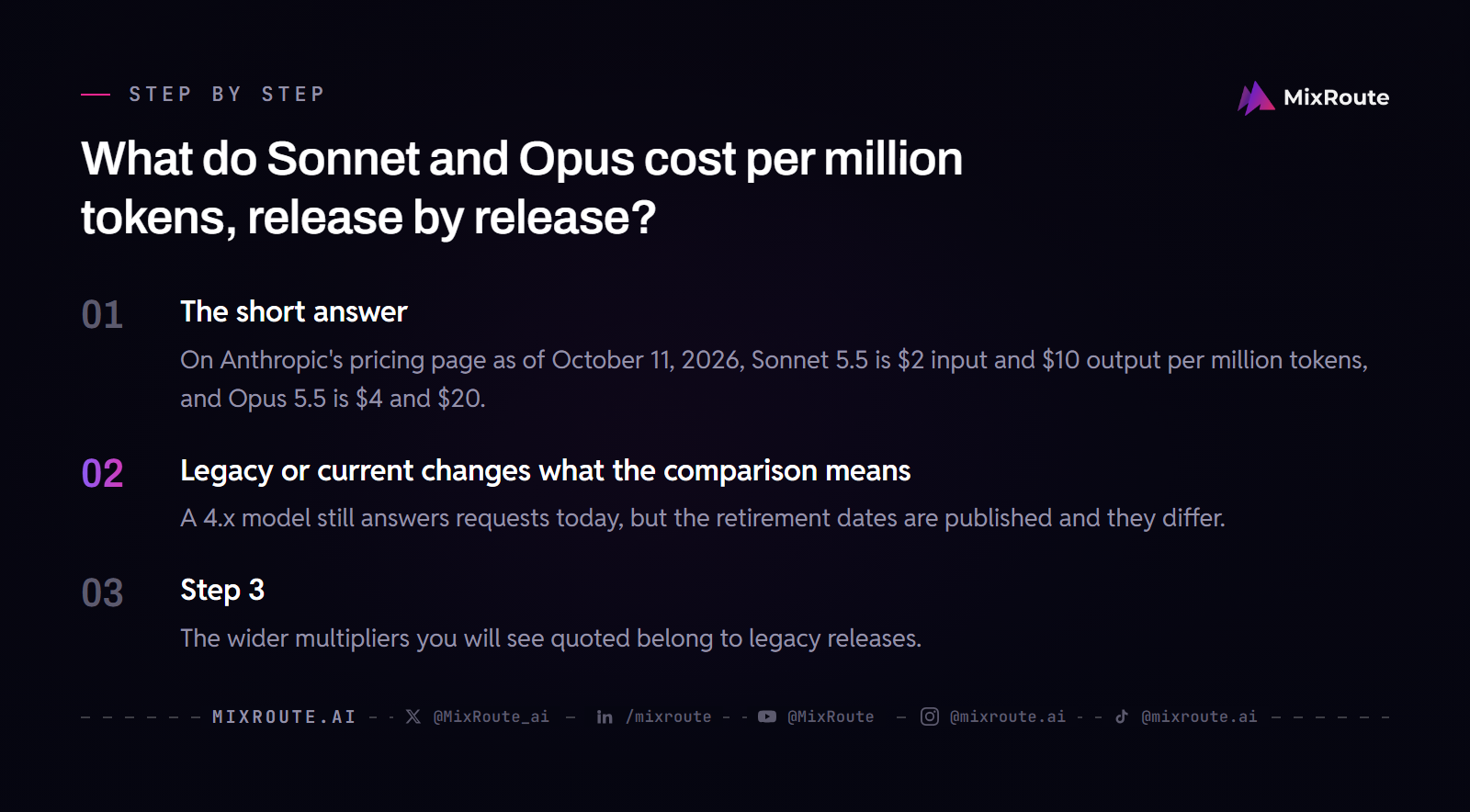
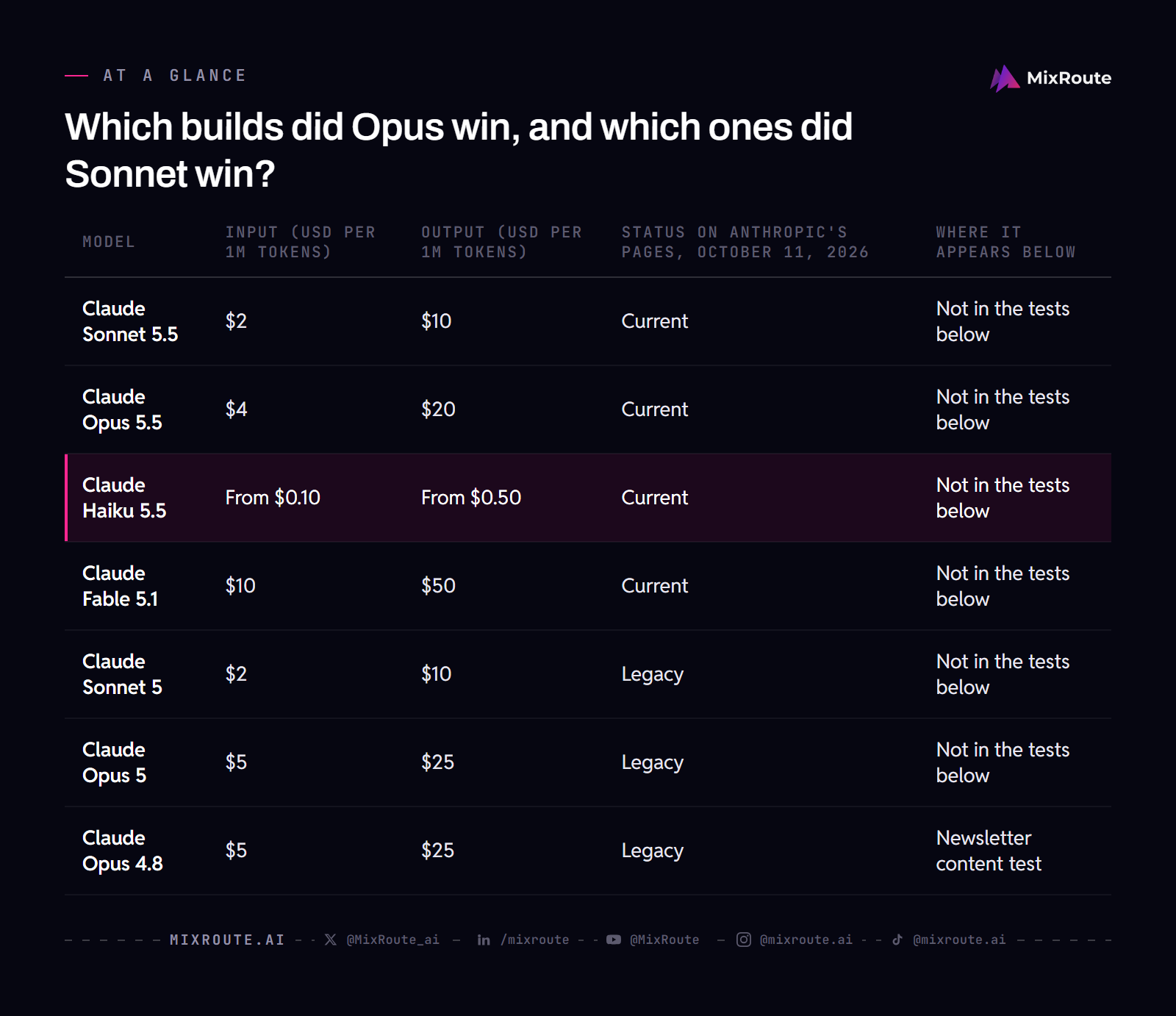
The wider multipliers you will see quoted belong to legacy releases. Opus 5 against Sonnet 5 was 2.5x, and every Opus from 4.5 through 4.8 sat at $5 and $25 against $3 and $15 for Sonnet 4.5 and 4.6, a 1.67x gap. Anthropic still publishes those rates and the 4.x models still answer requests today, but they are listed under legacy models now.
| Model | Input (USD per 1M tokens) | Output (USD per 1M tokens) | Status on Anthropic’s pages, October 11, 2026 | Where it appears below |
|---|---|---|---|---|
| Claude Sonnet 5.5 | $2 | $10 | Current | Not in the tests below |
| Claude Opus 5.5 | $4 | $20 | Current | Not in the tests below |
| Claude Haiku 5.5 | From $0.10 | From $0.50 | Current | Not in the tests below |
| Claude Fable 5.1 | $10 | $50 | Current | Not in the tests below |
| Claude Sonnet 5 | $2 | $10 | Legacy | Not in the tests below |
| Claude Opus 5 | $5 | $25 | Legacy | Not in the tests below |
| Claude Opus 4.8 | $5 | $25 | Legacy | Newsletter content test |
| Claude Opus 4.7 | $5 | $25 | Legacy | Newsletter content test |
| Claude Opus 4.6 | $5 | $25 | Legacy | Research-agent CLI |
| Claude Sonnet 4.6 | $3 | $15 | Legacy | Research-agent CLI |
| Claude Opus 4.5 | $5 | $25 | Legacy | One-shot blog build |
| Claude Sonnet 4.5 | $3 | $15 | Deprecated, retires November 30, 2026 | One-shot blog build |
Rates move, so the date travels with the number. The table also shows the current Sonnet row sitting below the legacy Sonnet row it replaced: $2 and $10 against $3 and $15 per million tokens. A comparison that names the tier without the release can put a legacy rate next to a current one without either side noticing.
Legacy or current changes what the comparison means
A 4.x model still answers requests today, but the retirement dates are published and they differ. Sonnet 4.5 was deprecated on September 30, 2026 and retires November 30, 2026, with claude-sonnet-5-5 as the recommended replacement. Opus 4.5 is committed only as not sooner than November 24, 2026, and Haiku 4.5 not sooner than October 15, 2026. Opus 4.6 through 4.8 and Sonnet 4.6 run into 2027. If a task of yours still runs on a 4.x model in production, that date is the one to plan around.
Repricing old token counts at new rates has a second trap. Claude 4.7 and later models use a newer tokenizer that produces roughly 30% more tokens for the same text, while Sonnet 4.6 and earlier use the previous one. The same document that cost a million input tokens on an older model does not stay at a million when it moves up a generation.
Which builds did Opus win, and which ones did Sonnet win?
Both comparisons ran on legacy releases. Opus 4.5 used 19.3% fewer tokens than Sonnet 4.5 on the same one-shot blog build and still cost about 41% more, while Sonnet 4.5 shipped more surface features for less money. In the second build, a research-agent CLI, Opus 4.6 finished with a working integration and Sonnet 4.6 left that integration broken after an attempted fix. Each build is one run, and the coding comparison says so in its own note.
The one-shot blog build: fewer tokens, bigger bill
One prompt, “Create a blog with posts, authors, and categories”, built once with each model in the author’s own content platform. Sonnet 4.5 burned 139,070 input tokens at $3 per million and 49,770 output tokens at $15 per million, about $1.16 for the build. Opus 4.5 burned 108,500 input tokens at $5 per million and 43,820 output tokens at $25 per million, about $1.64.
That arithmetic settles the common assumption that fewer tokens means a smaller bill. The Opus 4.5 rate runs 67% higher on both input and output, and a 19.3% token saving does not cover it. The author’s own conclusion is to pick Opus for the quality of its architectural decisions. He also priced the identical token counts at Sonnet 5’s $2 and $10 per million tokens and landed near $0.78, calling that a rough ceiling rather than a measurement, since a different model would not produce the same token counts on the same prompt.
The research-agent build: the integration that never finished
The second build asked each model to construct a Python research-pack project with a working CLI inside Claude Code. Opus 4.6 hit a test failure, fixed it fast, and shipped a working CLI plus integration using fewer tokens, at roughly $1.00 output-only. Sonnet 4.6 built most of the project and its CLI was mostly fine, but the integration still did not work after an attempted repair, at about $0.87 output-only, with more time and more tokens spent getting there.
What travels beyond that run is the failure mode: an end-to-end result that needed finishing by hand. If your own task can absorb a repair pass, the cheaper run is a reasonable bet.
Where does Opus’s higher rate stop paying off?
The rate sets a floor, not the bill. Three things sit between the rate table and your invoice: the effort setting you choose, how wordy the model runs on your task, and whether the work can wait for a batch or hit a prompt cache. Batch API requests are 50% off input and output, so Opus 5.5 drops to $2 and $10 per million tokens and Sonnet 5.5 to $1 and $5. Prompt cache reads cost 10% of the base input price on most models and 5% on Opus 5.5 and Sonnet 5.5, which is $0.20 and $0.10 per million tokens. On non-urgent or cache-heavy work, those two discounts change the bill without changing the tier.
Effort moves the bill without changing the tier
Effort is a dial next to the model picker in the app and a field called effort in the API. The levels run low, medium, high, xhigh and max. Most models default to high, while Opus 5.5 and Haiku 5.5 default to medium. Below high, answers come back faster and lighter. Above it, the model slows down and reasons more deeply before it writes a word.
Deeper reasoning means more tokens, and more tokens means a bigger bill or a faster burn through a plan’s usage limits. Lower effort buys speed and cheapness with less depth. One author’s habit from the newsletter test is high for most drafting, xhigh for the pieces that are voice-sensitive or reasoning-heavy, max rarely for prose because it burns a lot of tokens for very little extra polish, and low or medium for quick, high-volume jobs. Paying an Opus rate for a formatting pass at high effort is where the higher tier stops earning its rate.
The content test where the flagship did not win the copy round
Four models, one newsletter prompt, one source set, the author’s own voice rules, and the two newer Opus releases run at the higher effort setting. The result split by sub-task. Opus 4.8 led on strategy and on making sense of messy, unrelated inputs, while the sharpest strategic synthesis in that test came together under Opus 4.7 at higher effort. An older Opus, 4.6, produced the warmest, most on-brand copy and the headline the author liked best. Sonnet 4.6 wrote fluently and quickly but needed the most editing, mostly for the constructions the author’s style rules cut. The published issue borrowed its best sections from several models, and every draft got a human pass before it went out.
Accuracy was close across all four on the dozen checkable facts the author verified. The single miss came from Opus 4.8: summarizing a Forbes article it could not open, it assumed the author had written it. The other models said they could not fetch the article. Keep a human pass on anything drawn from a source the model could not read, whichever tier wrote it.
How do you test the pick on your own work without a runaway bill?
Run the same task on both tiers and compare where the answers differ, not how long they are. Start with a task you already know well, such as summarizing a report you have read yourself. Run the prompt on the lighter model first, then open a new chat and run the identical prompt on the heavier one. Because you can grade both outputs, the difference tells you which tier the task belongs to.
On the current releases the spec sheet does not decide it for you: Opus 5.5 and Sonnet 5.5 both carry a 1M-token context window and a 128K maximum output. The IDs that go into a request or an allowlist are claude-opus-5-5 and claude-sonnet-5-5, alongside claude-haiku-5-5 and claude-fable-5-1. What separates the two in the docs is latency, listed as moderate for Opus 5.5 against fast for Sonnet 5.5, plus price and capability.
Bound the experiment with key-level controls
A key on MixRoute carries its own model allowlist and its own spend budget, which makes this experiment cheap to enforce. model_limits_enabled turns the allowlist on and model_limits takes the list, so a test key can call Sonnet and nothing else. The budget field is remain_quota, documented as remaining quota in internal units, and the console text describes it plainly: “Enter the amount this key can still spend, not a cumulative total. Each request is deducted from it and the key stops when it reaches zero.” That is an allotted amount rather than a monthly quota or a rate limit, and your account balance stays the outer ceiling. These are key-level fields rather than routing controls; a model allowlist can reject a request for a model outside the list, so test with the models you intend to permit.
MixRoute’s pricing page lists a 0% platform fee and no markup on tokens.
When you are ready to put a real budget behind the experiment, compare the platform fee and plan terms.
When should you look past both tiers?
Haiku takes quick lookups, categorization, extraction and simple summaries at the lightest rate-limit cost, and Fable sits above Opus for long-horizon work where you would rather describe the outcome and let the model plan the steps. The guide’s own task table reads like this:
| Task | Guidance’s pick | Why |
|---|---|---|
| Summarizing articles | Haiku | Content extraction that needs no complex reasoning |
| Debugging code | Sonnet | Fast feedback with clear bug identification |
| Analyzing complex research papers | Opus | Deep analysis across long documents, including methodology critique |
| Building a working project from a rough idea | Fable | Plans the steps and keeps working with fewer mid-task check-ins |
The decisions that stay in the Sonnet-versus-Opus frame are the ones where a single attempt on Sonnet either answered or failed. When a task outgrows Sonnet toward many connected steps or dense source material, it has stopped being a two-tier question. Fable 5.1, the tier above Opus, lists at $10 input and $50 output per million tokens, with cache reads at $0.25 per million. For that wider frame, see how GPT-5.6 Sol and Claude Fable 5 compare.
FAQ
Is Opus worth the extra cost over Sonnet?
Only after Sonnet has failed on that same task. On a subscription plan the tradeoff shows up as how fast you burn your limits; through the API it is the per-token rate, $4 and $20 against $2 and $10 per million tokens on Opus 5.5 and Sonnet 5.5. A failed Sonnet attempt costs you one prompt you can read, and it tells you the shape of the task instead of leaving you guessing at difficulty. If the work can absorb a repair pass, the cheaper run stays a reasonable bet.
Which Sonnet and Opus releases are current?
Anthropic’s live lineup is Fable 5.1, Opus 5.5, Sonnet 5.5 and Haiku 5.5. Fable 5, Opus 5, Sonnet 5, Haiku 4.5 and the 4.x Sonnet and Opus releases sit under legacy models: still callable, still priced, no longer the current release of their tier. Sonnet 4.5 is the one with a hard date. It was deprecated on September 30, 2026 and retires November 30, 2026, with claude-sonnet-5-5 as the recommended replacement. For new work the pair that matters is Opus 5.5 at $4 and $20 against Sonnet 5.5 at $2 and $10 per million tokens.
Can I just run everything on Opus?
You can, on a paid Claude plan or through the API, and the cost lands in two different places. On a plan it is how fast you burn the usage limits; through the API it is the per-token bill. Opus 5.5 defaults to medium effort where most models default to high. Raising effort on top of the Opus rate is where the spend builds, and the app guide puts Fable 5.1 above both tiers on rate-limit weight.
Does the biggest model write the best copy?
No. In the newsletter test the flagship led on strategy while an older Opus produced the copy the author liked best, and Sonnet wrote fluently with the most editing needed afterward. Source access shapes the result as much as model size does: the one factual miss in that test came from the biggest model summarizing an article it could not open and assuming who had written it. Whatever tier drafts your copy, keep the human pass, and check anything drawn from a source the model could not actually read.
How do I keep a model experiment from running up a bill?
Give that key a named set of models and its own spend budget, and it stops when the amount you allotted is used up. On MixRoute the allowlist is model_limits_enabled with model_limits, and the budget is remain_quota. Set a small number first, then top it up once the task earns the spend. The budget is an allotted amount for that key rather than a monthly quota or a rate limit, and your account balance stays the outer ceiling.
Is the per-token rate the whole bill?
Not on its own. Effort changes how many tokens a run spends, so the same task at max effort costs more than the same task at low. Two discounts apply to either tier: batch requests are 50% off input and output, and prompt cache reads cost 10% of the base input price, or 5% on Opus 5.5 and Sonnet 5.5. Keep the first experiment small, and raise the effort setting only when the output needs it.
What does MixRoute change about this choice?
MixRoute adds no platform fee on top of provider token rates, and each API key can be limited to a named set of models with its own spend budget, so a Sonnet default and a bounded Opus path can live on one account. The token rates themselves are Anthropic’s, so the tier math does not change. What changes is how cheaply you can run the comparison: one key for the Sonnet baseline, one for the Opus path, each with its own cap.