Anthropic vs OpenAI: Which Products Fit Your Use Case
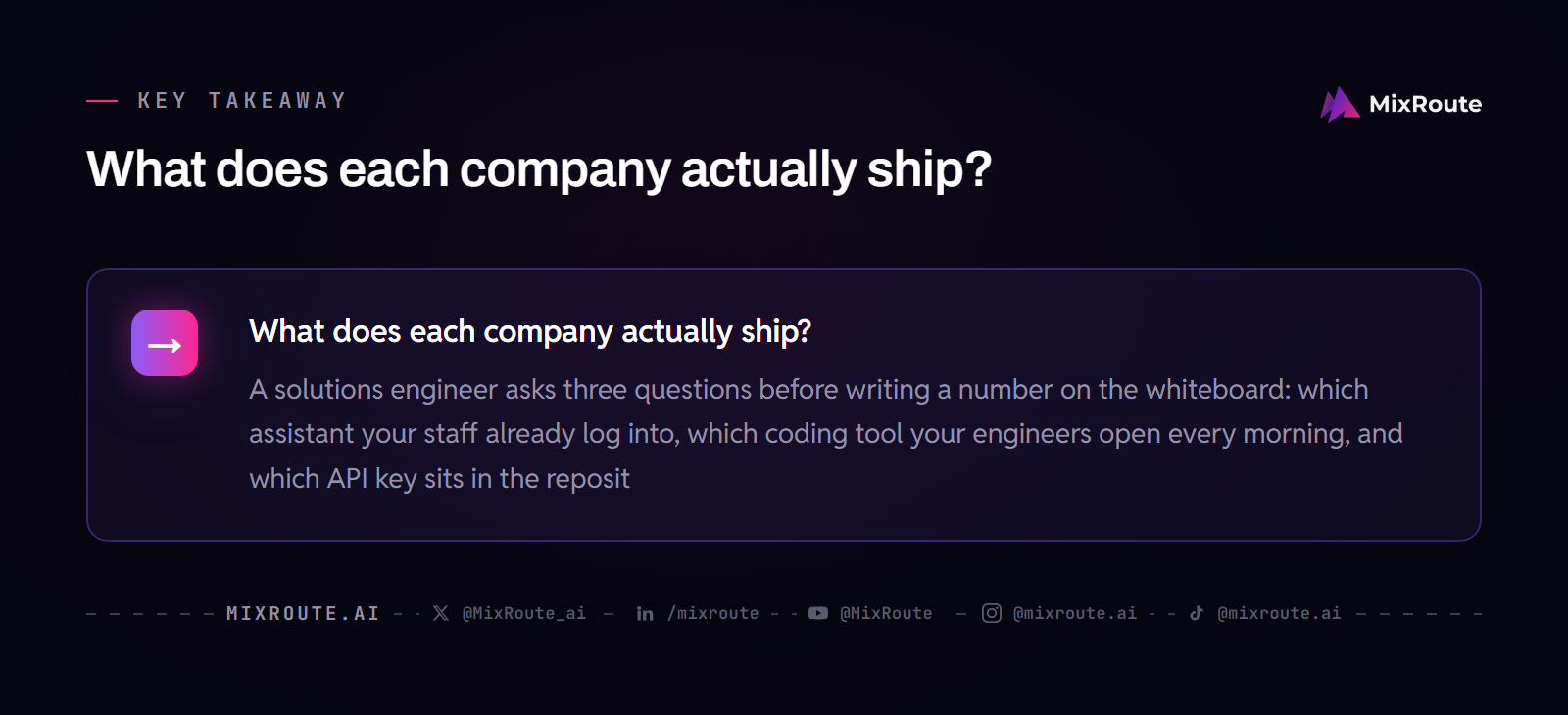
What does each company actually ship?
A solutions engineer asks three questions before writing a number on the whiteboard: which assistant your staff already log into, which coding tool your engineers open every morning, and which API key sits in the repository. The mistake is treating Anthropic versus OpenAI as a model beauty contest. Both vendors ship an assistant, a coding tool and a developer API, so the layer you are buying decides more than the logo does. OpenAI is the usual starting point for product-facing teams that need flexible APIs and broad tooling; Anthropic is the usual starting point where output has to stay steerable and predictable.
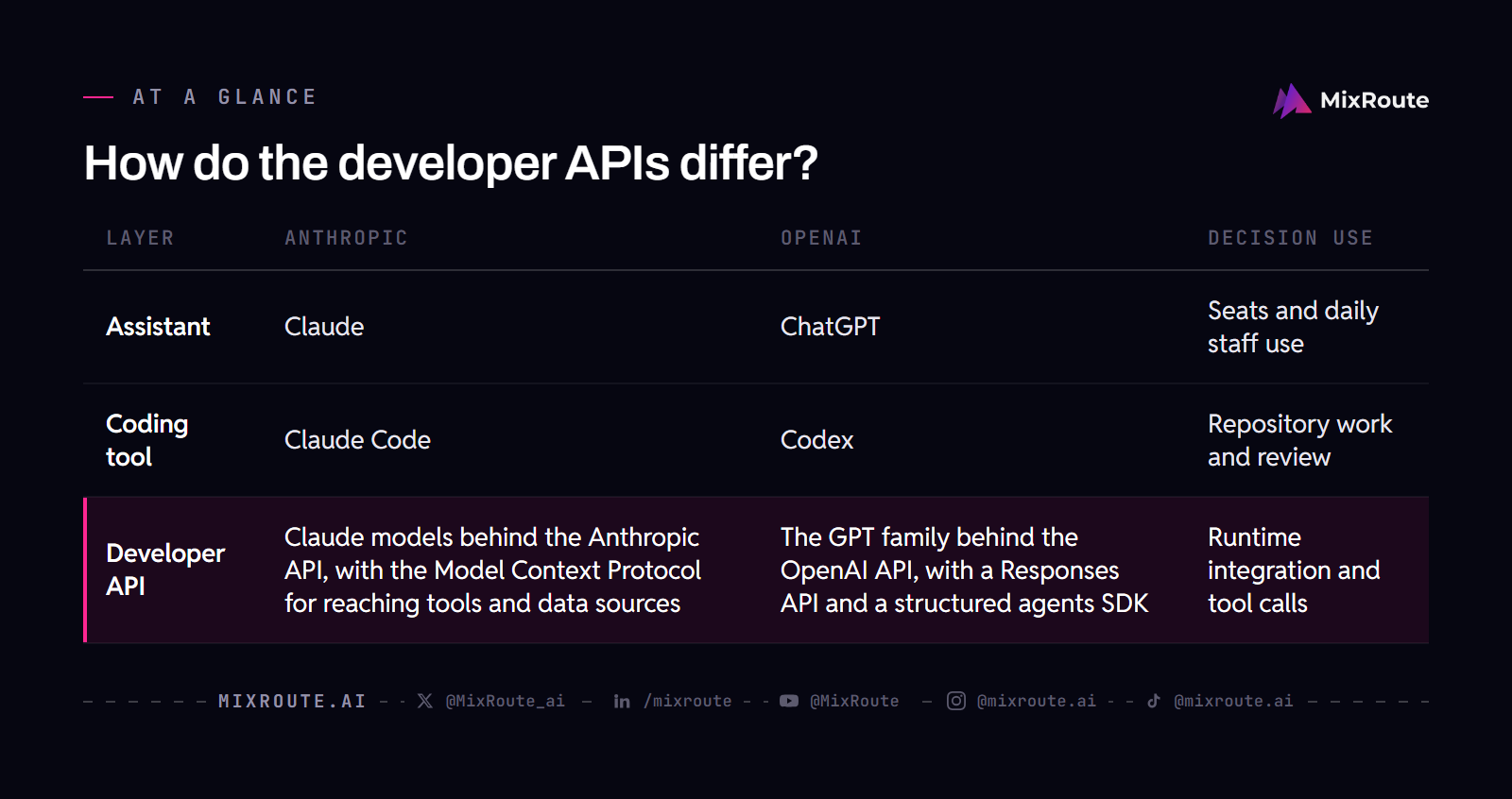
Claude and ChatGPT sit at the assistant layer, Claude Code and Codex at the coding-tool layer, and each vendor’s developer API at the bottom. The same three layers show up in MindStudio’s agent comparison, Ramp’s vendor comparison and Coursera’s overview, and the tier rates come from a dated Solvimon rate-card comparison.
Company-to-product map
| Layer | Anthropic | OpenAI | Decision use |
|---|---|---|---|
| Assistant | Claude | ChatGPT | Seats and daily staff use |
| Coding tool | Claude Code | Codex | Repository work and review |
| Developer API | Claude models behind the Anthropic API, with the Model Context Protocol for reaching tools and data sources | The GPT family behind the OpenAI API, with a Responses API and a structured agents SDK | Runtime integration and tool calls |
Buying the assistant is a subscription decision: seats, admin controls, a login your staff use every day. Buying the API is an engineering decision, and that is the one where you own the key, the retry behavior and the error body that lands at 2 a.m. when a request dies mid-stream.
The layer decides who owns the integration
A two-person startup shipping a chat panel feels almost none of this. They take an API key, drop it into an environment variable and move on. The layer question bites later, when the same team adds a coding assistant and then a document workflow that has to read a legal archive, and three keys, three invoices and three retry policies end up in one repository.
If the work is “our staff need a better assistant”, you are comparing seats. If it is “our product calls a model at runtime”, you are comparing APIs, and what the API layer hands you without extra code matters more than any claim about model quality.
Which ecosystem fits your use case?
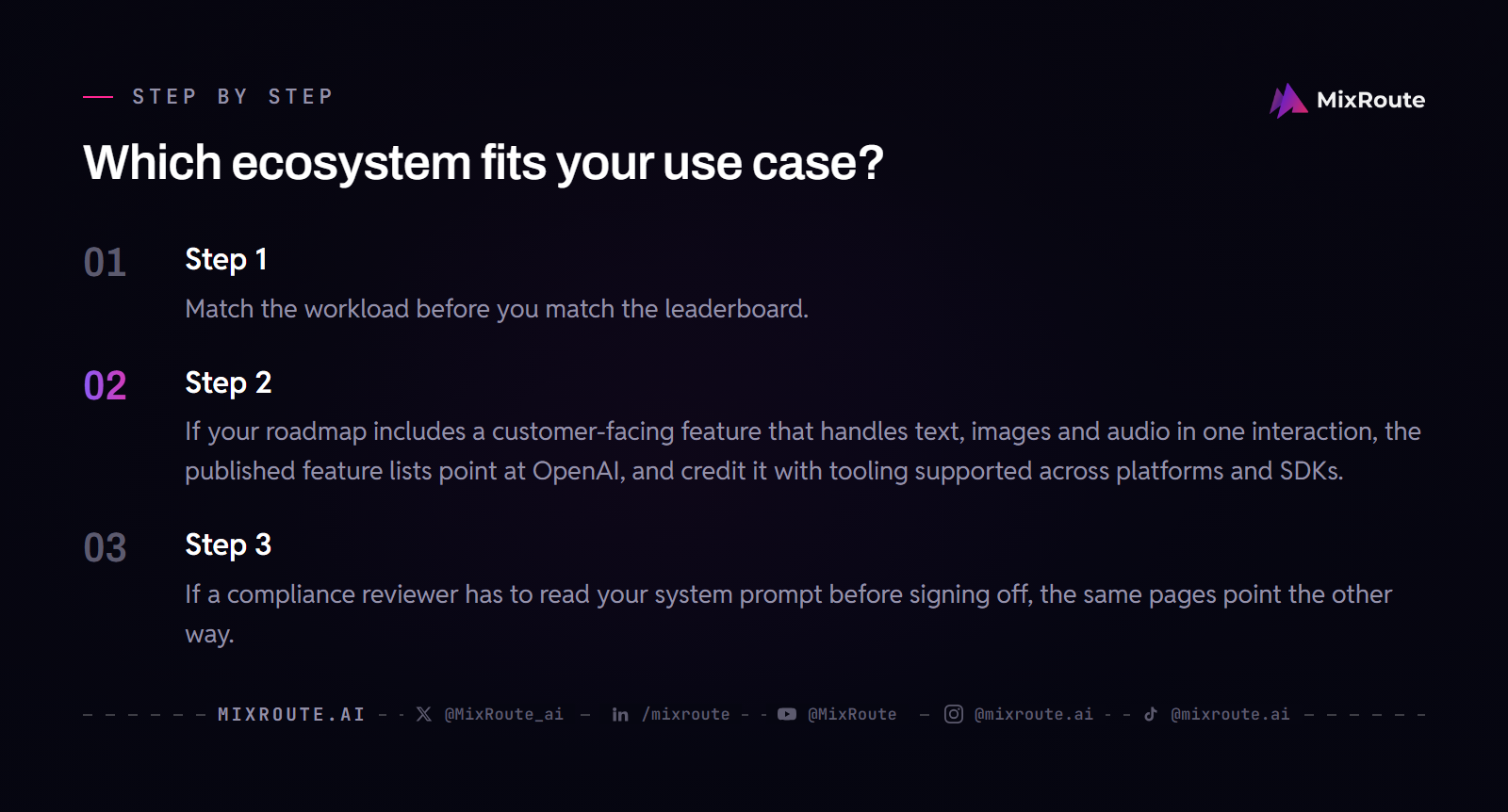
Match the workload before you match the leaderboard. Comparisons keep landing on the same split: OpenAI carries product-facing breadth, Anthropic carries work where the output has to stay steerable.
Match the workload to the job
- If your roadmap includes a customer-facing feature that handles text, images and audio in one interaction, the published feature lists point at OpenAI, and credit it with tooling supported across platforms and SDKs. That matters when your stack already runs on three of them.
- If a compliance reviewer has to read your system prompt before signing off, the same pages point the other way. Anthropic is described there as the stronger fit for steerable, predictable behavior, for compliance-heavy and customer-facing work, and for long-document analysis in legal or technical material.
- Drafting, brainstorming and general assistant use show up on both sides, so the layer you are buying matters more than the vendor for those tasks. A team writing release notes and answering support tickets is not making a frontier decision.
Use-case fit table
| Workload condition | Vendor described as a fit | What the condition changes |
|---|---|---|
| Customer-facing product with text, images and audio | OpenAI | Start with its listed multimodal and cross-platform tooling, then test the exact flow. |
| Compliance-heavy work that needs steerable, predictable output | Anthropic | Review the policy and permission boundary before choosing a model tier. |
| Drafting, research or general assistant use | Both | Choose the layer, data handling and integration path that fit the team. |
How do the developer APIs differ?
On the code side, the two vendors hand you different scaffolding. OpenAI’s side is described with a structured agents SDK released in early 2025 and named primitives: agents that carry instructions and tools, handoffs that pass control between them, and guardrails that validate input and output. Around it sits the Responses API, which replaced the older Assistants API and carries built-in web search, code execution and file retrieval. You get a working agent with fewer moving parts, provided the framework’s shape fits your application.
Anthropic’s side looks different. The Model Context Protocol, described as an open standard released in late 2024, defines how compatible agents connect to external tools and data sources. Write an MCP server once and any compatible agent can use it, so your team owns the server and the tools it exposes.
Agent frameworks and tool wiring
The difference shows up the first time your agent has to reach outside the model. With a built-in tool, the vendor owns the call and you inherit its behavior. With a protocol, you own the server and decide what it exposes. Neither is free: a protocol means somebody on your team maintains the thing on the other end.
Where a coding tool puts its guardrails
A third-party analysis of the two skill systems found nearly identical file structures, both built around SKILL.md files with YAML frontmatter, and very different instructions about what the model should run and what it should only read. The OpenAI side describes a render-inspect loop, where a document is generated, rendered to an image and inspected until the layout is clean. The Anthropic side describes explicit levels of freedom, from “run exactly this script” up to text instructions where several approaches are valid, plus permission boundaries that keep a human in the loop. That analysis works from official documentation, GitHub repositories, leaked system prompts and developer discussion, so treat it as context rather than an implementation specification.
This is a governance question wearing a tooling costume. If your repository is regulated, being able to say “run this migration script and do not modify the command” is worth more than a cleverer review loop.
Context windows belong to individual model versions, so a context number without a model name and a date is wrong within a quarter. Claude Opus 5.5 and Sonnet 5.5 both carry a 1M-token window.
Developer API differences table
| API question | Anthropic | OpenAI | Dated context |
|---|---|---|---|
| Agent framework | Model Context Protocol for connecting compatible agents to tools and data | Structured Agents SDK with agents, handoffs and guardrails | Descriptions captured in late 2024 and early 2025 |
| Built-in tools | Server tools such as web search, web fetch and code execution run on Anthropic’s infrastructure; MCP covers the tools you host yourself | The Responses API includes web search, code execution and file search | Vendor documentation |
| Context window | 1M on Claude Opus 5.5 and Sonnet 5.5 | 1.05M on gpt-6-astra and gpt-6.1-sol; prompts over 272K input tokens bill at higher rates | Vendor documentation |
Which model tier should you start with?
Start one tier below where you want to be. Both vendors publish a value tier, a mid tier and a flagship, and the table below carries their list rates per million tokens. The first version of most features does not need the top one. Pick the small model, watch where it fails, and move up when the failure is about capability rather than prompt wording.
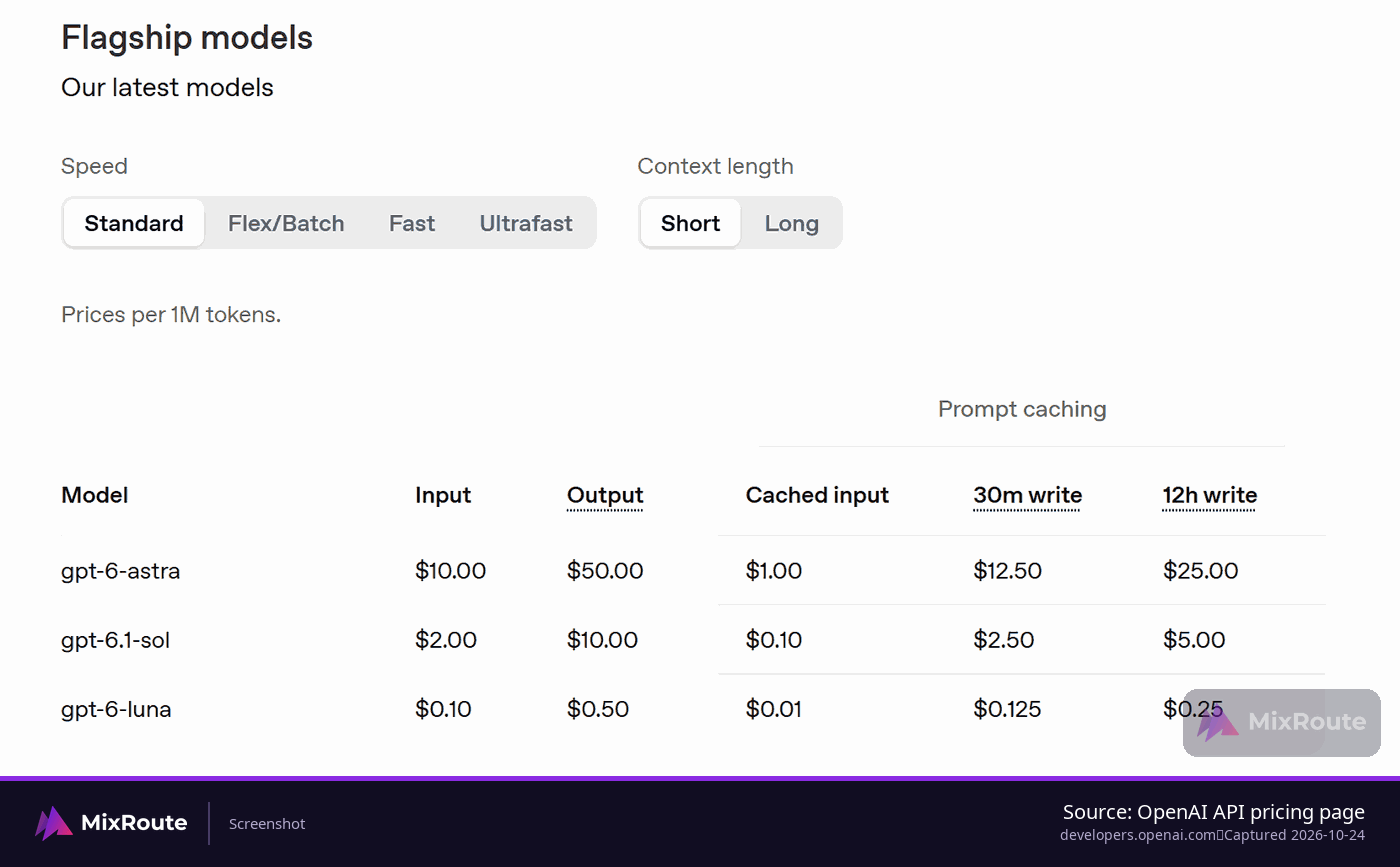
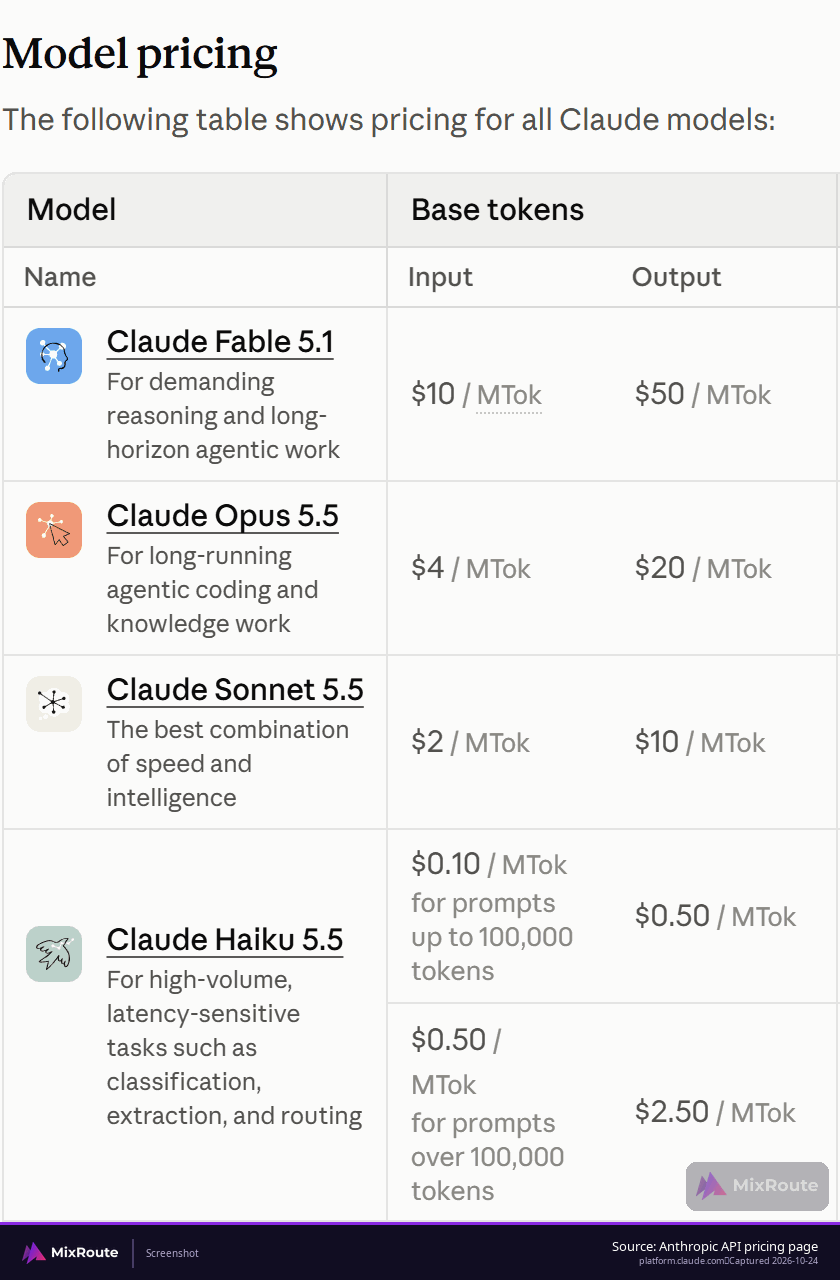
| Tier (list rates, October 12, 2026) | Input per 1M tokens | Output per 1M tokens | Note |
|---|---|---|---|
| gpt-6-astra | $10.00 | $50.00 | OpenAI flagship |
| Claude Opus 5.5 | $4.00 | $20.00 | Anthropic default for most workloads |
| gpt-6.1-sol | $2.00 | $10.00 | OpenAI mid tier |
| Claude Sonnet 5.5 | $2.00 | $10.00 | Anthropic mid tier |
| gpt-6-luna | $0.10 | $0.50 | OpenAI value tier |
| Claude Haiku 5.5 | $0.10 | $0.50 | Anthropic value tier; prompts over 100,000 tokens bill at $0.50 and $2.50 |
What the tokenizer does to the bill
Two prompts of the same length are not the same bill. The newer Claude tokenizer turns the same text into roughly 30% more tokens than earlier Claude models did, so a budget carried over from an older Claude model understates the cost per request by about that margin.
That roughly 30% figure is Anthropic’s own approximation rather than a measurement on your own traffic, and its pricing page says the exact increase depends on the content and workload shape, so treat it as a budget input, not a fixed multiplier. How your prompts tokenize decides the rest.
Claude Fable 5.1 sits above Opus 5.5 in Anthropic’s lineup at $10/$50 per million tokens, the same list rate as gpt-6-astra. If that premium tier is the one you are weighing, compare gpt-5.6-sol and Claude Fable 5 model by model before you commit.
Do you have to choose one vendor?
No. Comparisons describe multi-model use as common, with different models at different steps inside one product.
The engineering point holds either way, because each vendor’s API still means its own key, its own client and its own line on the invoice.
One key instead of two integrations
MixRoute sells one API key across 250+ models, which removes one integration while leaving both vendors available. Point the OpenAI SDK at https://api.mixroute.ai/v1 and the model name stays unchanged. Point the Anthropic SDK at https://api.mixroute.ai and client.messages.create keeps working, because the compatible Messages endpoint at https://api.mixroute.ai/v1/messages accepts native Anthropic request and response formats. You receive one key and one bill, and the pricing page lists a 0% platform fee on inference.
The migration itself uses the same client with a new key and a new base URL, as long as you stay on the route you already use. Mixing the two routes is a different job: moving from the Anthropic SDK route onto the OpenAI-compatible Chat Completions path means rewriting the client, because the request and response formats differ. That sits between two full integrations and a single-vendor commitment.
How fast do the prices and model names move?
Faster than any cost model you build this quarter stays accurate. A dated index counts six documented list-price events for each vendor in the twelve months before July 2026, and Anthropic’s pricing page now confirms that the $2/$10 per million token rate introduced with Claude Sonnet 5 is the standard price, which Claude Sonnet 5.5 also lists: the increase to $3/$15 scheduled for September 1, 2026 will not happen.
A tier name from a July snapshot can still exist in December at a different rate, and the reverse happens too.
A vendor cuts a flagship price, and every cost model built on the old card is quietly wrong. The index counts list prices only, so negotiated enterprise rates sit outside it. For a decision you have to defend later, use a value tier in production, a mid tier behind a feature flag, and a rate card with a scheduled recheck.
FAQ
Is Claude better than GPT?
Neither wins outright, and the comparisons tie the answer to the job. Claude is described as the stronger fit where output has to stay steerable and judgment-heavy; GPT is described as the stronger fit where tooling and integration breadth matter. The useful question is which failure costs you more: an answer that drifts off your internal policy on turn twelve, or an integration you write yourself because the SDK does not cover it. A support bot and a contract summarizer can answer that question differently.
Can I use both vendors in one product?
Yes. Comparisons describe the choice as not either-or, and the practical shape is a step-level split: the step that summarizes a contract and the step that answers a customer carry different risk, so they do not need the same model behind them. Running both through their own APIs means two keys, two clients and two lines on the invoice. MixRoute sells one key across 250+ models instead, so each step can point at a different vendor without a second integration.
Which one is better for coding work?
Both ship coding surfaces. Third-party feature lists credit Claude with clean, well-structured code generation, and list multilingual coding through Codex on the OpenAI side. The cons matter as much as the pros: the Anthropic list flags more conservative creative output, and the OpenAI list balances fast prototyping against accuracy risk that comes from its training data. For repository work the deciding factor is the guardrail rather than the benchmark: can the tool be told to run one script and touch nothing else?
Is the Claude API or the OpenAI API cheaper?
It depends on your input and output mix. At current list prices the matching tiers are level: Claude Fable 5.1 and gpt-6-astra both list $10 per million input tokens and $50 per million output tokens, and Claude Sonnet 5.5 and gpt-6.1-sol both list $2 and $10. Token counts can still tilt it: Anthropic says its newer tokenizer produces roughly 30% more tokens for the same text than earlier Claude models did, and each vendor counts tokens its own way, so an identical prompt can land on different totals even when the rates match. A rate-card comparison will not settle it; a token count on your own prompts will.
What is the Model Context Protocol for?
It is an open standard, released in late 2024, for connecting compatible agents to external tools and data sources, and it matters whenever an agent has to reach systems outside the model. Because one server can serve any compatible agent, it turns up in code editors and coding environments as well as inside Claude. The trade-off is ownership: your team runs the server, so what it exposes and how it authenticates are yours to define.
Why can the same text cost more on Claude?
Because you pay per token, not per character. The newer Claude tokenizer turns the same text into roughly 30% more tokens, so a matching input rate does not produce a matching total. It applies to the current Claude models, Fable 5.1 and Sonnet 5.5 among them. Two prompts of identical length can land on different bills, and only a token count on your own text shows which one you are paying for.
Which vendor fits enterprise agents?
Both are listed as strong for enterprise work with different priorities: OpenAI on API maturity and developer community, Anthropic on steerability, permissions and how the setup presents to a compliance reviewer. The decision then moves to procurement, where data handling, published guidance and your own legal team’s review carry more weight than a leaderboard score. One practical input is the assistant your staff already log into, because that is the seat you will be supporting either way.