AI API Gateway vs API Aggregator: Architecture, Control, and Trade-offs
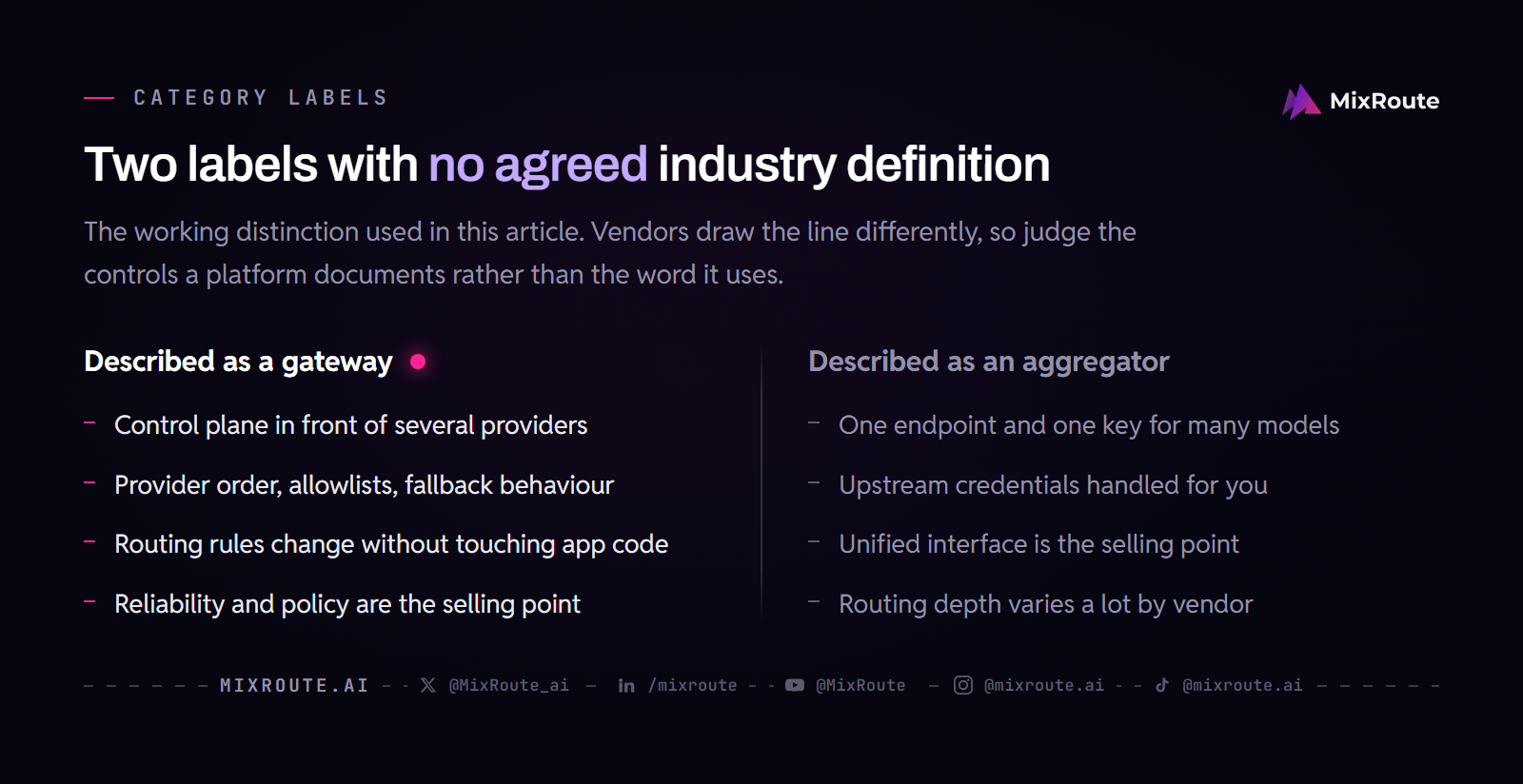
An AI API gateway is a control plane that routes requests across providers with policies, while an API aggregator primarily consolidates multiple APIs behind one endpoint, often focusing on access and billing. Neither term has an agreed industry definition and vendors draw the line differently, so treat this as the working distinction used in this article rather than a settled classification of any particular product. The operational difference is not about feature checklists but about where routing intelligence, cost control, and reliability mechanisms actually live. For a production team, the choice between these categories determines who owns failover logic, how your billing is structured, and who you call when a model provider goes down.
AI API Gateway vs API Aggregator: What’s the Difference?
The core difference is architectural: a gateway acts as a control plane with routing policies and provider-agnostic logic, while an aggregator centralizes access through a single endpoint, primarily managing authentication and billing.
Definition of AI API gateway
An AI API gateway is a hosted service or deployable software layer that sits between your application and multiple model providers. Its primary function is to manage the traffic flow based on a set of policies you define. This includes provider selection, fallback order, and load balancing. The gateway becomes the single point of entry for all your inference requests, allowing you to change routing rules without modifying your application code.
Definition of API aggregator
An API aggregator consolidates multiple APIs behind a single, unified endpoint. In the context of AI, this means you use one API key and one interface to access dozens of models. The aggregator handles the integration with each upstream provider, so you do not have to maintain multiple SDKs or authentication protocols. While it simplifies access, the aggregator’s primary job is to unify the interface. That does not imply weak routing. OpenRouter, for example, exposes order, only, ignore and allow_fallbacks as request parameters. Judge the specific vendor rather than the label.
Key differences at a glance
To make a choice, you have to look at the operational control you are given. The table below breaks down the fundamental differences in roles and capabilities.
| Characteristic | AI API Gateway | API Aggregator |
|---|---|---|
| Primary role | Control plane for traffic and policies | Point of consolidation for API access |
| Routing logic | Often granular, based on cost, latency, or custom rules | Varies widely. Some document ordering, allowlists and fallbacks as request parameters. |
| Billing mechanism | Can be subscription, usage-based, or pass-through | Varies: platform or top-up fees, credit-purchase fees, or per-token markups |
| Operational focus | Reliability, policy enforcement, and observability | Unified access and payment processing |
Architecture: Where Does the Control Plane Live?
The architecture determines who holds the logic for selecting and failing over between providers, and the placement of that logic defines the operating model.
Hosted gateway architecture
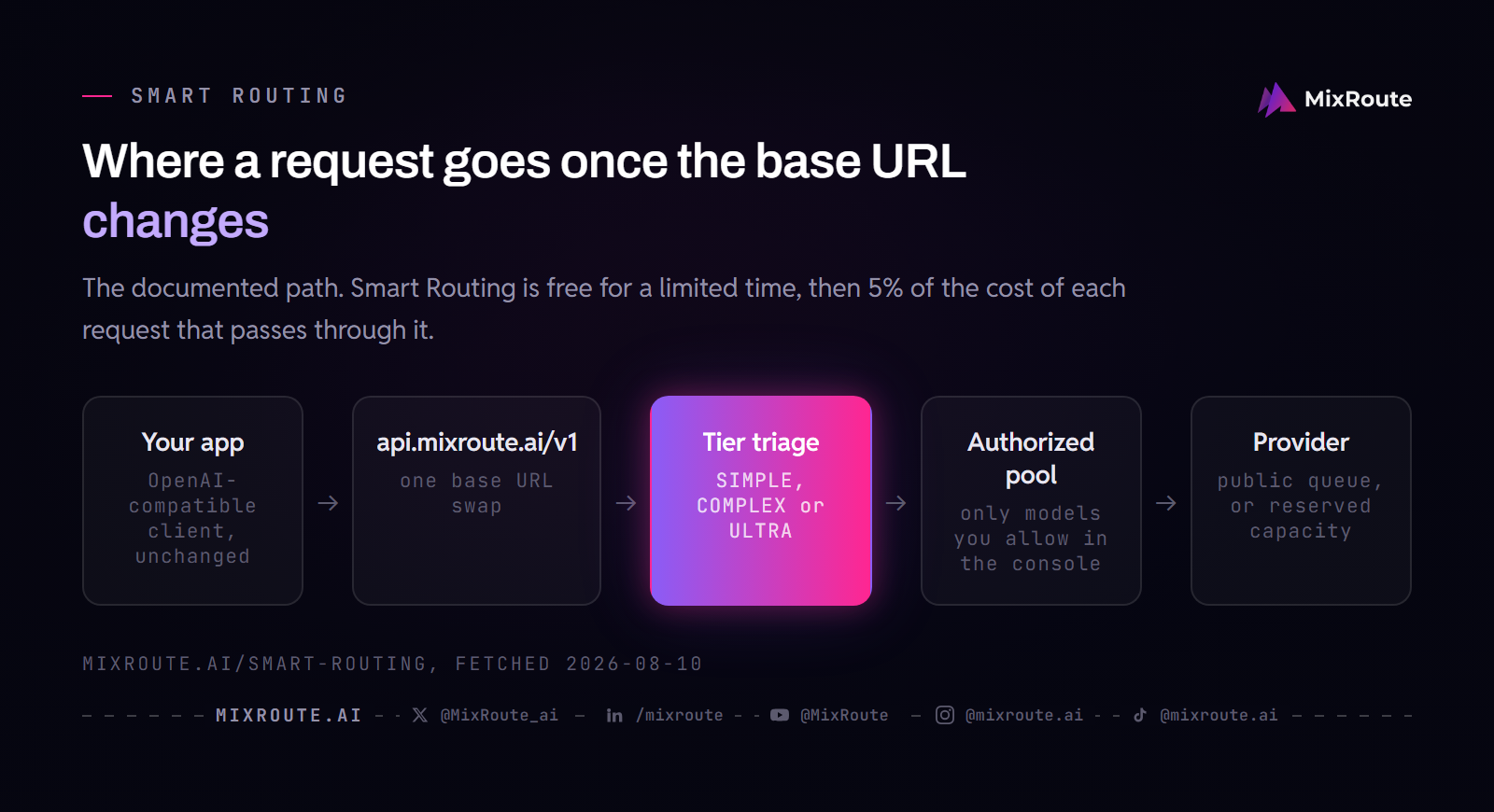
Hosted gateways, such as MixRoute, run the control plane on their own infrastructure. For the customer, integration is one change: point the base URL at https://api.mixroute.ai/v1 and keep your existing OpenAI-compatible client. This shifts the burden of maintaining the routing layer to the vendor. The vendor operates, scales, and monitors the infrastructure. Customers do not deploy or manage any gateway software in their own cloud.
Aggregator architecture
Aggregators also run as hosted services, but they often position themselves as a pass-through layer. They provide the unified endpoint and handle upstream credentials, but the degree of routing intelligence can be more limited. Some hosts provide extensive control. For instance, OpenRouter documents provider routing controls and states: “If Provider A fails, then Provider C will be tried next,” as of 2026-08-10. This shows that the line between a gateway and an aggregator is not strict, but the architectural intent differs.
Deployment models and implications
MixRoute is a hosted service, not software you deploy. This is a critical distinction. You are not buying a piece of software to run on your own Kubernetes cluster. You are buying a managed service. The implication is that you trade infrastructure control for operational simplicity. You do not have to worry about scaling the gateway itself or patching it, but you also do not have the ability to run custom code inside the request path.
Control: Routing, Fallbacks, and Custom Logic
Control is defined by the granularity of the routing rules and the ability to customize behavior without modifying your own application code.
Routing controls in gateways
A gateway offers granular controls over how requests are dispatched. This includes setting a strict provider order, defining allowlists and blocklists, and controlling fallback behavior. MixRoute, for example, offers Smart Routing. This feature tiers requests into SIMPLE, COMPLEX, and ULTRA categories. It can only select inside the model pool the user authorizes. This is a control feature, not just a load balancer. However, customization is tier-gated, not absent. The SCALE tier includes custom routing strategies, while the ENTERPRISE tier adds a service contract and a dedicated manager. What is not available at any tier is customer-written middleware or code running inside MixRoute.
Routing options in aggregators
Aggregators are not without routing features. Many offer basic provider failover. OpenRouter specifically documents several controls you can use: order to try providers in a specific order, only as an allowlist, ignore as a skip list, and allow_fallbacks to enable backup providers when the primary is unavailable. They also support model fallback arrays and provider sorting. That is a substantial level of control, and it means some hosts in the aggregation category provide real routing logic rather than a fixed path.
Customization and extensibility
Customization in this context refers to the ability to encode business logic into the routing path. If your application requires very specific rules about cost ceilings or latency targets, the platform must support that. MixRoute offers custom routing strategies at higher tiers. However, the platforms are not generally built for running custom code functions. For total control over middleware, an organization might still need to build a thin orchestration layer internally, regardless of whether they choose a gateway or an aggregator.
Billing: Fees, Markups, and Credit Terms
Billing structures reveal the underlying business model of the provider, and they are very distinct between gateways and aggregators.
Fee structures
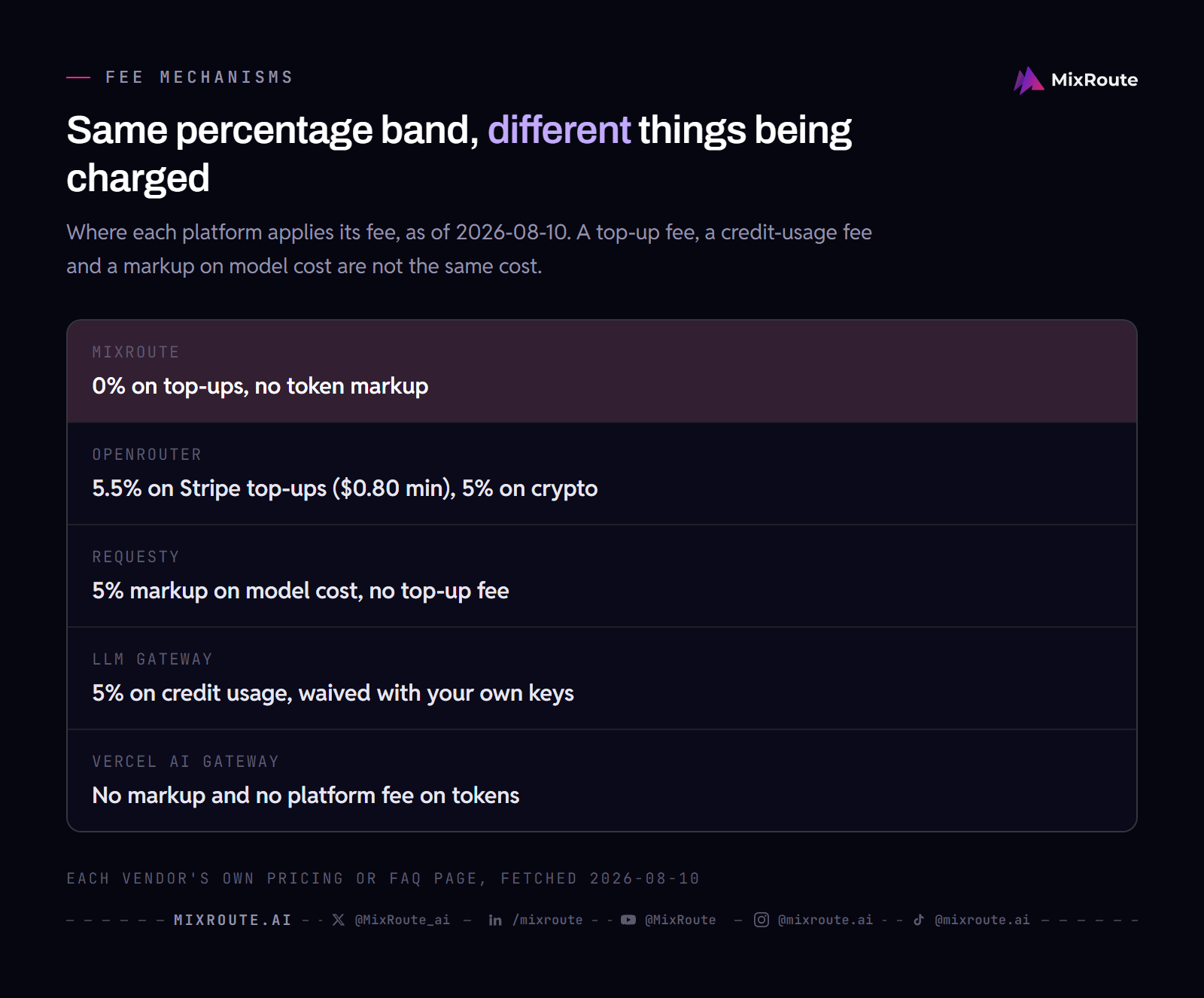
Fee structures fall into two primary categories: subscription/platform fees and usage-based markups. Platform fees in this band land in different places. OpenRouter charges 5.5% with a $0.80 minimum on Stripe top-ups, and 5% on crypto top-ups, as of 2026-08-10. Requesty applies a 5% markup on model cost instead of a top-up fee, so a model listed at $10 per million tokens costs $10.50 through it. LLM Gateway charges a flat 5% platform fee when you purchase credits and waives it when you bring your own provider keys. These fees are visible.
Markup and pass-through pricing
Some platforms make money on the spread between what you pay and what the provider charges. This is a token markup. Others pass through provider pricing exactly. The marketplace has different strategies. Vercel AI Gateway states it charges no markup and no platform fee on tokens, as of 2026-08-10. MixRoute does not mark up token prices and top-ups carry no platform fee. It earns through provider partnerships and volume agreements. The optional Smart Routing feature is the one exception, and it is priced separately below. This is a reseller cost structure, distinct from a fee-on-top-up model.
Credit policies and expiry
Terms also differ on liquidity. MixRoute credits never expire. This is a critical operational detail. Some platforms may impose credit expiry, which forces you to use prepaid amounts within a window. Additionally, MixRoute offers bonus tiers on deposits: GROWTH ($1,000-$4,999) gives 2% capped at $100, PRO gives 3% capped at $450, and SCALE gives 5% capped at $1,500. This pricing structure is part of the operating model decision. Smart Routing is optional and completely free, with no routing service fee. You only pay for actual usage of the selected model.
| Billing Component | MixRoute | OpenRouter (as of 2026-08-10) |
|---|---|---|
| Top-up fee | 0% | 5.5% (Stripe), 5% (crypto) |
| Token markup | No markup | No markup on inference |
| Credit expiry | Never expire | Reserves the right to expire unused credits after one year |
| Optional feature fee | Free Smart Routing; no routing service fee | N/A |
Reliability: Failover, Capacity, and Observability
Reliability encompasses failover mechanisms, capacity guarantees, and the depth of telemetry you can access.
Failover mechanisms
Failover is the ability to route around a failing provider. Both categories can implement this, but the quality depends on the platform. OpenRouter documents sequential fallback across providers, and a models array that falls back to the next model on context-length errors, moderation flags, rate limiting and downtime. More sophisticated gateways might allow for conditional fallbacks based on error types, but that is not guaranteed.
Capacity and reservations
Capacity is where gateways can differ significantly from simple aggregators. MixRoute offers Reserved Capacity. This buys provisioned throughput from cloud providers so that requests use a dedicated pool instead of the public queue. This is not a guarantee of endless scale, but it does provide a mechanism for avoiding the noisy-neighbor problem of the public queue. This capacity adjusts quarterly. For production workloads that cannot tolerate queuing delays, reserved capacity is a differentiator.
Observability and monitoring
Observability involves the data you get back about your traffic. You need to know token counts, latency, and cost per request. MixRoute has a zero data retention policy beyond billing metadata, meaning they track token counts, latency, and cost. They do not log request/response content. This is a precise and important detail. If your workload deals with sensitive data, the absence of content logging is a compliance win. You should verify what telemetry is exported to your own monitoring stack.
Operating Responsibility: Who Runs What?
The operating model dictates the division of labor between your team and the vendor for infrastructure uptime and scaling.
Managed vs. self-managed
Hosted gateways and aggregators are both managed services. The vendor owns the infrastructure. This means the vendor is responsible for the gateway’s uptime, scaling, and patching. With MixRoute, customers do not operate, scale, or monitor any MixRoute infrastructure. This is a full shift of operational burden. Self-hosted gateways exist in the market, but they are not the same product category as hosted services. If a product is self-hosted, the burden of scaling and monitoring falls squarely on your platform team.
Scaling and maintenance
With a hosted service, scaling is the vendor’s problem. When a new model is released, the vendor integrates it. MixRoute provides access to 200+ models through a single endpoint, and the maintenance of those integrations is handled upstream. With an aggregator, you get access to many models immediately, but you are still responsible for managing the request patterns on your side. You are not patching the gateway, but you are responsible for making sure your clients handle rate limits and errors correctly.
Monitoring and support
Support levels vary. Enterprise tiers generally include a dedicated manager and a service contract. This shifts monitoring of the relationship to the vendor. For lower tiers, support is typically via ticketing or chat. It is worth noting that MixRoute does not document an identity provider integration or a logging pipeline integration. It is not documented, rather than asserting that it does not exist. You must assume that you will build the integration between your internal monitoring and the gateway’s cost/latency data.
Decision Matrix: Which Operating Model Fits Your Team?
Use this matrix to evaluate your needs across control, cost, reliability, and operational overhead, and to rule out categories early based on disqualifiers.
| Requirement | Choose a Gateway (e.g., MixRoute) | Choose Hosted Aggregation |
|---|---|---|
| Data privacy | Zero data retention beyond billing metadata is acceptable | Must confirm the logging policy of the specific vendor |
| Fine-grained routing logic | Custom routing strategies at SCALE and ENTERPRISE tiers | Provider ordering and fallbacks via documented API params |
| Billing simplicity | 0% top-up fee, credits never expire, reseller model | 5-10% platform fee band, credit expiry terms vary |
| Dedicated capacity mechanism | Reserved Capacity dedicated pool, quarterly adjustment | The OpenRouter provider-routing pages reviewed on 2026-08-10 did not document a dedicated capacity option; verify the current product scope before purchase. |
Decision criteria
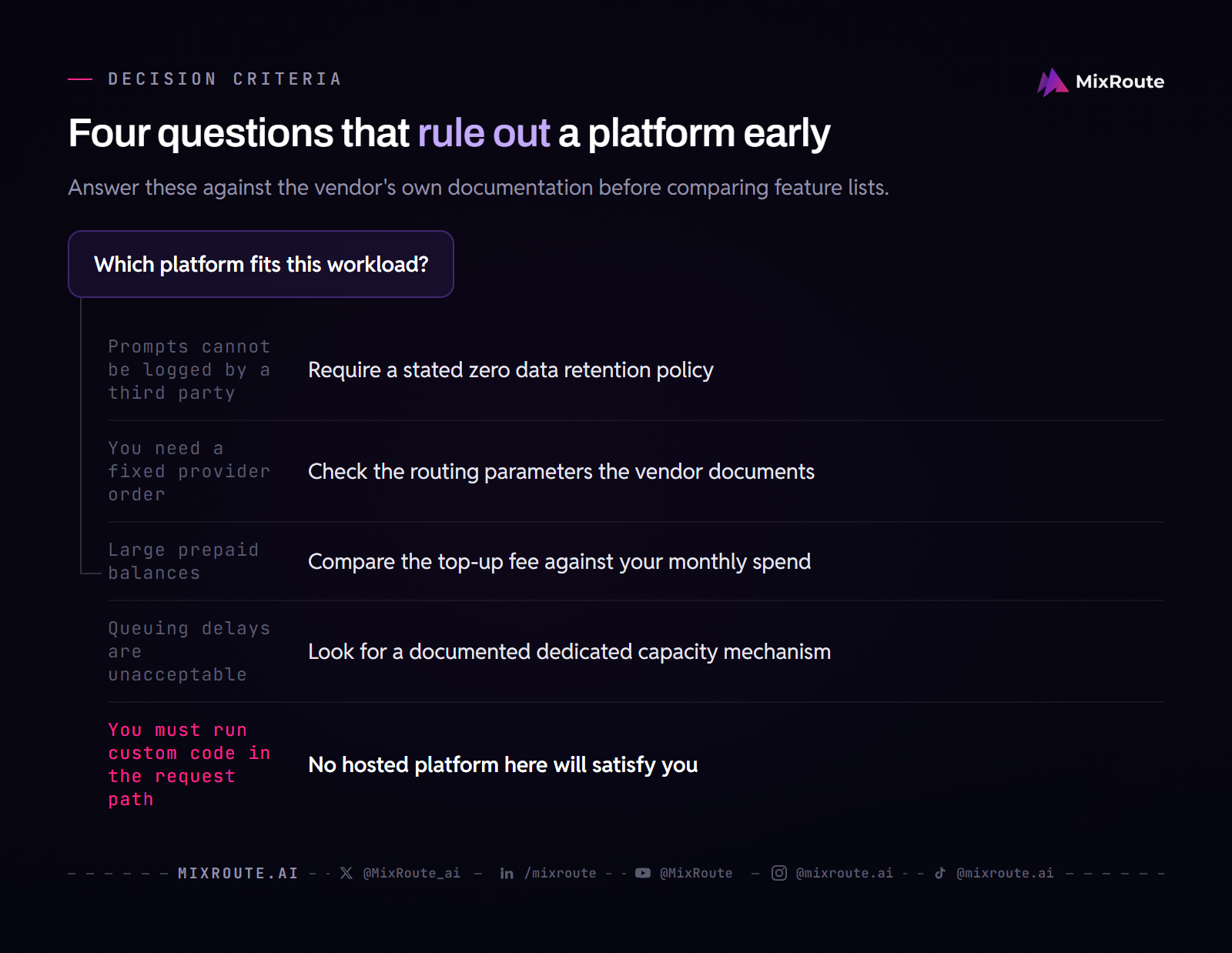
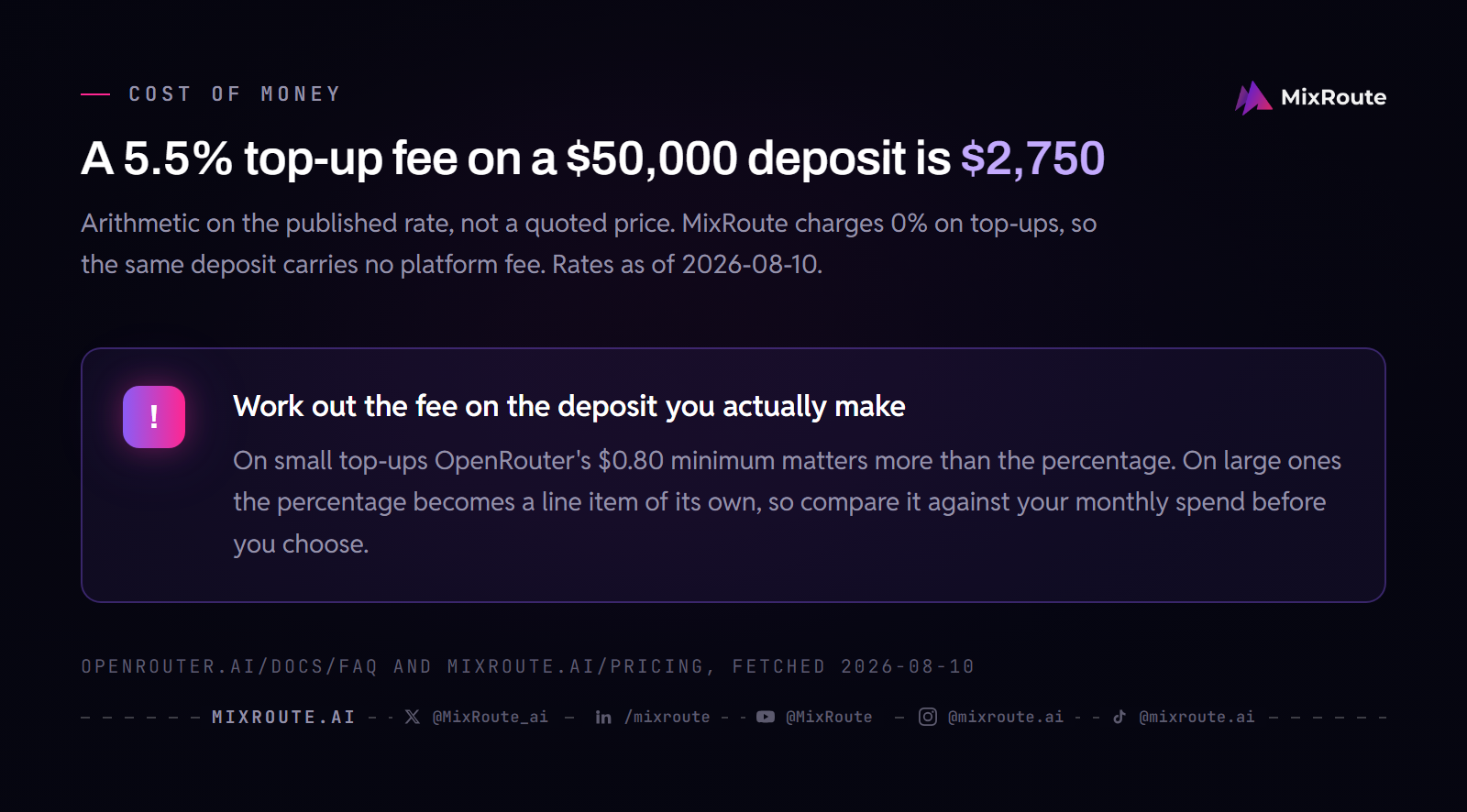
Your first criterion should be data retention. If your application sends sensitive prompts that cannot be logged by a third party, you need a platform that explicitly states a zero retention policy. Your second criterion is routing logic. If you need a fixed order of providers to control cost, you need to ensure the platform supports that specific operation. Your third criterion is the cost of money. Compare the top-up fee to your operational spend. A 5.5% top-up fee on a $50,000 deposit is $2,750. That might be acceptable for some, but it is a line item to calculate.
Disqualifiers
Ruling out a category quickly saves time. If you are a regulated industry that requires data residency or on-premise deployment, hosted services are not for you. If you need to inject custom code into the request path, no hosted gateway or aggregator in this comparison will satisfy you. If you require a strict guarantee on throughput, a public queue may be a disqualifier. Rely on the documented mechanism of a dedicated pool, not on promises of infinite scale.
Recommended paths
For teams looking for a low-friction, low-billing-overhead option, a platform like MixRoute is a strong fit. It offers a 0% top-up fee, and reserved capacity is available at the Enterprise tier. For teams that want moderate routing control without a subscription, OpenRouter offers documented provider routing controls via parameters. The practical choice is between treating a provider mainly as a billing and access layer, or relying on it as an active participant in your reliability strategy. That is a question about the specific controls a vendor documents, not about which label it carries.
To move from theory to your actual numbers, compare the top-up cost against your current spend with a volume estimate. This will show whether the fee difference is material to your budget.
For more background on the foundational concepts, review our AI API gateway basics. To understand the optional feature in detail, see how Smart Routing works. If you are concerned about latency, explore how Reserved Capacity is structured. For a full breakdown of tiers, check the pricing details. Finally, for operational resilience, read our guide on handling LLM API failures.
FAQ
Can an AI API aggregator provide the same reliability as an AI API gateway?
Reliability depends on specific features like failover and capacity, not on the category label. An aggregator can have automatic failover, but it may not offer dedicated capacity like a gateway with reserved pools. You must compare the specific mechanisms of failover and queuing, not just the vendor’s marketing summary.
How do billing models differ between AI API gateways and aggregators?
Gateways may charge a subscription or usage fee, while aggregators often charge a platform fee on top-ups or a markup. Credit policies and top-up fees vary. For example, MixRoute has a 0% top-up fee and credits that never expire, while others in the market charge 5-10% as a top-up fee, a credit-usage fee or a markup on model cost, depending on the platform.
What control do I have over routing in an API aggregator?
Aggregators typically offer provider routing, but the level of control varies by vendor. OpenRouter, for example, documents parameters like order, only, ignore, and allow_fallbacks for granular control. Other aggregators may only offer a simple automatic failover without these options.
Which operating model requires less internal infrastructure?
Hosted gateways and aggregators both offload infrastructure management. You do not need to run the routing layer yourself. However, you must still integrate your own monitoring and handle client-side error handling. Self-hosted gateways require significant DevOps effort, which is not the case with hosted services like MixRoute.
How do failover mechanisms work in each model?
Both models can implement failover. OpenRouter states: “If Provider A fails, then Provider C will be tried next,” as of 2026-08-10. That is one worked example from its routing documentation. It also documents a models array that falls back on context-length errors, moderation flags, rate limiting and downtime. More advanced gateways might offer conditional fallback policies based on error codes, but that is not a universal standard. Check the documentation for the specific behavior you need.
What are the hidden costs of using an API aggregator?
Look for platform fees on top-ups, token markups, and credit expiry. OpenRouter charges 5.5% with a $0.80 minimum on Stripe top-ups, and 5% on crypto top-ups, as of 2026-08-10. Some platforms may also have a markup on the inference cost itself. Always read the fee schedule before depositing funds.