Why Do LLM API Token Limit Failures Happen and How to Fix Them
A token limit failure is an LLM API request that the API rejects or interrupts because token usage exceeds what the API allows, and it splits into two classes that need opposite fixes. The first is transient throttling: the gateway returns HTTP 429 when aggregate traffic empties the rate limit bucket before the request reaches the provider. The second is deterministic size rejection: the payload itself exceeds the model context window, so a retry cannot admit it. This page sources both classes from gateway vendor engineering write-ups, a gateway policy reference on prompt estimation, and one open issue report about tokens consumed on failed calls, then maps each to detection, remediation, and prevention. Use it to decide between backoff and retry or input compaction.
What is an LLM API token limit failure?
An LLM API token limit failure is a request the API rejects or interrupts because token usage exceeds the allowance it enforces. The allowance has two layers. The first is a rate quota, usually stated in tokens per minute (TPM) and requests per minute (RPM), which caps aggregate traffic from an account or workspace. The second is the context window, which caps a single request and its completion together. Failure on the first layer is transient throttling: HTTP 429 comes back when the bucket is empty and clears as it refills, as TrueFoundry describes in its gateway write-up published 12 May 2026. Failure on the second layer is deterministic: the payload exceeds the size the model accepts, and no amount of waiting changes that.
The two classes of token limit failure
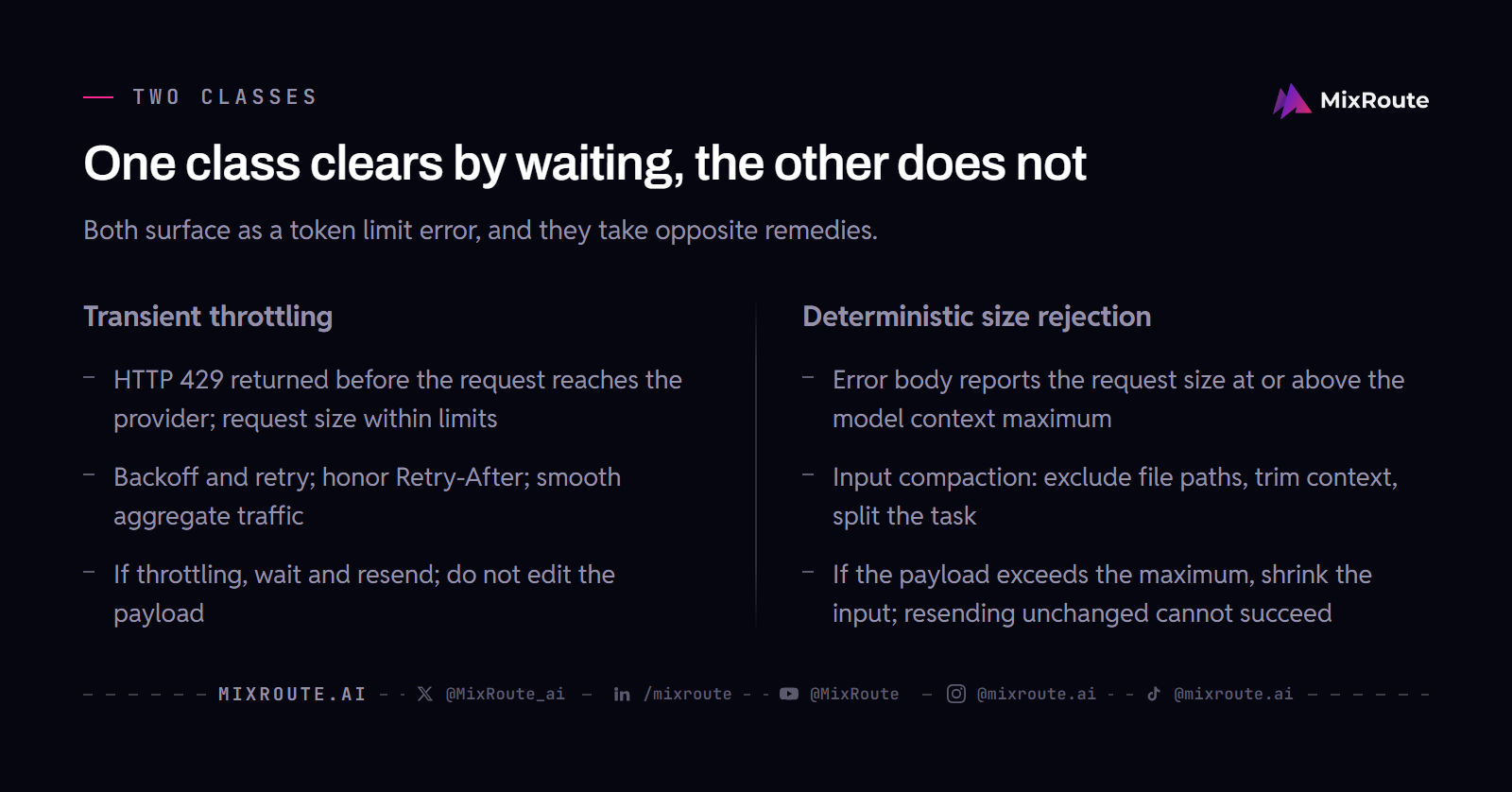
The two classes look similar from the caller’s side but demand opposite remedies. Transient throttling returns HTTP 429 before the prompt reaches the model. Deterministic size rejection returns a size error after the payload is measured against the context window. A third related manifestation is output truncation, where generation ends at the output token ceiling instead of reaching a natural finish. For the wider field, read a taxonomy that names every LLM API failure class.
What causes LLM API token limit failures?
Token limit failures have two root causes, one per class, and the cause decides the remedy. Throttling comes from aggregate TPM and RPM pressure that empties the rate limit bucket before a request reaches the provider. Size rejection comes from an assembled context grown past the model context window.
Aggregate rate pressure drains the bucket
TrueFoundry’s gateway write-up of 12 May 2026 describes a token bucket keyed by user, repository, and model, with continuous refill, and states that an empty bucket at arrival makes the gateway reply with HTTP 429 before the request reaches the model. That document presents one gateway vendor’s design rather than a rule every provider follows. Parallel agents draw from one bucket, so bursts drain it faster than the refill rate. The cause is pressure on aggregate traffic, not a defect in the request, and the identical request typically succeeds once the bucket refills. That is why throttling is transient.
Accumulated context crosses the context window
The deterministic class comes from the assembled context, not from traffic. Coding agents that ground themselves in a repository accumulate file paths and file contents into the prompt, and each added file pushes the token count higher. When the total crosses the context maximum, the provider rejects the request on size alone. Oversized context requires shrinking the input to change the outcome, because the ceiling is a property of the request. For the mechanics of the ceiling being crossed, read an explanation of how context windows set the single-request ceiling.
How do you detect a token limit failure and output truncation?
Detection is a monitoring task. Rate limiting becomes actionable when systems capture the right signals: Portkey offered HTTP 429 response counts, token spend per tenant, and quota utilization percentages as examples worth capturing in its April 2026 write-up on rate limiting for LLM applications. Those signals reveal whether pressure is aggregate or payload sized, which picks the remedy.
Monitoring signals that separate the classes
Count HTTP 429 responses on the request path and watch the rate over time; a rising count strongly suggests the bucket is emptying under aggregate pressure. Pair that with token spend per tenant or workspace to see which traffic source drains the quota. Add quota utilization percentages from rate limit headers or the provider’s admin API to forecast the next throttle before it lands. The deterministic class announces itself in the error body, which usually reports the request size alongside the rejection, so compare that size to the model context maximum. A request at or above the maximum is a size rejection by definition; the table in the fix section formalizes the decision. For a fuller signal set, read the metrics that make LLM API observability actionable.
Verifying output truncation
Output truncation needs a separate check. Inspect the finish reason: a natural completion ends with a stop reason, while a generation that hits the output token ceiling ends with a length reason. A length reason means the response stopped at the ceiling and the visible content is incomplete. Treat token usage counters cautiously during error storms, because an open JetBrains YouTrack issue (LLM-23600) reports that failed attempts consumed tokens in one vendor’s AI integration; that report is unconfirmed and covers a single product.
How do you fix a token limit failure?
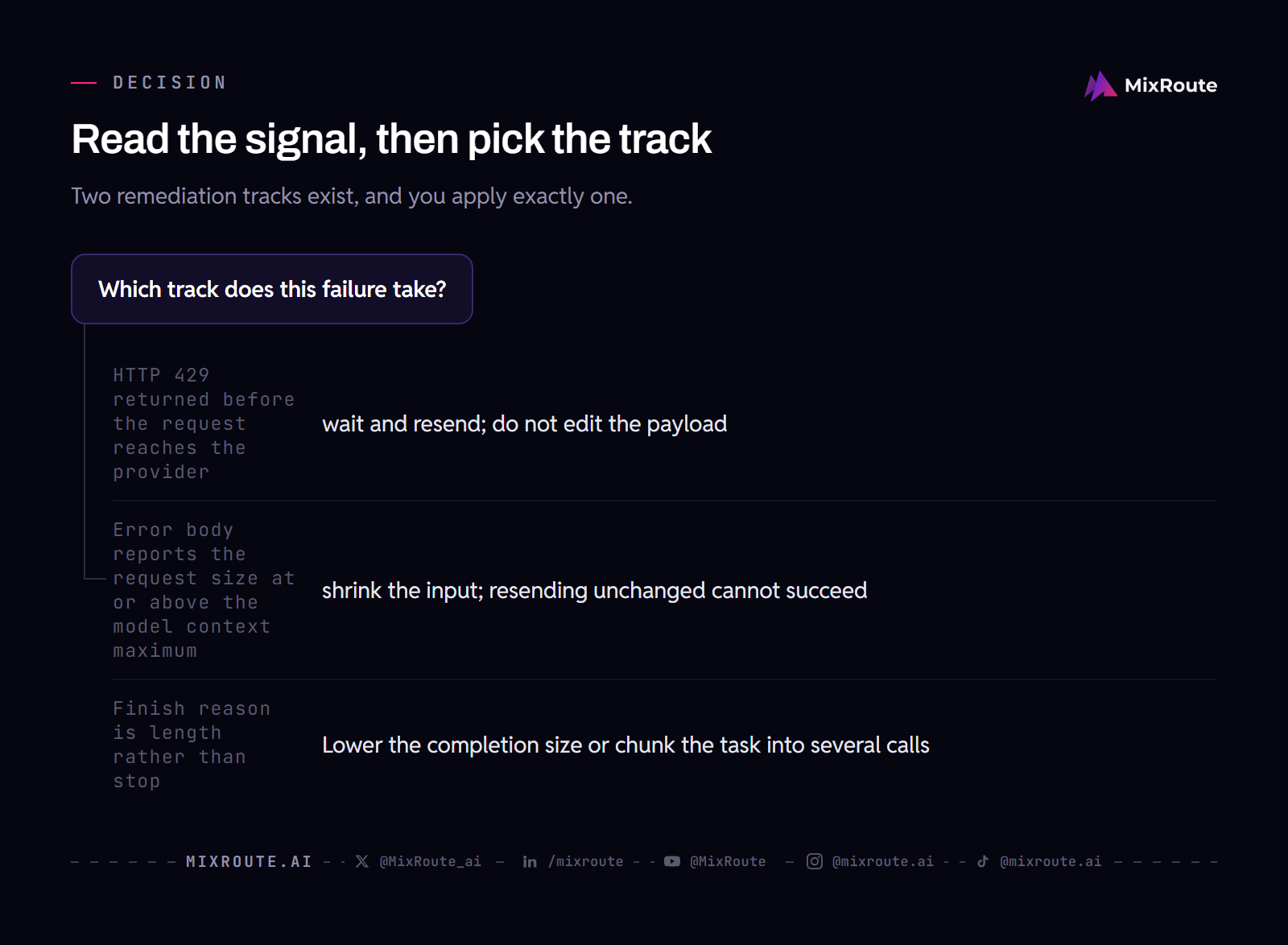
Two remediation tracks exist, and you apply exactly one, depending on the class you detected. Throttling responds to backoff and retry, because the bucket refills continuously and a delayed request can go through. Size rejection does not respond to retry: the provider rejects the identical payload each time, since an unchanged payload measured against an unchanged maximum produces the same rejection, and only input compaction changes the outcome.
Backoff and retry for the throttling track
When the class is transient throttling, honor the Retry-After header, add exponential backoff with jitter so synchronized clients do not hit the bucket at once, and cap retries so requests do not loop against an empty bucket. In parallel, reduce aggregate pressure: flatten bursts, move batch jobs off-peak, and spread load across tenants or keys where the quota is per tenant. The payload stays untouched, because the defect is timing, not content.
Input compaction for the size track
When the class is deterministic size rejection, compact the input. Exclude file paths the task does not need, trim conversation history to recent turns, drop attached files that carry no task value, and split one oversized task into several requests that each fit the context window. A payload above the context maximum is rejected on size, so the next attempt has to be smaller rather than merely later. For the full sequence, read a production checklist for handling LLM API failures.
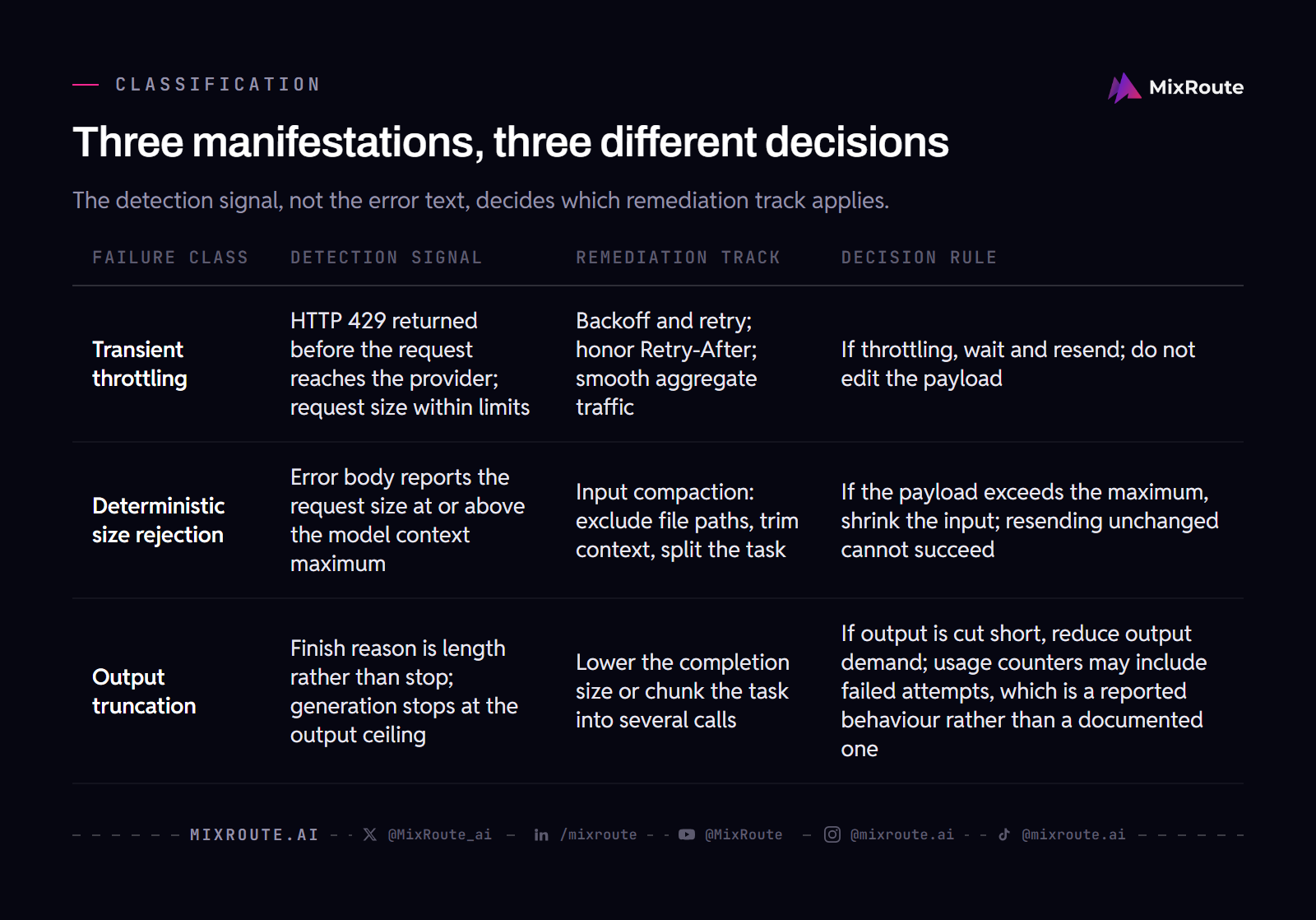
The table below classifies the three manifestations and their decision rules.
| Failure class | Detection signal | Remediation track | Decision rule |
|---|---|---|---|
| Transient throttling | HTTP 429 returned before the request reaches the provider; request size within limits | Backoff and retry; honor Retry-After; smooth aggregate traffic | If throttling, wait and resend; do not edit the payload |
| Deterministic size rejection | Error body reports the request size at or above the model context maximum | Input compaction: exclude file paths, trim context, split the task | If the payload exceeds the maximum, shrink the input; resending unchanged cannot succeed |
| Output truncation | Finish reason is length rather than stop; generation stops at the output ceiling | Lower the completion size or chunk the task into several calls | If output is cut short, reduce output demand; usage counters may include failed attempts, which is a reported behaviour rather than a documented one |
How do you prevent token limit failures with pre-send budgeting?
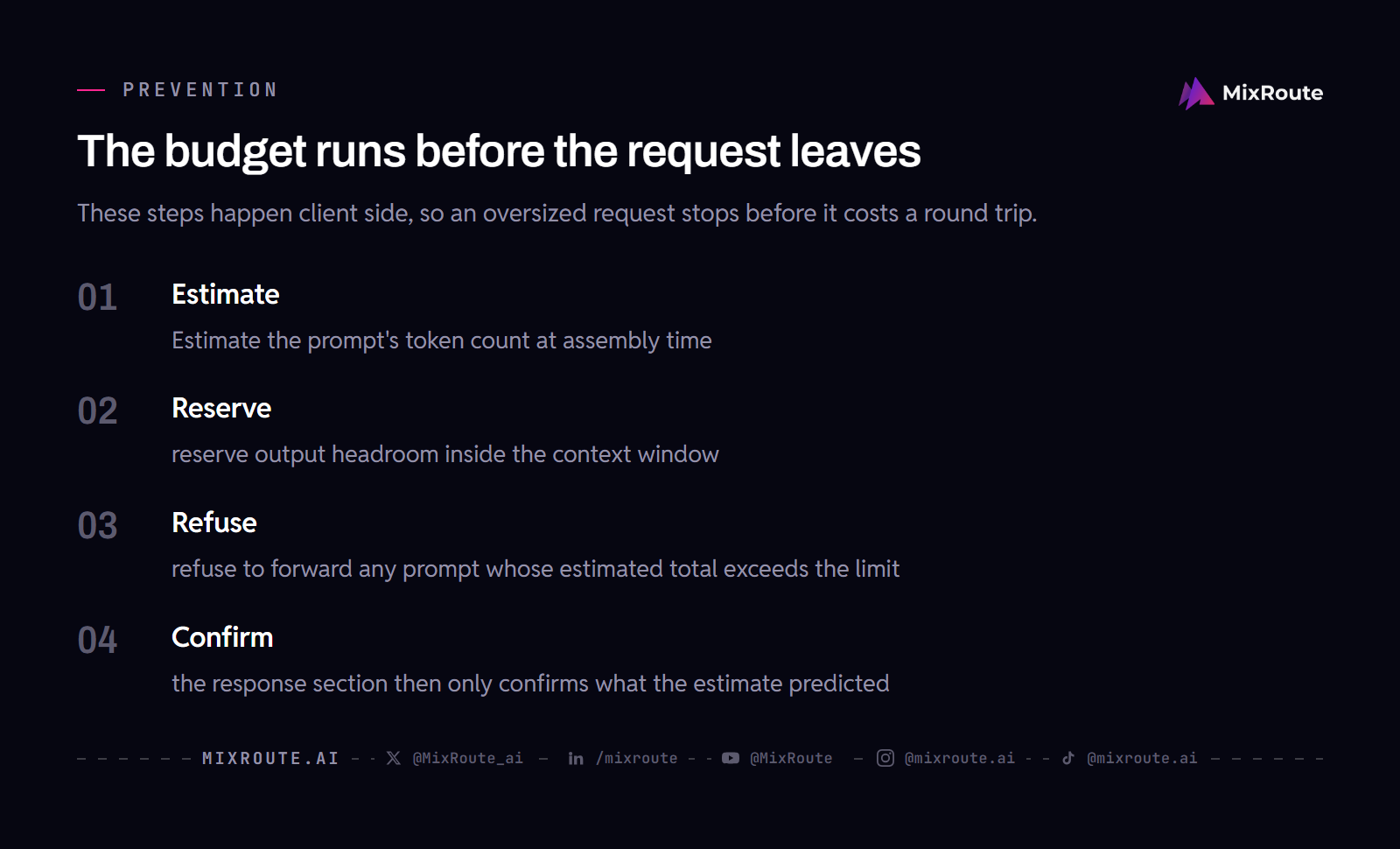
Prevention moves the work to before the send. Estimate the prompt’s token count at assembly time, reserve output headroom inside the context window, and refuse to forward any prompt whose estimated total exceeds the limit. A request already over the limit must not be sent, because sending it only completes a round trip that fails deterministically.
Estimate prompt tokens before the request leaves
Prompt token estimation is the mechanism that makes prevention possible; Microsoft’s Azure API Management llm-token-limit policy, read 2026-09-02, is a gateway policy that falls back to actual usage values from the response section when estimate-prompt-tokens is set to false, so the check happens after a round trip that was already going to fail. Keeping estimation enabled moves the check to the client side, and the prompt is compacted or refused locally instead of reaching the backend over the limit. Reserve output headroom as part of the same check: the window covers the prompt and the completion together, so budget the prompt against maximum minus a reserved output allowance. Without that reservation, a prompt that fits exactly can still truncate the completion at the output ceiling.
Why post-response accounting misleads
Post-response usage accounting misleads when errors are frequent. An open JetBrains YouTrack issue, LLM-23600, reports that failed attempts still consumed tokens in one vendor’s AI integration; the vendor has not confirmed the report, and the practical response is to check your own provider’s accounting before trusting the usage total during an error storm. Budgeting shifts to pre-send estimation; the response section then only confirms what the estimate predicted. Compaction must preserve task-critical information: keep the instruction, the latest user request, and the schemas or facts the task references; cut only what the task does not need.
For the transient class, prevention means pacing traffic under the quota: batch non-interactive work, space requests below the TPM ceiling, and watch quota utilization so the bucket does not run dry. Spikes still happen, which is what the retry track absorbs.
How does the MixRoute LLM API gateway handle token limit failures?
MixRoute operates as an LLM API gateway between your application and upstream providers. Smart Routing works by having an in-house routing model judge each request’s complexity and task type, then selecting a model from the pool the customer authorizes; the triage step runs in memory with a 1M-token context window and is cleared immediately afterwards. See how Smart Routing selects models. The full context passes through untouched: no rewriting, no compression, no truncation. Compaction therefore stays the caller’s job and the pre-send budget described above is still work the application must do. Every key can be given usage limits, and anything beyond them is blocked. See the pricing structure.
Start routing your LLM traffic through a gateway that routes on complexity and task type.
FAQ
What does 'token limit exceeded' mean in an LLM API?
It means the request consumed more tokens than the API allows, either because the aggregate rate quota was exhausted or because the single request exceeded the model context window. The quota case is transient and clears as the bucket refills. The context case is deterministic and stays until the input is compacted.
Is an HTTP 429 the same as a token limit failure?
HTTP 429 is the transient branch of a token limit failure: the gateway returns it when the rate-limit bucket is empty, before the request reaches the provider. Classify it as aggregate pressure, apply backoff and retry, and leave the payload unchanged.
Why does retrying my oversized request keep failing?
Because a payload that exceeds the context maximum is rejected deterministically, so resending the unchanged request cannot succeed and only input compaction fixes it. Check the request size on the error, then trim context and file paths before the next attempt.
How do I detect output truncation?
Detect truncation by checking whether the response completed naturally or stopped at the output token ceiling, and check your provider’s usage accounting before assuming it includes failed attempts. An open JetBrains YouTrack issue reports one vendor’s integration that charged tokens for failed API calls, but that report is unconfirmed. A finish reason of length rather than stop marks the ceiling, so reduce the completion demand or split the task into smaller calls.
What signals should I monitor for token limit failures?
Monitor HTTP 429 response counts, token spend per tenant, and quota utilization percentages, which Portkey named as examples worth capturing in its April 2026 write-up on rate limiting for LLM applications. Those signals reveal whether pressure is aggregate or payload sized, which decides between retry and compaction.
Can I avoid token limit failures entirely?
You can prevent the deterministic class by budgeting prompt tokens before the send and reserving output headroom, and you can reduce throttling by smoothing aggregate traffic against the quota. The transient class can still appear under spikes, which is what backoff and retry absorb.
Does MixRoute help with LLM API token limit failures?
MixRoute functions as an LLM API gateway. Its Smart Routing component judges each request by complexity and task type within the customer’s authorized model pool, then forwards it; see the Smart Routing mechanism. Crucially, the full context passes through untouched: no rewriting, no compression, no truncation. Because MixRoute does not compact or budget prompts, the pre-send budget described earlier remains the application’s responsibility. See the pricing structure.