Best AI Models for Job Search Tasks: A Builders Guide (2026)
No single model is best for job search, because a job search product runs five different jobs. For the bulk work, parsing resumes and extracting ATS keywords, use a small model such as Claude Haiku 5.5 or GPT-6 Luna: 10,000 resumes a month cost $4.00 on either at list price. Match postings with embeddings, not a chat model. Use Claude Sonnet 5.5 ($2 input, $10 output per 1M tokens) for the cover letters and interview coaching that a person reads. Prices are as of October 19, 2026.
The expensive mistake is running all five jobs on one top model. On the parsing workload below, Claude Opus 5.5 costs $160 a month and Claude Haiku 5.5 costs $4 for the same task.
The five jobs hiding inside a “job search tool”
A job search tool looks like one product, but your bill sees five workloads with very different economics.
- Resume parsing. PDF or DOCX into structured fields. High volume, no creativity, a fixed output schema.
- ATS keyword extraction. Pull requirements out of a job description, score the gap against a resume. Classification work.
- Job matching. Rank thousands of postings against one candidate. This is a retrieval problem, not a chat problem.
- Resume tailoring and cover letters. The output a human actually reads and judges. Low volume, high stakes.
- Interview prep and negotiation coaching. Multi turn conversation, moderate volume.
Tasks 1 and 2 are where your token volume lives. Task 4 is where your quality reputation lives. They should not run on the same model. If they do, you are either overpaying on the bulk work or shipping weak output on the work that matters.
Which AI model for which job search task
Use a small model with structured output for anything a machine reads, embeddings for matching, and a mid or top tier model for anything a person reads. Every chat model in the table lists structured output and a context window of at least 1M tokens on its MixRoute model page, so the choice comes down to price and input types.
| Task | Model class | Why | Anchor model |
|---|---|---|---|
| Resume parsing | Small, structured output | Fixed schema at high volume, so price and valid JSON decide it. | Claude Haiku 5.5, GPT-6 Luna, DeepSeek V4.1 Flash |
| ATS keyword extraction | Small, structured output | Classification against a fixed schema. | Claude Haiku 5.5, GPT-6 Luna |
| Job matching at scale | Embeddings, not chat | Ranking thousands of rows through a chat model is the wrong tool. | An embeddings model such as text-embedding-3-small, plus a vector store |
| Resume tailoring, cover letters | Mid to top tier | A human reads this and judges your product on it. | Claude Sonnet 5.5, Claude Opus 5.5 |
| Interview prep, negotiation | Mid tier | Multi turn coaching. Gemini 3.8 Flash also takes audio and video answers. | Claude Sonnet 5.5, Gemini 3.8 Flash |
Cheap models for anything a machine reads. Better models for anything a human reads.
Why resume parsing on a frontier model burns money
Parsing is the workload where model choice moves your margin most. Take 10,000 resumes a month, roughly 2,000 input tokens each including instructions, and roughly 400 output tokens each of structured JSON. That is 20M input and 4M output tokens per month.
| Model | Input rate | Output rate | Monthly cost |
|---|---|---|---|
| Claude Opus 5.5 | $4 / MTok | $20 / MTok | $160.00 |
| Claude Sonnet 5.5 | $2 / MTok | $10 / MTok | $80.00 |
| Gemini 3.8 Flash | $0.75 / MTok | $3.75 / MTok | $30.00 |
| DeepSeek V4.1 Flash | $0.30 / MTok | $1.20 / MTok | $10.80 |
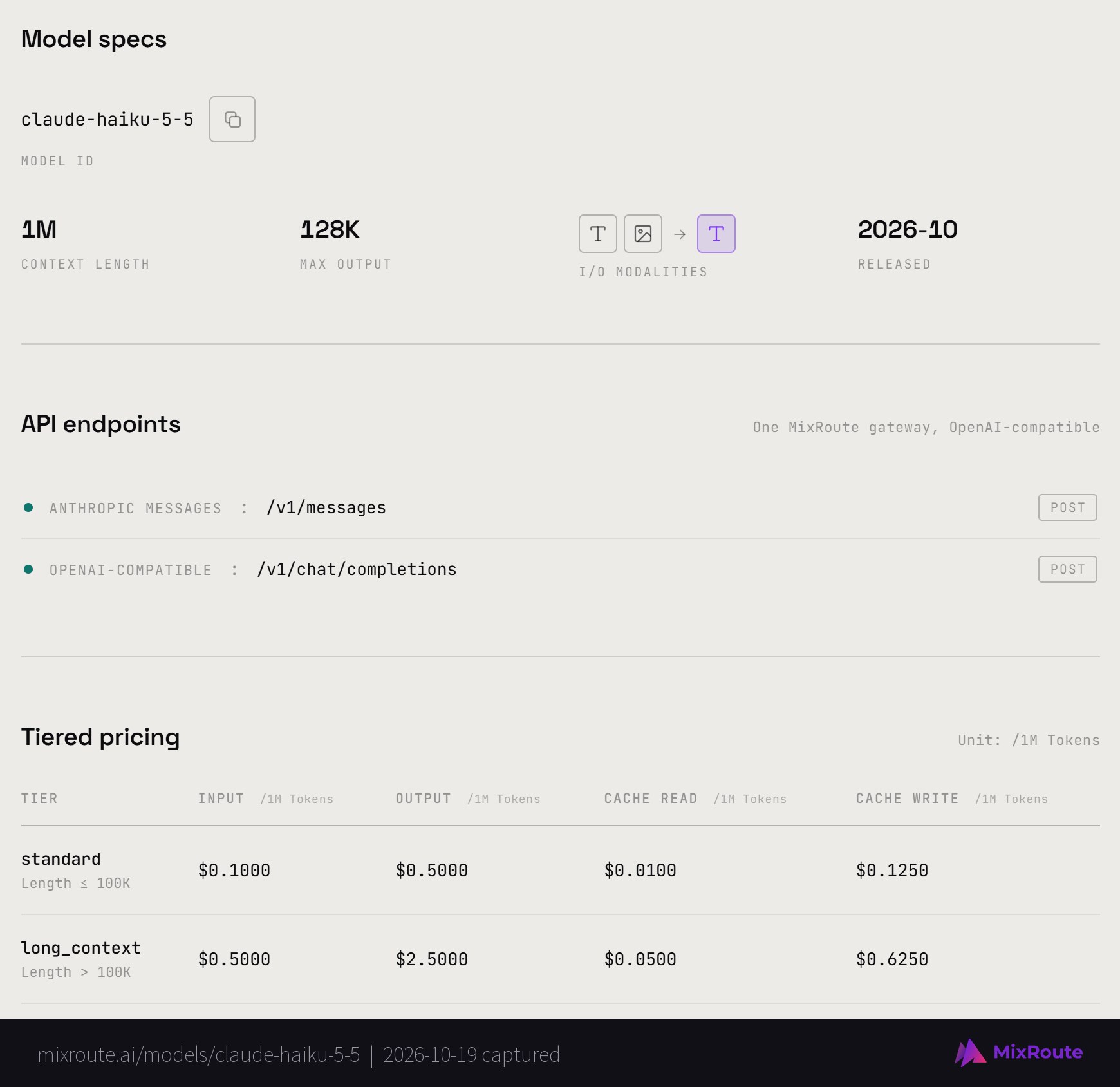
| Claude Haiku 5.5 | $0.10 / MTok | $0.50 / MTok | $4.00 |
| GPT-6 Luna | $0.10 / MTok | $0.50 / MTok | $4.00 |
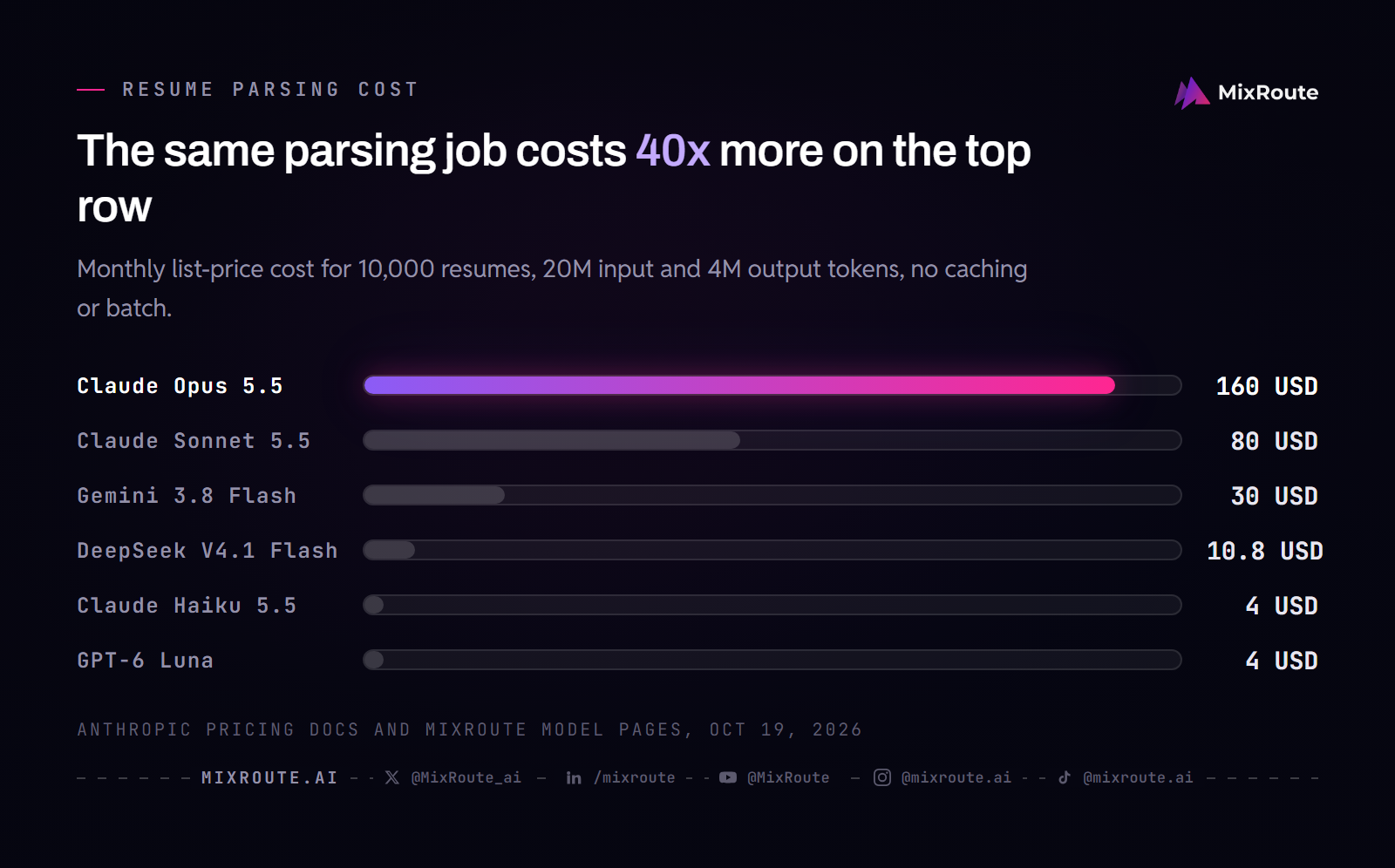
Same task, same volume, and a 40x spread between the top and bottom row.
Methodology: Claude rates are Anthropic’s published list prices from the Claude pricing docs. Gemini 3.8 Flash, DeepSeek V4.1 Flash and GPT-6 Luna rates are the ones on their MixRoute model pages, all checked on October 19, 2026. Luna’s rate applies to prompts up to 272K tokens. Cost is input tokens times input rate plus output tokens times output rate, with no caching or batch discounts.
Extracting a job title and a date range into a fixed schema is not where a $156 monthly premium for Opus 5.5 obviously pays back. Run 200 of your own resumes through Haiku 5.5 and Opus 5.5, count the wrong fields from each, and pay for the larger model only if the count differs enough to matter.
Keep one resume per request. Claude Haiku 5.5 bills prompts over 100,000 tokens at $0.50 input and $2.50 output, and GPT-6 Luna reprices prompts over 272K tokens, so stuffing a hundred resumes into one prompt can move you onto the higher tier.
Two levers widen the gap in practice:
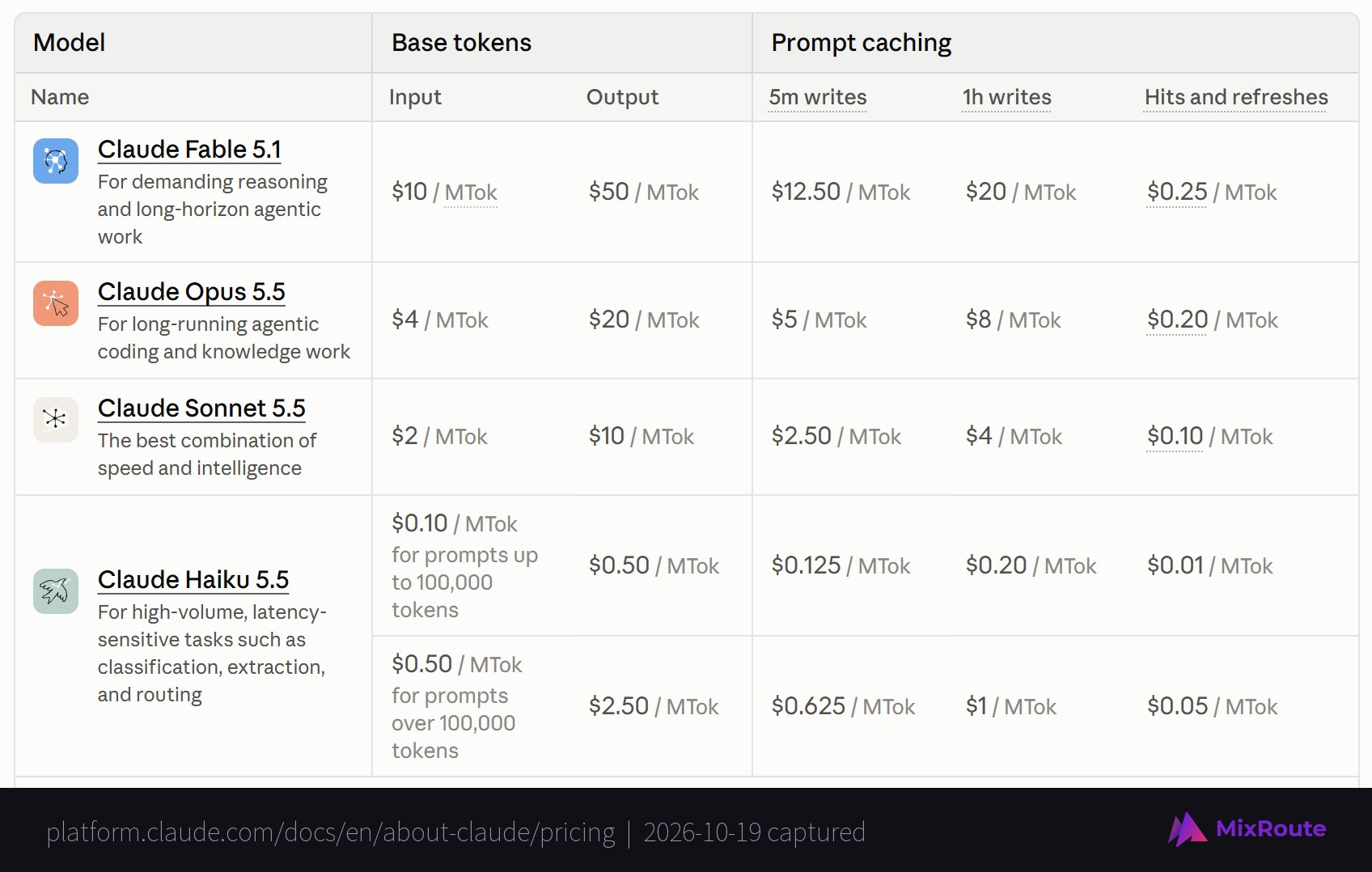
Caching. Your parsing prompt is identical on every call. On Claude Haiku 5.5 a cache hit costs $0.01 per million input tokens instead of $0.10, and on DeepSeek V4.1 Flash it costs $0.006 instead of $0.30. Claude Sonnet 5.5 and Opus 5.5 charge 0.05x the input rate for a hit, $0.10 and $0.20. If you re-run the same system prompt 10,000 times and do not cache it, that is a self-inflicted bill.
Batch. Resume parsing is rarely latency sensitive. Anthropic’s Batch API takes 50% off both sides, which puts Haiku 5.5 at $0.05 input and $0.25 output and the example above at $2.00. MixRoute’s model pages list the standard rates, so the table does not include that discount.
Check what file types the parser accepts
Gemini 3.8 Flash is the one model in the table that takes a PDF directly. Its MixRoute model page lists text, image, file, audio and video input. Claude Haiku 5.5, Sonnet 5.5, Opus 5.5, GPT-6 Luna and DeepSeek V4.1 Flash list text and image input.
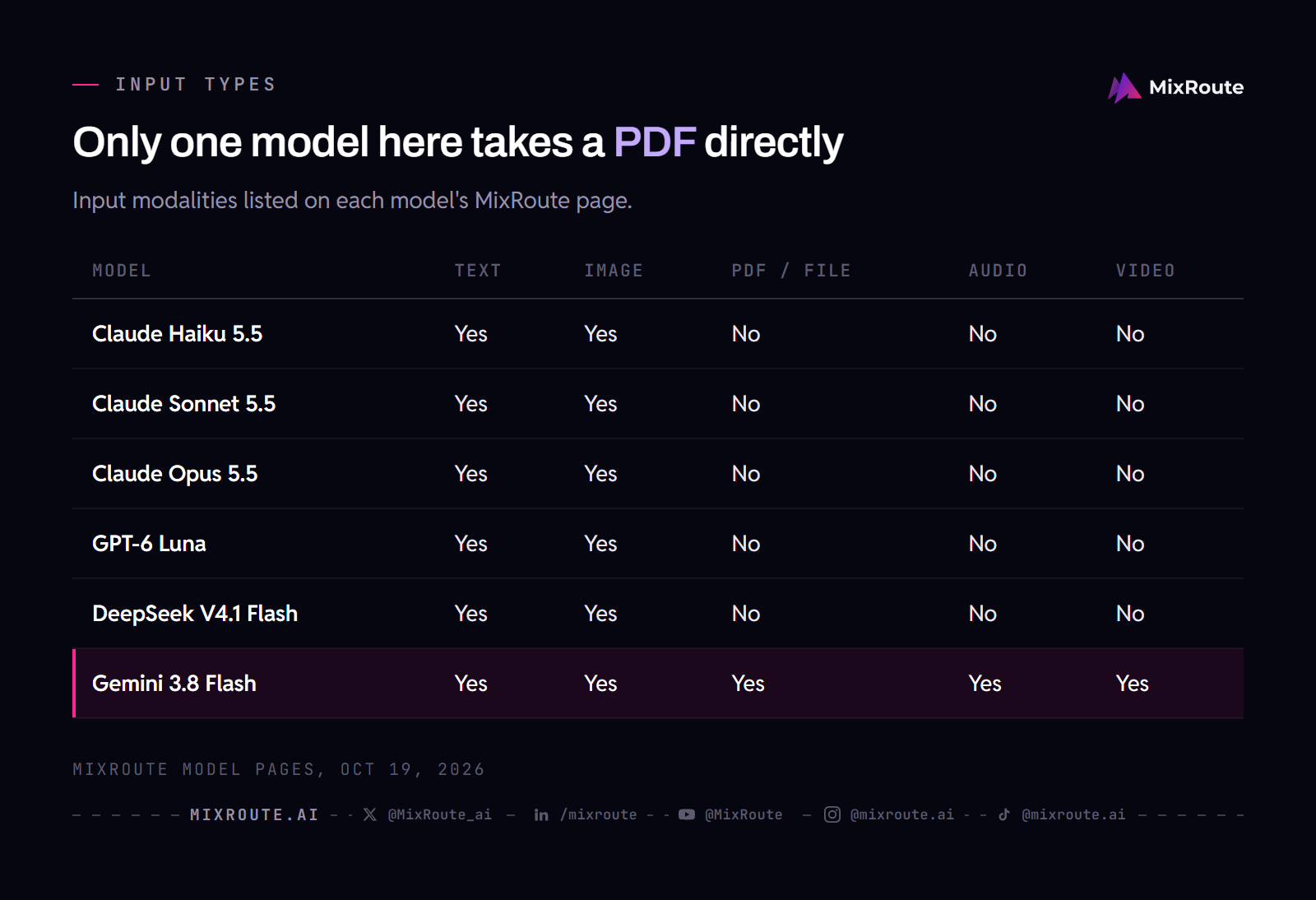
That changes how you build the pipeline. If you already convert PDFs and DOCX files to text before the model call, the cheapest rows work as they are. If candidates upload scans or phone photos, send the page images to a model that lists image input. If you want to skip the conversion step for PDFs, Gemini 3.8 Flash costs $30.00 on the example above against $4.00 for Haiku 5.5, so compare that with the cost of running your own PDF extraction.
Input types also explain the interview prep pick. A mock interview where the candidate answers out loud needs a model that accepts audio, and Gemini 3.8 Flash lists it. For typed answers, Claude Sonnet 5.5 at $2 input and $10 output fits.
Cover letters are the one place quality actually pays
Cover letters and tailored resumes are where a bigger model earns its price, because a person reads them. A letter that sounds like a template sinks the product no matter how cheap the inference was. This is also low volume: one candidate generates a handful of letters, not thousands.
Do the arithmetic on where the money is. At 10,000 parses a month you move 24M tokens. At 200 cover letters a month you might move 400,000, say 300,000 input and 100,000 output. At list price that costs $1.60 on Claude Sonnet 5.5, $3.20 on Claude Opus 5.5 and $8.00 on Claude Fable 5.1 ($10 input, $50 output). The same letters on Haiku 5.5 cost $0.08.
At those numbers price will not pick the model. Generate letters for five real candidates on Sonnet 5.5 and Opus 5.5, and let the people who read them choose. The model page describes Sonnet 5.5 for everyday knowledge work and Opus 5.5 as more careful than its predecessor about stating only figures and sources it can back up, which matters for a letter that cites a candidate’s results.
Whichever model you use, put the candidate’s real employers, dates and metrics in the prompt and tell the model to use nothing else. Models can invent details, and an invented metric in a letter is worse than a plain one.
Spend where the human looks. Save where the machine looks.
Job matching is a retrieval problem, not a chat problem
Match with embeddings, then ask a chat model about the shortlist only. The most common architecture mistake in this category is looping 5,000 job postings through a chat model and asking “does this match?” 5,000 times.
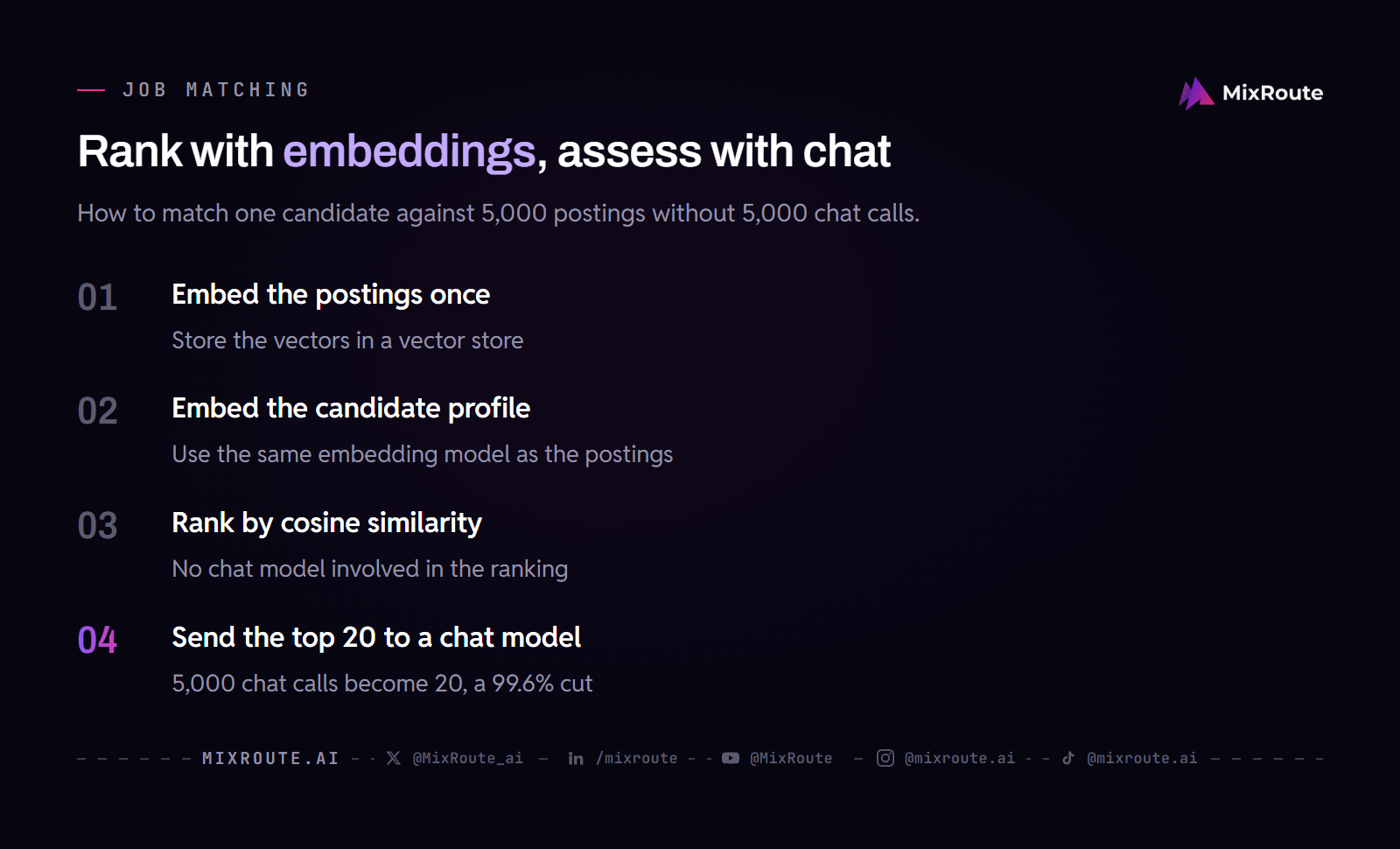
Embed the postings once. Embed the candidate profile with the same embedding model. Rank by cosine similarity. Then send only the top 20 to a chat model for a real assessment. That cuts the chat calls by 99.6%, and embeddings are built for the question you are asking, which is semantic similarity.
The embedding step is cheap. MixRoute lists text-embedding-3-small at $0.02 per 1M tokens, so embedding 5,000 postings of roughly 500 tokens each is 2.5M tokens, or $0.05. For the shortlist assessment, use Claude Haiku 5.5 when the result feeds a score and Claude Sonnet 5.5 when the candidate reads the explanation.
If your matching cost scales linearly with your job database, you built it wrong.
The tokenizer trap when you compare model prices
Two models at the same rate can bill you differently, because each tokenizer counts the same resume as a different number of tokens. The rate card is not the bill.
Anthropic’s newer tokenizer, used by Claude 4.7 and later models including Sonnet 5.5, Opus 5.5, Haiku 5.5 and Fable 5.1, produces approximately 30% more tokens for the same text. Claude Sonnet 4.6 and earlier use the previous one. The exact increase depends on the content.
Here is what that does to the table. If your 2,000 and 400 token figures came from Claude Sonnet 4.6, Haiku 4.5 or another earlier model, expect about 30% more tokens on the current Claude rows. Opus 5.5 moves toward $208 a month, Sonnet 5.5 toward $104 and Haiku 5.5 toward $5.20. A team still parsing on Claude Haiku 4.5 at $1 input and $5 output pays $40 on the original counts, so even with the extra tokens, moving to Haiku 5.5 lands near $5.20. The Gemini, DeepSeek and GPT-6 Luna rows use their own tokenizers, so count a sample resume on each model before you trust the forecast.
Prices move too. Claude Sonnet 5 launched with introductory pricing of $2/$10 per MTok through August 31, 2026, with a rise to $3/$15 scheduled for September 1. Anthropic’s pricing page now says $2/$10 is the standard price and the increase will not happen. A forecast built on the old deadline overstates the cost.
The takeaway that survives every price change: measure cost per task, not cost per token.
How to run five models without five accounts
One OpenAI compatible endpoint lets you call every model above with a string change. Without it, five tasks mean four vendors, Anthropic, OpenAI, DeepSeek and Google, each with its own account, key, billing and SDK. Faced with that, it is tempting to hardcode one model and eat the 40x on their highest volume workload.
MixRoute serves these models behind one base URL, so switching a task from one model to another changes only the model field.
from openai import OpenAI

client = OpenAI(
    api_key="YOUR_MIXROUTE_KEY",
    base_url="https://api.mixroute.ai/v1",
)

# Bulk work: cheap model, structured output
parsed = client.chat.completions.create(
    model="deepseek-v4.1-flash",
    messages=[{"role": "user", "content": f"Extract to JSON:\n{resume_text}"}],
    response_format={"type": "json_object"},
)

# Human facing work: better model. Same client, same key.
letter = client.chat.completions.create(
    model="claude-sonnet-5-5",
    messages=[{"role": "user", "content": f"Write a cover letter:\n{context}"}],
)

# Watch your real token count, not the rate card
print(parsed.usage.prompt_tokens, parsed.usage.completion_tokens)
Model IDs do not always match the page slug. The IDs for this article are claude-haiku-5-5, claude-sonnet-5-5, claude-opus-5-5, gpt-6-luna, deepseek-v4.1-flash, gemini-3.8-flash and text-embedding-3-small. Copy the Model ID from each model’s spec card on the MixRoute model catalog.
That last line of the code is the habit worth building. Log tokens per task, per model, and you will catch a tokenizer change or a price step before your invoice does.
MixRoute is built for this shape of workload: one OpenAI compatible API across 250+ models, no markup on provider pricing, and payment by card or USDT / USDC. Smart Routing, which picks among the models in a pool you authorize, adds no routing fee.
FAQ
What is the best AI model for parsing resumes? A small, high throughput model with structured output. Claude Haiku 5.5 ($0.10 / $0.50 per MTok) and GPT-6 Luna (the same rates for prompts up to 272K tokens) both list structured output, and DeepSeek V4.1 Flash ($0.30 / $1.20) adds image input. At 10,000 resumes a month that is $4.00, $4.00 and $10.80 at list price. Run 200 of your own resumes through two of them and keep the one with fewer wrong fields.
Should I use one AI model for my whole job search app? No. A job search product runs bulk extraction and human facing writing, and those want opposite tradeoffs. One model means overpaying on the bulk work or underdelivering on the writing. Route per task.
How much does it cost to run AI resume parsing? At 10,000 resumes a month, roughly 24M tokens total, the cost ranges from $4.00 on Claude Haiku 5.5 or GPT-6 Luna to $160.00 on Claude Opus 5.5 at list rates. Prompt caching lowers both figures, and Anthropic’s Batch API halves Claude rates, which puts Haiku 5.5 at $2.00 for the same month.
Do I need embeddings for job matching? Yes, if you are matching against more than a few dozen postings. Embed once, rank by similarity, and send only the shortlist to a chat model. Looping every posting through a chat model scales your cost linearly with your database.
Why did my Claude bill go up when the price did not change? Anthropic’s newer tokenizer, used by Claude 4.7 and later models including Sonnet 5.5, Opus 5.5 and Haiku 5.5, produces approximately 30% more tokens for the same text. The per token rate held, the token count did not. Recount your prompts against the new model instead of reusing old measurements.
Is Claude Sonnet 5 getting more expensive? No. The introductory $2/$10 per MTok became the standard price, and Anthropic says the scheduled increase to $3/$15 on September 1, 2026 will not occur. Claude Sonnet 5.5, the current Sonnet, is also $2 input and $10 output, so budget your autumn workload at those rates.
Which Claude model is best for a job search app? It depends on the task. Claude Haiku 5.5 ($0.10 / $0.50 per MTok) fits parsing and keyword extraction. Claude Sonnet 5.5 ($2 / $10) fits cover letters and interview coaching. Claude Opus 5.5 ($4 / $20) is the step up for letters where a reader’s judgment justifies the price. Test each on your own candidates.
Can one model read PDF resumes directly? Gemini 3.8 Flash can, since its model page lists file input alongside text, image, audio and video. The Claude models, GPT-6 Luna and DeepSeek V4.1 Flash list text and image input, so send them extracted text or page images. Gemini 3.8 Flash costs $30.00 on the 10,000 resume example, so compare that with running your own PDF extraction.
The bottom line
There is a best model per task, and getting it wrong costs 40x on your highest volume workload. Claude Haiku 5.5 or GPT-6 Luna for what machines read, Claude Sonnet 5.5 or Opus 5.5 for what humans read, embeddings for matching. Measure cost per task, not cost per token.
MixRoute gives you each of those models behind a single OpenAI compatible endpoint with no markup, so routing per task costs you a string change instead of a migration. Start building on MixRoute